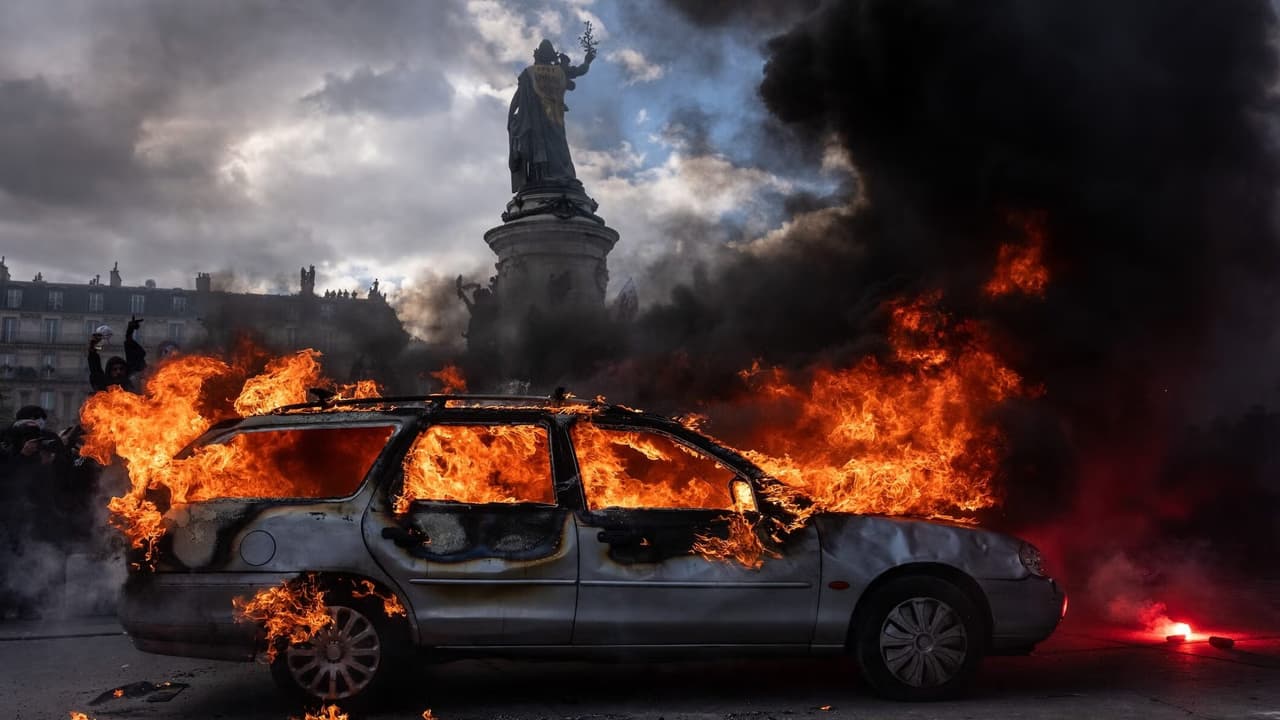
France is grappling with the aftermath of violent unrest that has rattled politics, markets and public confidence, as pressure grows on authorities to explain what went wrong.
French President Emmanuel Macron has rejected an offer from Interior Minister Laurent Nunez to resign following a weekend of unrest that swept across parts of the country, instead ordering his government to restore order and explain how security services failed to anticipate the scale of the violence.
The decision comes as France deals with the fallout from some of its most serious disturbances in years. What began as student-led demonstrations evolved into wider protests over declining public services, economic pressures and rising living costs. In several cities, violence overshadowed peaceful gatherings, leading to clashes with police, vandalism and looting.
The unrest arrives at a politically sensitive moment for Macron’s administration, with presidential elections just six months away and growing concerns surrounding economic weakness and rising public debt. The situation has also placed fresh pressure on an already fragile government as it attempts to advance a crucial budget package aimed at stabilising public finances.
Hundreds of thousands of people joined demonstrations over the weekend. Protesters voiced frustration over what they described as worsening public services and increasing economic strain. However, authorities said organised groups later exploited the gatherings, triggering disruptions in a number of major cities.
Paris, Marseille and Lyon were among the areas affected. Violence led to damage to public and private property, while police were deployed to contain disturbances and prevent further destruction.
France’s Interior Ministry responded with a large-scale security operation. According to Laurent Nunez, approximately 60,000 police officers and other security personnel were mobilised on Saturday. Despite that deployment, authorities acknowledged that security resources proved insufficient in some locations where disorder escalated rapidly.
Government Faces Scrutiny Over Security Failures
The Elysee Palace confirmed that Nunez submitted his resignation after the unrest but said Macron declined to accept it. Instead, the president instructed the minister to develop new measures aimed at preventing future outbreaks of barricades, looting and violent disorder.
Macron also demanded greater transparency regarding apparent intelligence and forecasting failures that left authorities unprepared for the scale of events in several cities.
The issue has since become a central political debate. Justice Minister Gerald Darmanin echoed the concerns, stating that intelligence services underestimated the threat posed by what he described as extreme-left groups involved in the disturbances. He argued that shortcomings in assessing the risk contributed to the state’s difficulty in responding effectively.
Beyond the political fallout, financial markets reacted negatively to the unrest. Investors are increasingly concerned that instability could complicate the government’s efforts to pass economic reforms and budget measures.
French government bonds came under pressure, pushing the country’s 10-year bond yield higher. Market analysts warned that investor confidence could face further tests as authorities work to restore stability.
Equity markets also reflected those concerns. France’s benchmark CAC 40 index fell during Monday trading, making it one of the weakest-performing major European stock markets. Shares of major French banks, including BNP Paribas, Societe Generale and Credit Agricole, also recorded declines.
The demonstrations unfolded against a broader European backdrop of public frustration over living costs and energy prices. Similar protests were reported in countries including Italy, Belgium and Albania, where households continue to face pressure from higher fuel costs linked in part to disruptions caused by the Iran conflict.
In France, however, attention is now focused on the government’s response. With investigations into intelligence failures underway and political scrutiny intensifying, Macron’s administration faces the challenge of restoring public confidence while managing rising economic and electoral pressures ahead of a pivotal period for the country.