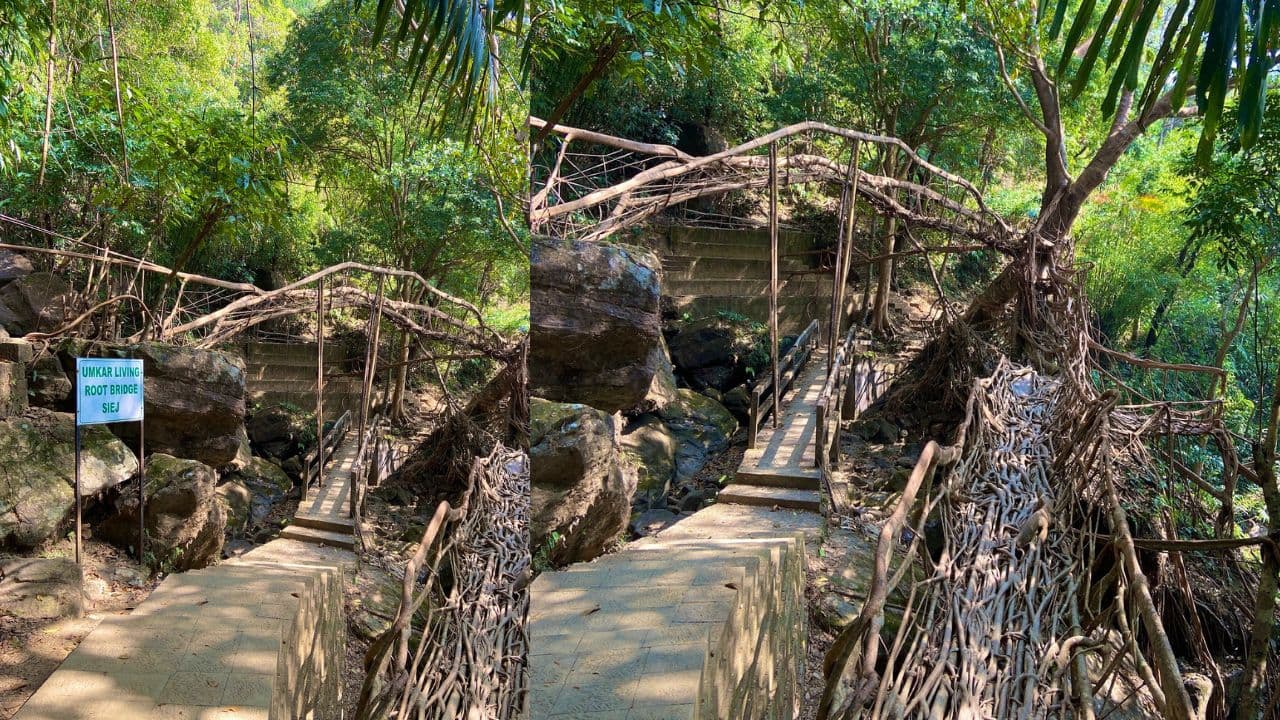
The Khasi and Jaintia tribes of Meghalaya know a unique art of making bridges from the living roots of trees. Hailey Warr, who has been preserving this art for decades, has been honored with the Padma Shri for his work.
Meghalaya Living Root Bridge: If someone says that bridges also breathe, you might think it is a joke. But it is true. There are bridges in Meghalaya which have life. Meghalaya, the north-eastern state of India, is the home of clouds. It is one of the rainiest places in the country. This entire area is full of mountains, dense forests and unique animals. Amidst this natural beauty, there is a tradition which surprises the world. This is the tradition of building a bridge made of living roots.
These bridges are not made of cement, iron or dry wood. To make these, the living roots of trees are saved for years, they are bent and a path is prepared to go from one place to another. In today’s times, when it seems difficult for a mother to braid her daughter’s hair, then the tribal people of Meghalaya, after years of hard work, braid the roots of the tree like a braid and make such a strong bridge on which many people can walk comfortably at the same time. This is really no less than a miracle.
It rains here most of the year, so the flow of water in the rivers and streams remains fast. Due to this, many times contact with nearby villages is lost. Some small bridges have been built in recent years, but for decades the people here have been building bridges with their traditional art without waiting for the government. These ‘living bridges’, an excellent example of bio-engineering, are still in use.
These bridges are not just a means of transportation, but they are a symbol of the local people’s culture, mutual cooperation and respect for nature. It takes the hard work of many generations for a bridge to be completely completed. It shows the unity and forward thinking of the community. A bridge that keeps growing is a living testament to the power of human imagination and nature. There are three main tribes in Meghalaya – Khasi, Garo and Jaintia. The hills on which these communities live are also known by these names. Among these, the people of Khasi and Jaintia communities have been carrying forward the tradition of building these living root bridges with great love for centuries.
For this they plant rubber trees (Ficus elastica) on both the banks of rivers and streams. In the local language they are called ‘Jingqiang Jri’. This tree is somewhat like our banyan tree, whose roots or ‘bilal’ hang in the air. In about 15 to 30 years, the roots of these trees connect with each other and form a network. When these roots are thin, they are started to be braided in the shape of a bridge. That means the roots are shown the way to grow. As the roots thicken, the strength of the bridge increases. Walking on the bridge is prohibited for a few years until the roots become completely strong. It is opened for use only after its strength is confirmed.
These bridges are completely eco-friendly. There is no need to cut trees to make them. They help people by living in harmony with nature. Besides, their lifespan is also very long. Local people say that some bridges are more than 300 to 500 years old. As the tree ages, the roots become stronger and the bridge becomes able to bear more weight. This bridge does not move even when many people walk together, it is so solid. Recently a proposal has been sent to include these bridges with living roots in the UNESCO World Heritage List. It is expected that this proposal will be approved soon.
Today, when the world relies on concrete and steel, a man from a small village in Meghalaya has shown a future based on roots. The reason for telling all this is Hailey War of Meghalaya, who has been selected for the Padma Shri award for 2026. He is a common farmer who has built a nearly 70 feet long bridge using the living roots of a tree.
Seej is a small village below the hills of Cherrapunji (now this record is in the name of Mausinram village), famous for the highest rainfall in the world. Hailey War, who lives here, grows betel nut, betel leaf, black pepper and fruits in his small farm. He has also been the head of this village for about 40 years. Hailey War, who inspired the next generation by building bridges from living roots, has been selected by the Government of India for the prestigious Padmashree award for 2026. Hailey War, who was living in anonymity till now, has suddenly come into the national attention. His decades of selfless service have been recognized at the national level. But there is no pride in this man, he is still devoting his time and effort to strengthening these living bridges.
The Bengaluru-based Press Information Bureau (PIB) of the Ministry of Information and Broadcasting, Government of India, recently sent a team of journalists on a tour to Meghalaya. During this time, the team went to Seej village and saw the ‘Umkar’ bridge made of living roots and talked to 69-year-old Hailey Warr who built it. He told that from the age of 10, he learned the art of making bridges from roots under the guidance of his grandfather. This was not a game or study, but a part of life. During the rainy season, on the way from one village to another, a small river or drain named ‘Umkar’ used to flow rapidly, which was very difficult to cross. Seeing this he decided to build a bridge of living roots.
Today this bridge attracts thousands of tourists. It is a double decker (two storey) bridge. This means that when the water flow is very high, the river can be crossed through the upper route. Four years ago, the government built a small bridge at this same place under the MNREGA scheme. But when the rains are heavy, the government bridge is of no use. Then people have to take the help of this bridge with living roots to go to another village.
The real importance of this bridge is understood only when you come here during the rainy season. When we went, it was not the rainy season, so we did not realize its importance that much. Hailey Warr explains, ‘As a child, I used to go with my father and grandfather to turn roots into bridges. Gradually I learned this unique art. I have built three such natural bridges so far.
On receiving the Padma Shri, he said, ‘I am a farmer who grows betel nut, betel leaf and black pepper. First of all I thank God for this honour. I am grateful to everyone who selected my name for this award. This is a tribute to my community, my ancestors and nature.
Building a bridge of living roots is not a task of a few days or years, it is a penance of decades. When roots emerge from a tree, they are shown the way. The roots grow and intertwine with each other. In the end, as a reward for man’s patience, nature builds a bridge. Hailey Warr says there is no room for haste in this work. His statement sums up his philosophy of life, ‘We don’t grow roots, we give them a chance to grow.’
The bridge we see today took about fifty years to build. But his work did not end here. He still takes care of the bridge every day, strengthening it so that it can be handed over safely to the next generation. Even at this age, the sparkle in his eyes and the agility in his hands show that this work is a part of his soul. Meanwhile, Hailey War’s son Willingson said, ‘Father’s work has changed the direction of my life. I am also carrying forward this tradition. This is not the work of our family, it is the responsibility of our culture.
When you stand in the silence of Seej village and look at this living bridge, you understand one truth. Nature does not have to be conquered, it just has to be understood. Hailey War’s life teaches this lesson. Now at this stage of his age, Hailey War is teaching the love of nature and the art of building bridges from living roots to the local youth. The number of such people should increase.
Scroll to load tweet…