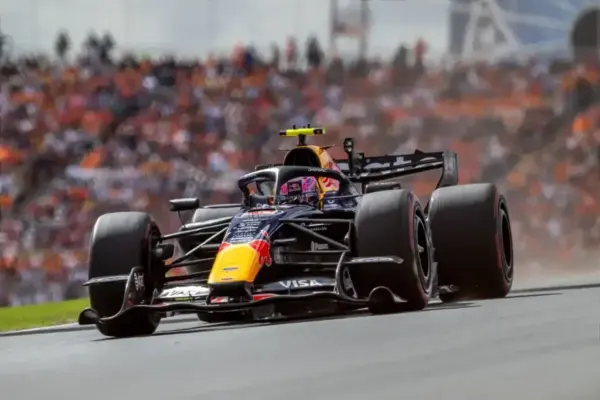
Liam Lawson’s performance at Zandvoort stunned the Formula 1 paddock, delivering exactly what Red Bull would have demanded from their rising star.
Qualifying just behind Max Verstappen and securing points in the race, Lawson showcased racecraft and composure that silenced critics who doubted his readiness for a top-tier seat. Yet, this breakthrough didn’t come at Suzuka in 2025 as many expected-it arrived 17 months later on home soil, forcing a re-examination of what Lawson’s weekend truly signifies.
Lawson’s weekend at Zandvoort was near flawless under punishing circumstances. Called up on Monday, given only a simulator session before flying to the Netherlands, and granted a solitary free practice to acclimate to the RB21-a car originally developed around Verstappen’s style-he still managed to outpace teammate Sergio Perez, finishing seventh and the sole Red Bull driver to score points. His qualifying gap to Verstappen was a razor-thin 0.115 seconds, and despite missing out on advancing to SQ3 during sprint qualifying, the overall package was impressive.
This performance starkly contrasts with Lawson’s turbulent 2025 debut in the RB21. Plucked into the Red Bull seat with just 11 races under his belt, Lawson struggled mightily. The car’s setup was tailored for Verstappen, and Lawson was thrust into the limelight amid relentless media scrutiny and immense pressure from Red Bull management, who seemingly backed Yuki Tsunoda over him. Lawson’s struggles culminated in three Q1 exits-including two last-place qualifying results during the China sprint weekend-and zero points. The difficulties were compounded by challenging tracks and a rough pre-season test, painting the picture of a driver overwhelmed by circumstances rather than a lack of talent.
Red Bull’s decision to demote Lawson back to their junior team in March 2025, framed by Helmut Marko as a career-saving move, now looks questionable. Lawson was handed a near-impossible task, battling a car not designed for him and a management team with little faith. Zandvoort’s weekend proves not only that Lawson is a capable grand prix driver-something never truly in doubt-but also that given more time and a better environment, he could have thrived. This casts a harsh light on Red Bull’s chaotic driver management during that period.
Max Verstappen, when asked about Lawson’s qualifying performance, suggested that the 2026 regulations have flattened the competitive field, limiting driver differentiation. Andrea Stella offered a nuanced counterpoint, emphasizing the complexity of this year’s technology that amplifies even the smallest driver differences. Both perspectives might hold truth, but what’s undeniable is that Lawson’s Zandvoort showcase was a statement: his talent can extract performance even from a challenging package.
Despite this, Lawson’s impressive outing may not drastically alter his future at Red Bull. His 2027 seat with the junior Racing Bulls team remains unconfirmed but plausible based on his consistent performances. However, with Marko’s departure and new management dynamics, it seems unlikely that Lawson will abruptly replace Isack Hadjar in the senior team. The “what could have been” scenario looms large-had Red Bull acted differently before 2025, Lawson might have enjoyed a smoother development path, starting 2026 alongside Verstappen in a more suitable car, free from the stigma of failure.
Lawson himself acknowledges the uphill battle he faced in 2025 and knew he could have performed better with more time. His Zandvoort weekend is less about proving his capability to himself and more about vindicating his talent to the doubters. It’s a powerful reminder that sometimes, driver careers are shaped as much by opportunity and support as raw skill. In Red Bull’s high-stakes game, Lawson’s redemption at Zandvoort stands as a bold indictment of past decisions and a beacon of what might still be possible.