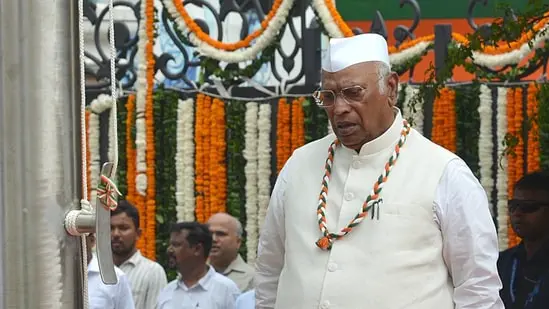
Congress MP Mallikarjun Kharge on Tuesday responded to the BJP’s criticism over his rendition of ‘Vande Mataram’, saying he sang the same version that had been sung by Mahatma Gandhi, Jawaharlal Nehru, Sardar Patel and former prime minister Atal Bihari Vajpayee.
Speaking to reporters in South Goa, the Congress president said that if singing the version was considered a crime, cases should also be registered against the national leaders who had sung it before him, news agency PTI reported.
“I sang the ‘Vande Mataram’ which Mahatma Gandhi, Jawaharlal Nehru sang…the same song which Vallabhbhai Patel and Atal Bihari Vajpayee sang. If that is the crime, then file a case against Gandhiji, Nehru and Vallabhbhai Patel,” Kharge said.
The BJP had on Monday alleged that Kharge sang an “incomplete” version of the national song at a public meeting in South Goa. The party accused the Congress of showing disrespect to ‘Vande Mataram’.
What is the controversy?
The controversy centres on the version of ‘Vande Mataram’ sung by Kharge during his public meeting in South Goa on Monday. The BJP criticised the rendition as “incomplete”, while the Congress defended it by pointing to the same version being sung by several prominent national leaders over the years.
BJP not aware of historic decisions: Kharge
Kharge also said the BJP was not aware of the historical decisions taken by the Congress regarding the national song and the national anthem.
“They don’t know that before they were born, the Congress had passed the resolution to decide about the national song and the national anthem,” he said.
The Congress president said he had followed the version of ‘Vande Mataram’ that had been sung for decades.
“I did what has been happening for the last 80 years,” Kharge said.
Goa Congress defends rendition
Goa Pradesh Congress Committee (GPCC) president Girish Chodankar also defended the rendition in a social media post.
“There is an attempt to create confusion over Vande Mataram. At the Ekvot BLAs and Booth Workers Convention in Goa, attended by (party) President Mallikarjun Kharge Ji, we proudly sang Vande Mataram, the national song of India.”
Shah targets Sonia Gandhi
Earlier, Union Home Minister Amit Shah on Sunday (August 16) targeted senior Congress leader Sonia Gandhi for allegedly insulting ‘Vande Mataram’ during an Independence Day programme, demanding that she apologise to the people.
Union Minister HD Kumaraswamy also attacked Sonia Gandhi on Monday and said, “What can you expect from Sonia Gandhi now? Is Sonia Gandhi originally from our country? She came here after getting married, but the blood flowing through her veins is, by and large, Italian blood, isn’t it?”
Wrong Vande Mataram version at Thane event
Deputy chief minister Eknath Shinde on Monday pulled up organisers of a function in Thane after a version of Vande Mataram sung by Lata Mangeshkar was played instead of the officially approved version before the event.
“I want to say that Vande Mataram played was not the one approved by the Parliament. It was a song. The organisers must be cautious in future. The one approved in parliament must be played henceforth.,” he said.
What are the law and rules on Vande Mataram now?
The new law amends the Prevention of Insults to National Honour Act, 1971, by substituting Section 3 to explicitly include Vande Mataram alongside the National Anthem.
Under the amended provision, any person who intentionally prevents the singing of the National Song, or causes disturbance to an assembly engaged in its rendition, is liable to imprisonment for up to three years, a fine, or both. This is the same rule applied to the National Anthem since 1971.
However, the amendment does not, on its own, make the singing of the National Song compulsory. That had come before it via a government circular. The requirement for all six stanzas to be rendered at official functions stems from a Union home ministry circular issued earlier this year. The amendment in law now attaches criminal liability to deliberate disruption of the National Song’s singing.
This means that if Vande Mataram is made compulsory by an authority in charge of a function, anyone objecting to that can be jailed. Some states ruled by parties other than the Centre’s ruling BJP – such as Kerala – have stood against mandating the singing of Vande Mataram in full.
The amendment bill was introduced in the Rajya Sabha on July 24, passed by it on July 29, and cleared by the Lok Sabha on July 30 amid Opposition protests, before receiving Presidential assent on Tuesday.
Earlier, only the first two stanzas of Vande Mataram were traditionally sung at official events, since the remaining four contain imagery invoking the nation as a Hindu goddess, seen as excluding non-Hindu citizens. The BJP-led government of PM Narendra Modi, which describes itelf as “Hindu nationalist”, argued that Vande Mataram was central to India’s freedom struggle.