A fierce political debate has erupted between the BJP and Congress over the Modi government’s ‘calibrated silence’ on the assassination of Iran’s Supreme Leader. Congress calls it an ‘abdication’, while the BJP defends it as ‘responsible diplomacy’.
As West Asia plunges deeper into turmoil following the assassination of Iran’s Supreme Leader Ayatollah Seyed Ali Hosseini Khamenei in US-Israel strikes, India’s political landscape has erupted into a sharp debate over whether New Delhi’s calibrated silence is strategic diplomacy or a troubling abdication.
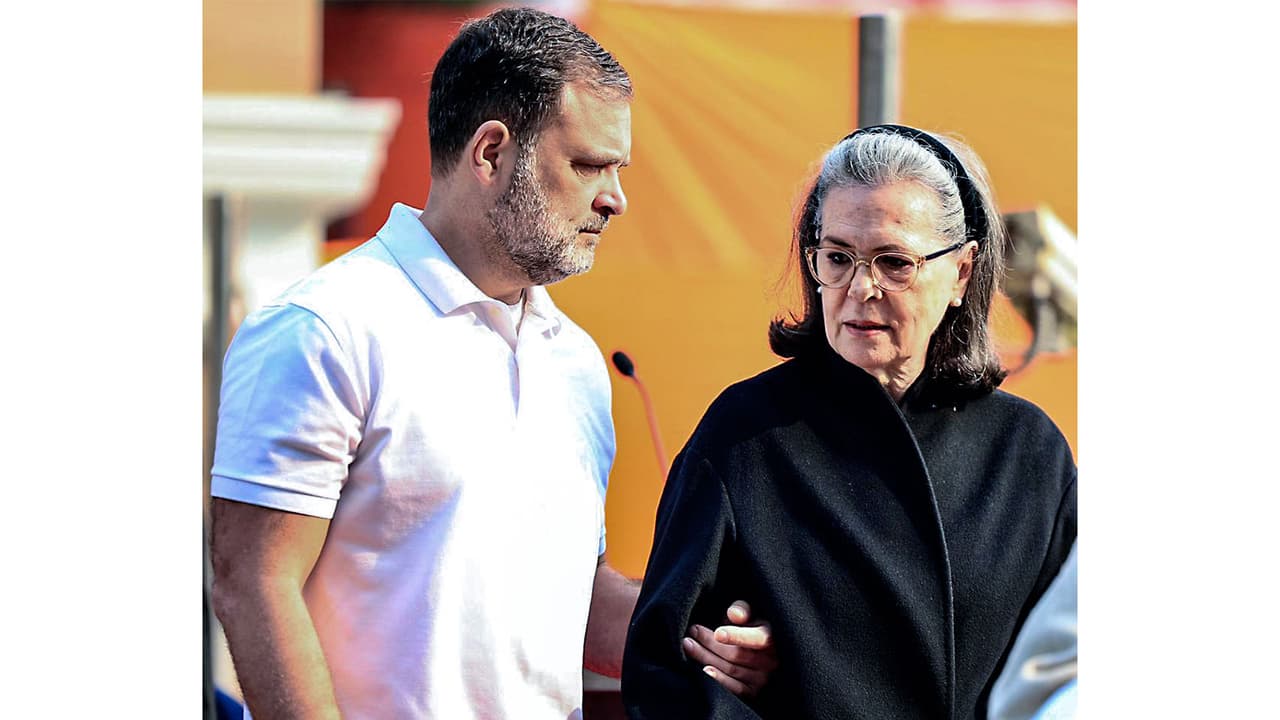
The Congress and the BJP on Tuesday locked horns over the Prime Minister Narendra Modi-led government’s stance, with the Gandhi family asserting India’s long-standing foreign policy doctrine of balance and non-alignment. Terming New Delhi’s response an “abdication” rather than neutrality, the Congress demanded moral clarity and parliamentary discussion, while the BJP countered Sonia Gandhi’s stance as “incorrect,” “inappropriate,” and driven by “appeasement.” They argued that India’s measured response is “responsible diplomacy” rather than “silence”. They maintain that India has consistently called for restraint, de-escalation, and respect for sovereignty.
Congress slams Centre’s ‘troubling silence’ as ‘abdication’
Congress Parliamentary Party Chairperson Sonia Gandhi triggered the political storm with a strongly worded opinion piece, criticising the Centre’s response to the Killing of Iran’s Supreme Leader Ali Khamenei in US-Israel airstrikes. “On March 1, Iran confirmed that its Supreme Leader, Ayatollah Seyed Ali Hosseini Khamenei, had been assassinated in targeted strikes carried out the previous day by the United States and Israel. The killing of a sitting head of state in the midst of ongoing negotiations marks a grave rupture in contemporary international relations. Yet, beyond the shock of the event, what stands out equally starkly is New Delhi’s silence,” she wrote.
Calling the Centre’s stance troubling, she added, “When the targeted killing of a foreign leader draws no clear defence of sovereignty or international law from our country and impartiality is abandoned, it raises serious doubts about the direction and credibility of our foreign policy.”
Sonia Gandhi further said, “Silence, in this instance, is not neutral but an abdication. It signals tacit endorsement of this tragedy.”
She also questioned the timing of Prime Minister Narendra Modi’s recent visit to Israel. “Barely 48 hours before the assassination, the Prime Minister returned from a visit to Israel, where he reiterated unequivocal support for the government of Benjamin Netanyahu, even as the Gaza conflict continues to draw global outrage over the scale of civilian casualties,” she wrote, adding that India’s “high-profile political endorsement without moral clarity marks a visible and troubling departure.”
Demanding accountability, she called for a discussion in Parliament over what she termed the government’s “disturbing silence.”
Rahul Gandhi questions PM’s stance
Echoing Sonia Gandhi’s concerns, Lok Sabha Leader of Opposition (LoP) Rahul Gandhi sharpened the attack on the government’s position. In a post on X, Gandhi said, “India must be morally clear. We should have the courage to speak plainly in defence of international law and human lives. Our foreign policy is rooted in sovereignty and the peaceful resolution of disputes — and it must remain consistent.”
He directly questioned the Prime Minister’s position, stating, “PM Modi must speak up. Does he support the assassination of a head of state as a way to define the world order? Silence now diminishes India’s standing in the world.”
Expressing concern over the broader conflict, Rahul Gandhi added, “Escalating hostilities between the United States, Israel and Iran are pushing a fragile region toward wider conflict. Crores of people, including nearly a crore Indians, face uncertainty.”
He also condemned violence on all sides. “The unilateral attacks on Iran, as well as Iran’s attacks on other Middle Eastern nations, must be condemned. Violence begets violence — dialogue and restraint remain the only path to peace,” he said.
BJP defends govt’s stance as ‘responsible diplomacy’
The BJP swiftly rejected the Congress’s allegations, asserting that India’s external policy remains consistent and mature. BJP leader Pratul Shah Deo defended the government’s approach, saying, “Sonia Gandhi should remember that India’s policy of non-alignment has been in place since the time of her mother-in-law and her mother-in-law’s father.”
“For a long time, India’s tradition has been that whenever tensions rise between two countries, India always mediates. We have appealed for peace,” he said.
Emphasising India’s diplomatic balance, Deo added, “We have some all-weather friends who have stood by us in every adverse situation, and we cannot forget their support.”
He further said, “However, it has been India’s long-standing tradition that whenever tensions rise between two countries or groups of nations, India always mediates. India is given great importance in such mediatory talks. We have appealed for peace and urged both sides to de-escalate immediately, because whenever there is a war or war-like situation, innocent citizens are the ones who suffer the most.”
From Maharashtra, Minister Girish Mahajan questioned the very premise of Congress’s criticism. “Why do we have to speak about that? Sonia ji should understand that what is our connection to it… We are living in peace here, so what is the need… It is an international policy… Whose against should we speak, America or Iran, and why,” he said in Nashik.
In Hyderabad, BJP spokesperson Prakash Reddy termed Sonia Gandhi’s remarks “ridiculous.” “Sonia Gandhi’s letter in connection with the Iran-America-Israel war is ridiculous. The government of India, under the leadership of PM Modi, is very clear, and its external policy is very clear. We are friendly with everyone… Whichever is in India’s interest, we are supporting that country,” he said.
He further alleged inconsistency in Congress’s stand. “As far as Iran is concerned, when Iran was supporting Hamas, terrorist activities and terrorist groups, we condemned it… The Congress party should understand that when Hamas attacked the Israeli people, killed them and kidnapped them brutally, at that time, what was the Congress’s stand? Were they in favour of Hamas? The Congress party is indirectly supporting terrorist activities,” he claimed.
Haryana Minister Arvind Kumar Sharma dismissed concerns about India’s global standing. “India’s credibility is the strongest… Regarding the attack on Iran, the Prime Minister and the Ministry of External Affairs are keeping an eye on it and reviewing it from time to time,” he said.
“The Prime Minister and the Ministry of External Affairs are handling this entire sequence of events with a good understanding,” Sharma added.
Congress MP offers condolences to Iranian representative
Amid the political storm, Congress MP Imran Masood met Abdul Majid Hakeem Ilahi, the India-based representative of Iran’s Supreme Leader, to offer condolences. “Seeing the passing of the head of any country is always a sad event, and India has had centuries-old ties with Iran. Regarding the passing of Khamenei Sahib, I came here to express my condolences on his death,” Masood said.
Sharing his conversation, he added, “He said that the friendship between Iran and India is 3,000 years old. Khamenei Sahib himself mentioned that Pandit Jawaharlal Nehru, in his Discovery of India, wrote about this relationship.”
Masood further said, “He had read it four times and personally told me, ‘To understand India, read Discovery of India.’ He was a very learned and capable person who possessed extensive knowledge about India and had a special connection with Gandhi Ji and Nehru.”
Conflict escalates in West Asia
This comes as US and Israeli strikes across Iranian cities targeted military infrastructure, leading to Khamenei’s death and that of senior officials. Iran retaliated with missile and drone attacks on US assets and allies across the region, including Israel and Gulf nations, widening the conflict and raising fears for civilians and expatriates.
The ongoing conflict has led to the closure of airspace over the Middle East region. As of March 3, the closure of airspaces over Qatar, the UAE, and Saudi Arabia has left an estimated 8,000 passengers stranded in Qatar alone, with tens of thousands more affected across the Gulf. (ANI)
(Except for the headline, this story has not been edited by Asianet Newsable English staff and is published from a syndicated feed.)