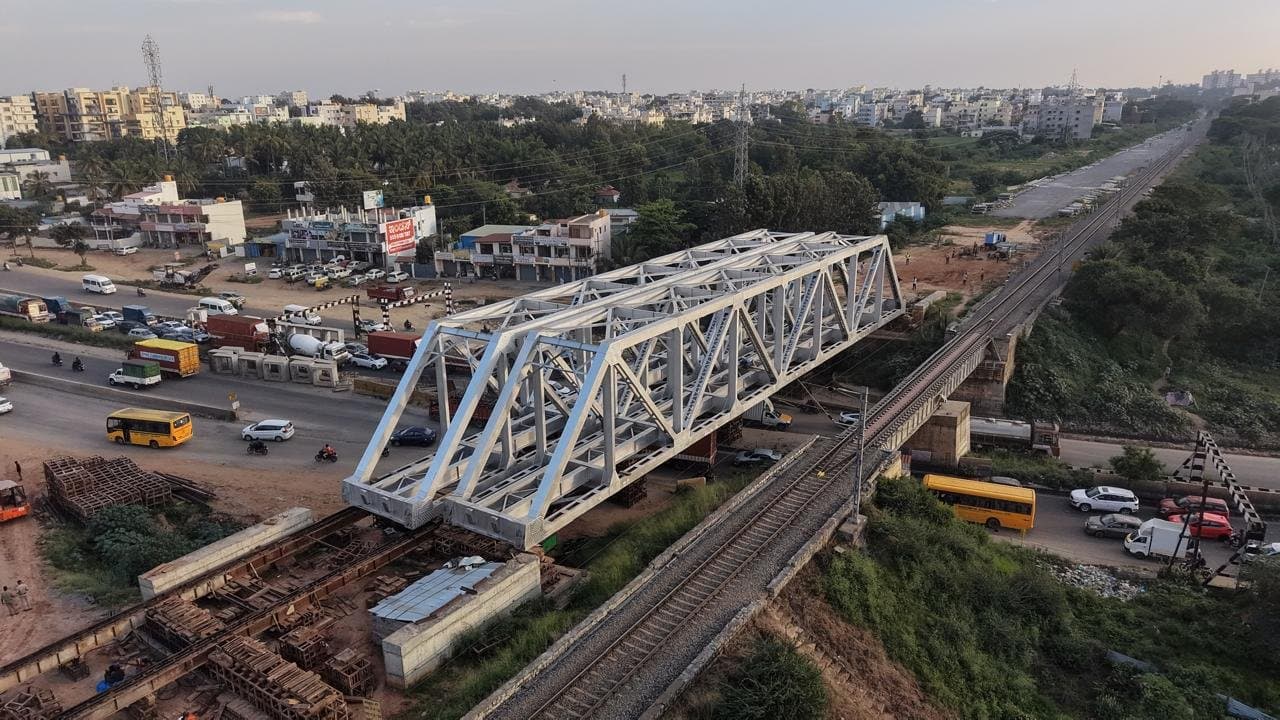
K-RIDE has launched two 61-metre girders over NH-44 near Chandapura as part of the Bengaluru-Hosur railway doubling project. The infrastructure upgrade aims to improve road traffic flow and strengthen regional connectivity.
Karnataka Rail Infrastructure Development Company (K-RIDE) has achieved a significant engineering milestone by successfully launching two Open Web Girders (OWGs) over Major Bridge No. 470 on National Highway 44 (NH-44) near Chandapura, Bengaluru. Each girder measures 61 metres in length and weighs approximately 245 metric tonnes. The first girder was launched on October 10, 2026, followed by the second on October 28.
The operation marks a significant step in the 48-kilometre Baiyappanahalli-Hosur (BYPL-HSRA) railway doubling project. According to K-RIDE, these are the longest girders the agency has launched for a railway doubling project in Bengaluru.
Key Engineering Details Of The Girder Launch
Each girder spans 61 metres and weighs approximately 245 metric tonnes. The approved design allows the structure to accommodate both Up and Down railway lines on a single substructure.
The engineering team used a winch-based pulling system to launch the girders. Temporary arrangements incorporating ISMB 600 steel sections were also installed to facilitate the operation.
According to K-RIDE, the work was carried out with appropriate safety measures, precise structural alignment and coordination to minimise disruption to traffic on NH-44. The operation was completed without disrupting vehicle movement on the highway, the agency said.
The project’s General Arrangement Drawing (GAD), structural design drawings and Temporary Arrangement Drawings (TAD) received approval from the South Western Railway headquarters in Hubballi.
Railway Bridge Design To Support NH-44 Expansion
One of the key advantages of the new bridge structure is that it does not require an intermediate pier in the middle of the national highway. This design will allow vehicles to pass beneath the railway bridge without obstruction from supporting pillars.
Once the railway works are completed, the existing bridge will be demolished and the highway will be improved in line with the expansion plans approved by the National Highways Authority of India (NHAI). The proposed highway expansion includes a 12-lane configuration.
The infrastructure upgrade is expected to improve traffic flow near Chandapura and reduce delays along the Bengaluru-Hosur corridor. It is also intended to improve road safety and accommodate future increases in highway traffic.
Meanwhile, doubling the railway line is expected to increase operational capacity and improve the movement of passenger and freight trains between Bengaluru and Hosur.
Benefits For Road And Rail Connectivity
The project is expected to improve connectivity between Bengaluru and Hosur by allowing road and rail traffic to operate more independently. The bridge design will also prevent railway support structures from obstructing highway traffic.
Once completed, the railway doubling project is expected to strengthen regional transport links and support industrial, commercial and logistics activities along the Bengaluru-Hosur corridor.
The project is also expected to increase railway capacity by providing additional infrastructure for passenger and freight services.
Scroll to load tweet…
K-RIDE Aims To Complete Works By January 2027
K-RIDE Managing Director Lakshman Singh said the successful launch of both girders marked an important milestone in the Baiyappanahalli-Hosur railway doubling project.
He said the grade-separated crossing would allow road and rail traffic to move independently, reducing the need to stop highway traffic when trains pass through the section.
K-RIDE aims to complete the associated railway and supporting works by January 2027. Singh said the progress reflected the agency’s commitment to strengthening railway infrastructure and improving regional connectivity across Karnataka.