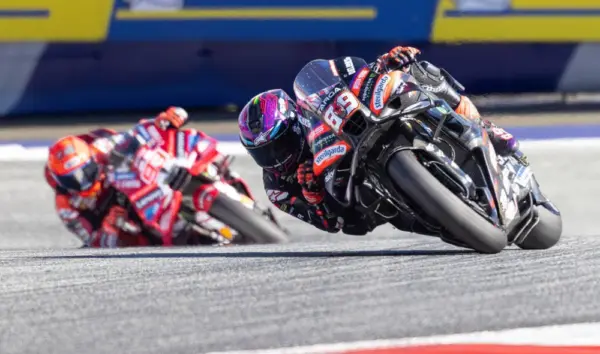
MotoGP 2026 Title Fight Pushes Two Champions to Their Physical Limits
The 2026 MotoGP World Championship has entered its most critical phase with the battle for supremacy intensifying not just on the track but within the very bodies of its leading contenders.
Jorge Martín and Marc Márquez, separated by a mere three points following the Austrian Grand Prix sprint race, are both grappling with significant physical challenges that threaten to shape the outcome of the title race.
Martín reclaimed the championship lead after a breathtaking comeback in Austria, where he surged from eighth back to the front, while Márquez secured second place behind the now-retired Pedro Acosta. Both riders face grueling physical hurdles: Martín is struggling with a compartment syndrome episode in his right forearm, a condition that emerged during the San Marino Grand Prix and risks requiring surgery. Meanwhile, Márquez continues to battle the lingering effects of his multiple arm and shoulder injuries sustained since his 2020 humerus fracture, which have forced him to recalibrate his riding style and strategic approach.
Marc Márquez’s journey is one of resilience amid adversity. The Cervera rider’s post-injury career has been defined by surgeries, setbacks, and a painstaking adaptation to a body that no longer responds as it once did. Throughout 2026, Márquez has openly acknowledged the impact of his physical condition on his racing decisions. After the Austrian sprint, he stated, “Pedro Acosta and Jorge Martín had more pace, but my priority was to finish just behind Pedro to minimize the points lost.” This pragmatic approach underscores Márquez’s evolved mindset-recognizing that championship success demands more than outright speed; it requires carefully managing risk and physical limitations.
Jorge Martín’s predicament is equally daunting but distinct. The reigning world champion began his tenure with Aprilia in 2025 battling a string of severe injuries, including fractures in both hands, his foot, and a complex radius and scaphoid fracture requiring surgery. A subsequent crash in Qatar left him with a hemopneumothorax and multiple rib fractures, compounding his physical challenges. Now facing a new, unfamiliar bout of compartment syndrome, Martín confronts the difficult choice between enduring pain on the bike or undergoing surgical intervention. After Austria’s sprint race, he admitted, “My arm suffered more than the previous day, but I consider it normal fatigue,” emphasizing the brutal physical toll of managing high-speed race conditions while fighting injury.
This clash between two champions highlights a profound reality in modern MotoGP: peak performance demands not only technical skill and mental fortitude but extraordinary physical resilience. The 2026 championship is not just about racing lines and tyre management; it is also a war against the body’s limits. Both Martín and Márquez embody contrasting battles-one of rebuilding and adaptation, the other of managing new and severe physical setbacks-yet their shared determination to compete at the highest level despite these constraints defines this season’s narrative.
MotoGP’s relentless evolution towards faster machines and more intense competition only amplifies this physical toll. As the championship hurtles toward its climax, the ability of Martín and Márquez to endure their bodily struggles will be as decisive as their speed on the asphalt. The fight for the World Championship in 2026 is a stark reminder that in MotoGP, the greatest rival may sometimes be within.