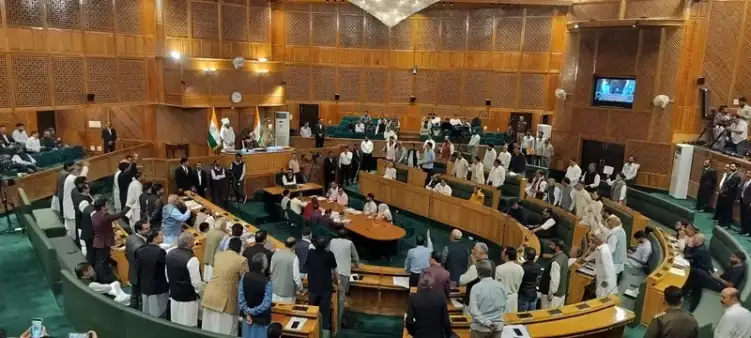
SRINAGAR: The Jammu and Kashmir Assembly on Wednesday plunged into a fierce debate over the explosive rise of self-styled “Facebook journalists” and other social-media newsmakers-many operating without training, accountability, or editorial scrutiny.
Lawmakers warned that this unchecked digital surge is warping public discourse, spreading misinformation at scale, and dragging elected representatives into orchestrated smear campaigns.
Several members demanded urgent government intervention, arguing that the absence of regulation has created a chaotic ecosystem where fake news thrives and reputations can be destroyed overnight. They said the trend reflects a seismic shift in the media landscape as social platforms have morphed into parallel newsrooms, pumping out real-time commentary, political gossip, and viral allegations without any licensing norms, ethical codes, or institutional oversight.
“This mushrooming of unregulated media actors is poisoning public trust and weakening democratic institutions,” one legislator said, urging the government to act before the situation becomes unmanageable.
But the House was not united. A few members cautioned that any move resembling censorship could backfire. PDP’s Waheed Ur Rehman Para warned that curbs on social media would strike at the core of democratic freedoms. “In an age built on open platforms and free expression, muzzling these spaces would be nothing less than gagging the very spirit of democracy,” Para argued, urging restraint.
Responding to the escalating concerns, Education and Health Minister Sakina Itoo announced that the Omar Abdullah Government is drafting a comprehensive media policy. She said guidelines covering both traditional journalists and digital content creators would be finalised within four months, with a committee already working alongside the Department of Information and Public Relations (DIPR).
“We are incomplete without media,” Itoo said, stressing the indispensable role of the press. But she delivered a blunt warning- politicians themselves are not innocent. “We cannot blame the media alone for the chaos online. We have contributed to this mess. Some of us have even set up our own social-media reel makers,” she remarked.
In a striking disclosure, Itoo referred to an alleged case involving a legislator who was reportedly running a social-media page under the name of a domestic worker. Some of the content posted there, she said, was “deeply uncomfortable,” adding that public representatives must examine their own conduct before pointing fingers.
Contrasting today’s digital free-for-all with earlier decades, she recalled the era of Doordarshan. “There was a time when people waited eagerly for the evening news. That dignity has been drowned in the noise of social media,” she said.
Itoo urged Speaker Abdul Rahim Rather to consider restricting mobile-phone use inside the Assembly, warning that unrestricted recording and circulation of proceedings could fuel further sensationalism.
She reaffirmed that the upcoming media policy would aim to restore order in J&K’s rapidly evolving media ecosystem, addressing both traditional journalism and the sprawling universe of social-media content creators who now shape public opinion with unprecedented reach.
The final day of the Assembly’s turbulent autumn session opened with fresh confrontation as ruling National Conference (NC) and opposition Bharatiya Janata Party (BJP) legislators clashed over the sudden withdrawal of two Bills seeking a salary hike for MLAs and ministers. The House-already charged after days of ruckus, slogan-shouting, and repeated clashes-erupted once again.
Trouble began moments after the session convened. NC MLA Altaf Kaloo waved a set of papers, claiming they contained signatures of BJP legislators who had supported the salary-hike proposal. The gesture triggered instant uproar. BJP MLA Sham Lal Sharma shot back, accusing Kaloo of turning a sensitive matter into political theatre. “Don’t turn this House into a stage for cheap politics,” Sharma said sharply.
He argued that discussing salary enhancements was morally indefensible when thousands of daily wagers, Anganwadi workers, and other casual employees were struggling for regularisation and basic benefits. “If you’re here for pay, go take a private job,” Sharma said, provoking loud reactions across the aisle.
On Tuesday, the usually calm House transformed into a stage for political jousting after Chief Minister Omar Abdullah dramatically withdrew two Bills proposing higher salaries and allowances for legislators and ministers – a move he said was meant to deny the BJP “a chance to play politics outside the House.”
The day began with slogan-shouting, verbal duels, and a BJP walkout, but tensions spiked when BJP members suddenly opposed the Bills despite raising no objections earlier in the House subcommittee chaired by senior BJP leader Surjit Singh Salathia. Abdullah, amused yet firm, called out the contradiction.
“In committee, you didn’t raise a finger. But now, with the Bill in the House, you want to oppose it so you can go out and claim the government doesn’t care about daily wagers and all that,” he said, gesturing toward the opposition. “That little performance won’t happen on my watch.” He added, “If even one member opposes, I withdraw.”
The confrontation escalated rapidly, with both treasury and opposition benches trading accusations. The withdrawal of the salary-hike Bills became a flashpoint in a session already marked by chaos. Over the past several days, the Assembly had witnessed walkouts, disruptions, and heated verbal clashes. The BJP had even moved a no-confidence motion against the Speaker-an unprecedented step in many years that deepened tensions.
As the session drew to a close, Speaker Rather attempted to restore calm. In his concluding remarks, he thanked members for what he described as a “useful” session that allowed legislators to raise issues concerning the people. Addressing the no-confidence motion, he said he preferred that the matter be taken up in the next session, even though procedural norms suggest such motions lapse with the end of the sitting.
The final day encapsulated the tenor of the entire autumn session-stormy, confrontational, and politically charged.