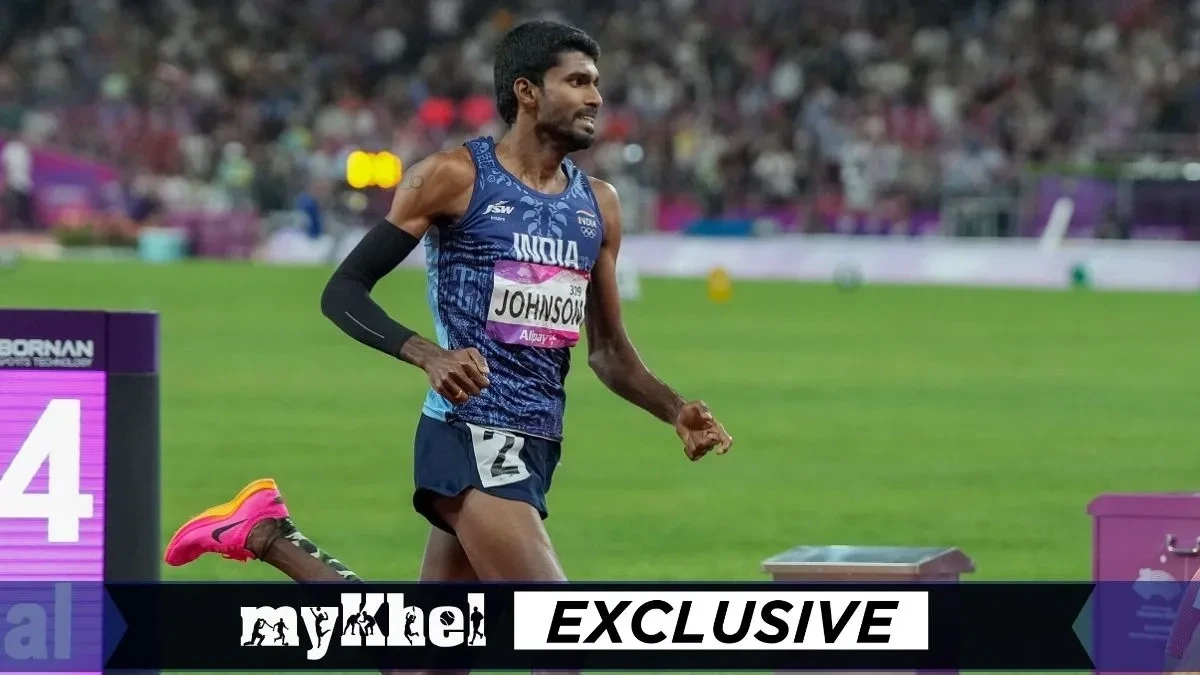
New Delhi, January 8: When Jinson Johnson announced his retirement, Indian athletics lost more than a decorated middle-distance runner.
It bid farewell to an athlete who carried belief through the unforgiving grind of elite competition for nearly 15 years.
Johnson’s journey had moments that altered history and stretches that tested endurance beyond the stopwatch. His qualification for the men’s 800m at the Rio 2016 Olympics was a landmark-making him the first Indian male runner since Sriram Singh in 1980 to line up in the Olympic 800m. Though he didn’t advance to the semifinals, the significance lay in reopening a door that had remained shut for decades.
Injuries, however, became frequent and cruel companions. Repeated setbacks, followed by the disruption of COVID-19, robbed him of rhythm and continuity. The Tokyo 2020 Olympics slipped away-not due to lack of preparation or desire, but because his body refused to keep pace with ambition.
Yet Johnson’s career cannot be measured only by its struggles. The 2018 Asian Games in Jakarta remain his defining chapter-gold in the 1500m and silver in the 800m, a rare double that underlined India’s growing strength in middle-distance running. Five years later, at the Hangzhou Asian Games, he signed off with a bronze in the 1500m, proving that experience could still compete even as speed waned.
He retires as India’s national record holder in the 1500m, with a timing of 3:35.24 set at ISTAF Berlin in 2019, and as a former national record holder in the 800m. The Olympic rings tattooed on his arm serve as a permanent reminder of what the sport meant to him.
What stands out in Johnson’s farewell is the clarity with which he spoke about timing, pain and acceptance. Reflecting on why he delayed his announcement, he explained the reasoning behind waiting for one final meaningful performance.
“I had planned to retire earlier, but I didn’t announce it,” he told myKhel. “I wanted to return with a good performance in my career, which is why I won a bronze medal at the last Asian Games. However, I suffered from several tendon injuries, and because of that, I struggled a lot in my career.”
Speaking about the difficult process of recognising when to step away, the 34-year-old detailed how training no longer matched his expectations or standards.
“Every athlete has their own time and phase, and I realised that it is important to retire at the right moment. I trained in Ooty even after the Asian Games, but my fitness was not good and I was not performing well in training. If we don’t train well, we won’t get good results in competitions. That is why I finally decided to retire.”
He then summed up his decision with calm acceptance rather than regret. “I had planned this decision earlier, and I am fully satisfied with my career.”
Recounting the long road back from pandemic disruption and injury, Johnson explained how thin the margin was between a comeback and an abrupt end. “During COVID-19, my fitness deteriorated and I suffered an injury. My body weight increased, and I did not compete in 2020 or 2021. In 2022, I returned to competition at the National Federation Cup in Calicut, where I won a bronze medal, though I was not fully satisfied with the performance.”
He further revealed how timing played a decisive role in his final Asian Games medal. “I did not compete in any other domestic events, nor did I take part in any international competitions during that period. At the beginning of 2023, I sustained a tendon injury, but I recovered later. I went on to win a medal at the 2023 Asian Games, which had been postponed from 2022. Had the Games been held in 2022 as scheduled, it would have been very difficult for me to win a medal.”
Admitting that 2018 marked the peak of his powers, the Kerala athlete reflected on a year that defined both his career and India’s middle-distance surge. “In 2018, my performance was very good. That year, I broke two national records, the 23-year-old national record in the 1500 metres and the 42-year-old national record in the 800 metres. I also won two medals at the Asian Games.”
He placed those achievements within the larger context of the team’s dominance. “Overall, it was my best performance year, and I contributed significantly to India’s medal tally. The Indian team dominated the middle-distance events at the Asian Games. In the 800 metres, Manjit Singh won the gold medal and I won the silver. In the 1500 metres, I won the gold medal.”
He concluded by highlighting the scale of that collective success. “In 2018, India achieved its highest-ever medal haul in middle-distance events at the Asian Games in Jakarta and Palembang.”
Even when speaking about unmet personal targets, Johnson chose honesty over disappointment. “Actually, while I was racing, I was thinking that I needed to run 800 metres in 1:43 and 1500 metres in 3:34. That was what was in my mind. However, I managed to run the 800 metres in 1:45.65 and the 1500 metres in 3:35.24.”
He accepted that ambition had pushed him, even if it wasn’t fully realised. “The target I had in mind was 1:46. I had set myself a high-level goal at that time, but I was not able to achieve it. Still, I am satisfied with how much I managed to do.”
Jinson Johnson exits the track not as a headline chaser, but as a benchmark. His records will be pursued, but perhaps more enduring will be the example he leaves behind-of persistence through injury, belief through doubt, and the grace to walk away at the right moment.