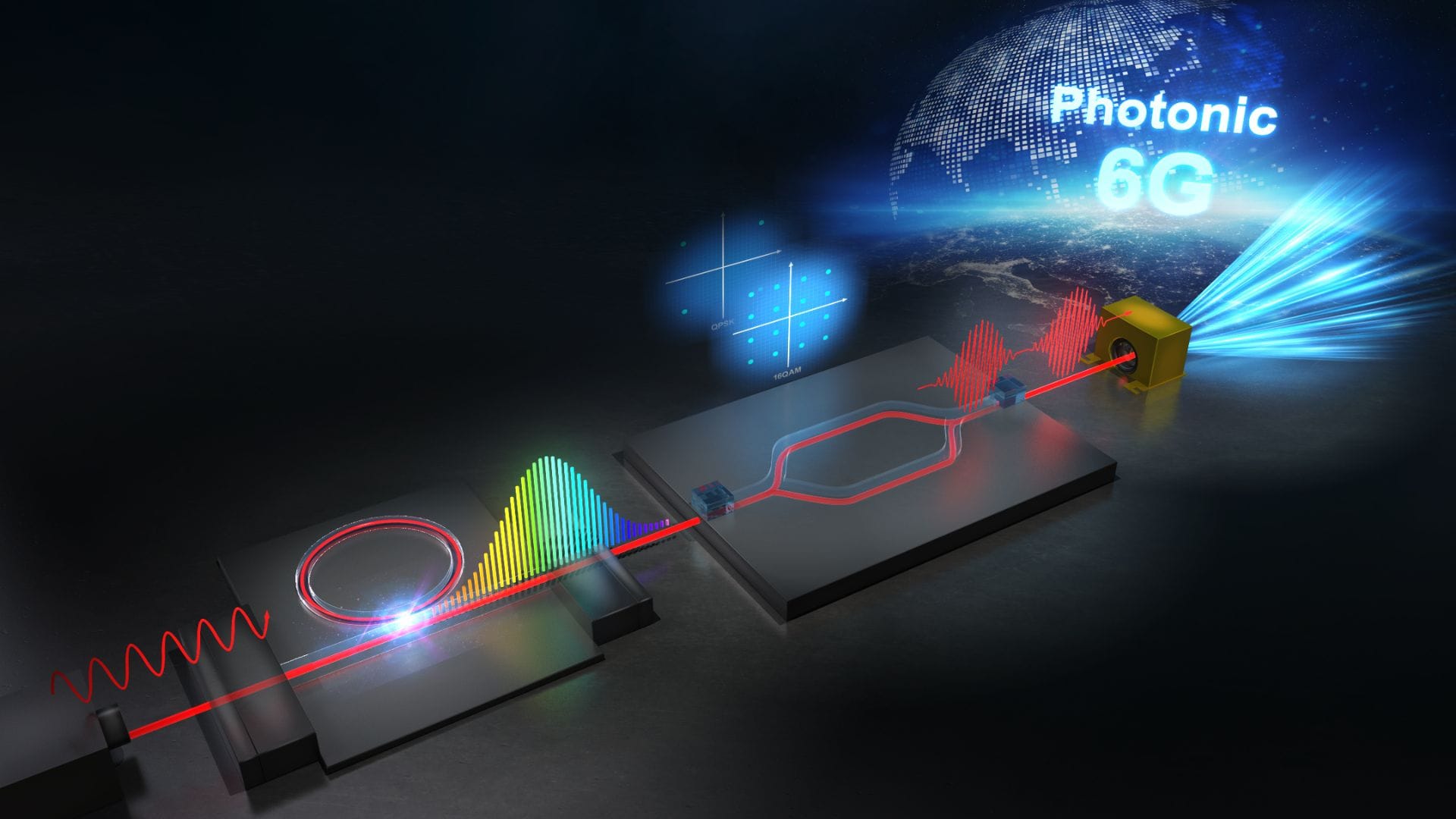
New Delhi: 5G systems use millimetre-wave bands, while the next-generation 6G systems are expected to use terrahertz waves above 300 GHz. Conventional electronics face fundamental limitations in signal generation, reduced output power and increased phase noise, all making stable, high-speed data wireless transmission difficult. Japanese researchers have developed a microcomb-driven terrahertz wireless communication system that combines terrahertz wave generation using a fibre-coupled microcomb, with high-order modulation techniques. A microcomb is a discrete multi-spectral structure where multiple optical frequency modes are arranged at equal intervals, comparable to the teeth of a comb. The ultrahigh-frequency optoelectronic signals are of significantly higher quality than those obtained using conventional electroncis.
The researchers leveraged the high frequency stability of the microcomb, generating a low-phase-noise terahertz carrier and demonstrating single-channel wireless transmission at 112 GBps in the 560 Ghz band. Conventional terahertz communication systems are typically limited to a few to tens of Gbps. This is the first time that 100 Gbps-class wireless communication has been demonstrated beyond 420 GHz, and provides the technological foundation for ultra-high-speed backhaul links and photonic-wireless integrated networks in 6G systems. Wireless communications have achieved higher data rates and larger capacity by increasing carrier frequencies. The researchers aim to further reduce the phase noise of microcombs to improve signal quality.
How a stable terrahertz signal was produced
The researchers first developed a microcomb device on a fibre-coupled microresonator, for a compact and stable terrahertz signal source. Optical adhesive was used to directly bond a silicon nitride resonator with optical fibre, eliminating the need for precise optical alignment using optical microscopes and multi-axis stages, as seen in conventional systems. The stable configuration allowed the use of high-power pump light, allowing for long-term, stable operation with low noise. The fibre-coupled microcomb was then used to realise the wireless communication system, using a pair of optical carriers, to demonstrate 100 Gbps-class communication beyond 420 GHz.