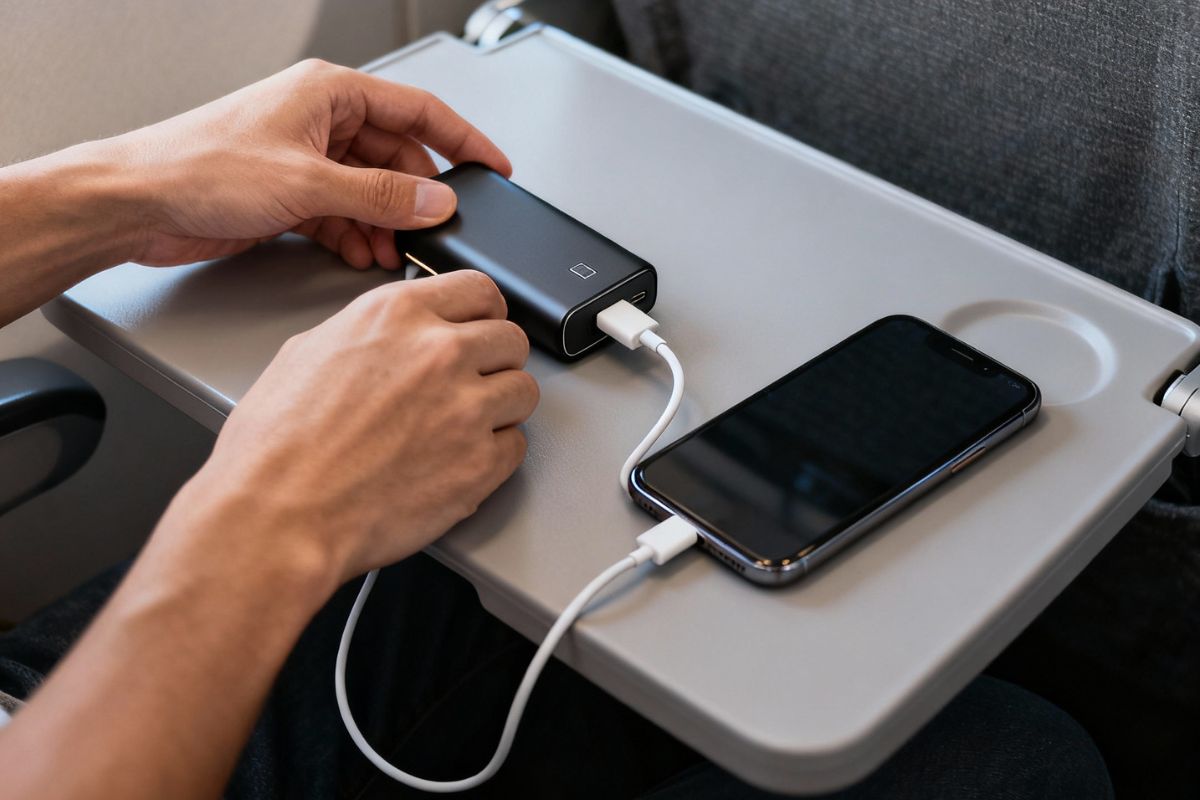
Japan is tightening the rules on power banks on planes. If you travel in or out of the country often, this is something you should pay attention to.
The Ministry of Land, Infrastructure, Transport and Tourism has confirmed that passengers will soon be banned from using mobile batteries during flights. The new rules are expected to take effect by April 2026.
Let’s break down what this actually means for travellers.
Power Banks Cannot Be Used During Flights
Under the new policy, passengers will not be allowed to use power banks on board aircraft.
That includes charging your phone, tablet, or any other device using a portable battery/ power bank during the flight.
This decision follows safety discussions at the International Civil Aviation Organisation, which has already prohibited charging mobile battery units on aircraft and is considering recommending a broader ban.
With this decision, Japan is aligning with those global safety concerns.
Limits on How Many Batteries You Can Carry
There will also be clear limits on how many power banks you can bring. Here is how it will work:
- Batteries over 160 watt-hours remain completely banned
- Batteries up to 160 watt-hours will be limited to two per passenger
At the moment, travellers can carry:
- Unlimited batteries under 100 watt-hours
- Up to two batteries between 100 and 160 watt-hours
The upcoming change mainly affects usage onboard, not just carrying them.
The rules will apply to all aircraft departing from or arriving in Japan, whether you are flying with a Japanese airline or an international carrier.
Airlines have already been informed and will be responsible for making sure passengers follow the rules.
Why Japan Is Taking This Step
Here’s the thing. Lithium-ion batteries can overheat. And when they do, they can catch fire very quickly. Power banks use lithium-ion cells. If damaged, defective, or exposed to heat, they can ignite.
According to Japan’s National Institute of Technology and Evaluation, there were 123 battery-related accidents in 2024. In 2020, that number was just 47. That is a sharp increase in a short time.
Many of those incidents involved batteries catching fire while charging smartphones.
There have also been real cases involving aircraft:
- In January 2025, an Air Busan aircraft caught fire at Gimhae International Airport.
- In October, a battery emitted smoke on an All Nippon Airways flight from Naha to Tokyo.
The issue is not limited to planes. In July 2025, a battery fire on Tokyo’s Yamanote train line injured five people.
What this really shows is that the risk is no longer theoretical.
Airlines That Have Restricted or Banned Power Banks
Japan is not alone; many international airlines have already tightened rules on power bank use on flights due to lithium battery fire risks. Most allow passengers to carry power banks in cabin baggage but prohibit using or charging them during the flight.
Here are 15 airlines that have introduced restrictions:
- Emirates
- Singapore Airlines
- Scoot
- EVA Air
- Thai Airways
- AirAsia
- Tigerair
- Starlux Airlines
- China Airlines
- Air Busan
- Malaysia Airlines
- Firefly
- MASwings
- Vietnam Airlines
- Vietjet Air
What Travellers Should Do Now
If you are flying to or from Japan soon, plan ahead.
- Charge your devices fully before boarding
- Bring fewer batteries if possible
- Check the watt-hour rating printed on your power bank
- Follow the airline crew’s instructions carefully
Since July, Japanese airlines have already advised passengers to keep batteries within reach and not place them in overhead bins while in use.
The upcoming ban goes further by stopping their use entirely during flights.
For frequent flyers, digital nomads, and business travellers who rely heavily on portable chargers, this change may require a small adjustment. But from a safety perspective, it is not hard to see why regulators are taking this seriously.
Air travel remains one of the safest ways to move around the world. Rules like this are meant to keep it that way.
Follow and connect with us on Facebook, Twitter, LinkedIn, Instagram and Google News for the latest travel news and updates!