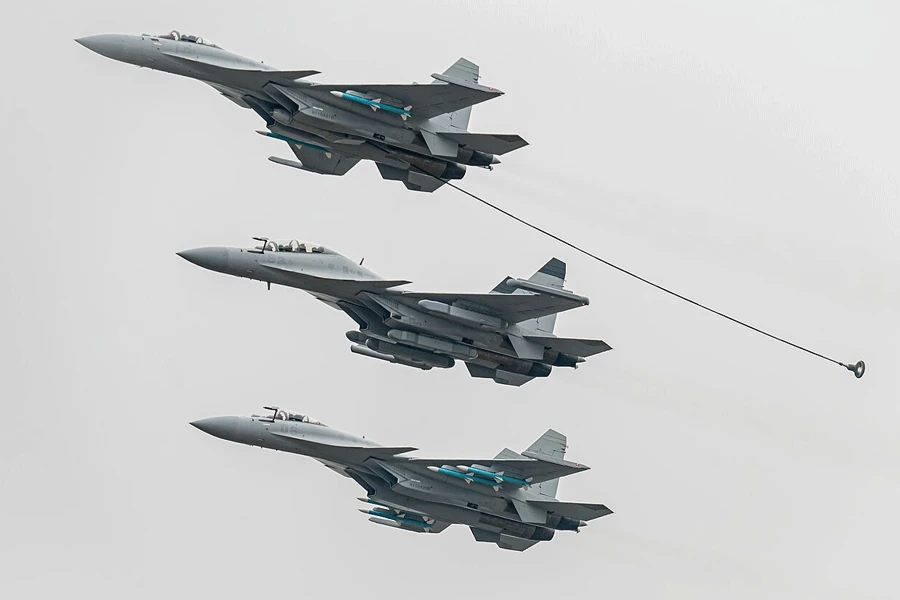
Japan-China tensions escalated over the weekend after Tokyo accused Chinese military aircraft of locking fire control radar on Japanese fighter jets near the Okinawa islands.
Prime Minister Sanae Takaichi vowed a “calm and resolute response” following the alleged incidents involving J-15 jets operating from China’s Liaoning aircraft carrier.
Takaichi said Japan would take all possible measures to strengthen maritime and airspace surveillance and monitor Chinese military activities, reported The Guardian.
Tokyo also summoned China’s ambassador on Sunday to protest and demand steps to prevent a recurrence of actions that defence minister Shinjiro Koizumi called dangerous and regrettable.
The Japanese defence ministry said the radar lock ons occurred twice on 6 December over international waters southeast of Okinawa’s main islands, where China’s People’s Liberation Army (PLA) said it was conducting far sea training.
The ministry reported that Chinese J-15 aircraft directed their fire control radar at Japanese F-15s at 4.32 pm for about three minutes and again between 6.37 pm and 7.08 pm.
Multiple scrambled Japanese jets detected the illuminations, which forced evasive action. Visual confirmation was not possible due to distance and no damage or injuries were reported.
Japan recorded about 100 fighter jet take-offs from the Liaoning during routine Chinese naval exercises that included three missile destroyers navigating between Okinawa’s main island and Miyako Island.
The defence ministry said fire control radar engagements indicate intent to guide missiles toward a target, which constitutes one of the most threatening acts a military aircraft can take.
It was the first time Japan’s defence ministry disclosed a radar lock by Chinese warplanes, Kyodo news agency reported.
Koizumi said the radar illuminations went beyond what is necessary for safe flight.
China rejected Japan’s accusations and issued counter protests. Senior Colonel Zhang Xiaogang of China’s defence ministry accused Japan’s self defence forces of maliciously following and harassing the Liaoning carrier group and repeatedly sending aircraft into exercise zones that China said had been demarcated and announced in advance.
A Chinese foreign ministry spokesperson urged Japan to stop what it called dangerous moves of harassment and accused Tokyo of hyping up a false issue to build tension and mislead the international community.
The incident adds to weeks of deteriorating relations that began after comments by Takaichi on the possibility of Japanese military involvement in a Taiwan conflict outraged China.
Takaichi said Japan could exercise its right to collective self defence and must anticipate a worst case scenario in the Taiwan Strait.
The remarks prompted US President Donald Trump to urge her to avoid further escalation. She has refused to withdraw her statements, saying Japan’s position has not changed.
Japan’s postwar constitution forbids the use of force to settle international disputes but a 2015 amendment passed under former prime minister Shinzo Abe permits collective self defence under certain conditions even if Japan is not directly attacked.
Beijing has responded to Takaichi’s comments with diplomatic and economic measures, including reinstating a ban on Japanese seafood and sending military and coast guard assets into waters near the Senkaku Islands and close to Okinawa.
Chinese state media has also revived questioning of Japan’s territorial claims over the Ryukyu Island chain.