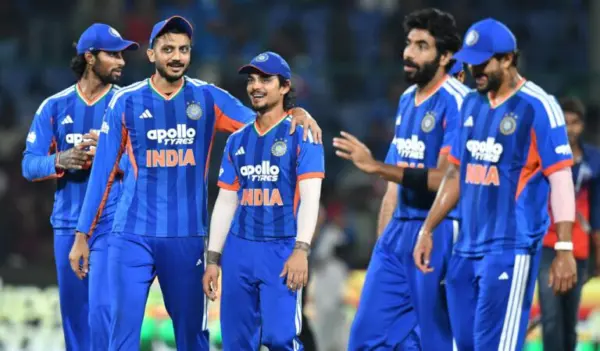
New Delhi: Japan Cricket Association COO Alan Curr on Sunday hoped that the historic maiden T20I against India will boost the sport’s profile in his country, helping it take a firm step towards achieving global recognition.
Reigning T20I world champions India will face Japan at the Sano International Cricket Ground on Tuesday, and the match will be live on FanCode, the official broadcaster of the contest.
“The boys are excited. An opportunity like this doesn’t come around very often for us,” Curr responded to a PTI query during a joint media interaction.
Curr remained optimistic that the India fixture can become a starting point for Japan to host more established cricket nations in the future.
“We’re trying to take all of this as part of the steps we’re taking to try and do that,” Curr said, referring to Japan’s future ambitions.
“In terms of the mainstream in Japan, it’s certainly piquing interest. It’s easy to say that the reigning world champions are coming to Japan to play against our team. But we’ve still got a long way to go,” he said.
The immediate challenge was that Japan has never hosted a cricket match of this scale.
The JCA had to transform the Sano ground over the last few days, adding temporary seating, VIP areas and ticket gates, besides enhancing the security arrangements.
The ground normally has permanent seating for around 500 spectators.
The association has also brought in a security consultant from England who has worked at World Cups, The Hundred and events involving India.
“We are taking all of this very seriously, and I think it’s really important for us to show that we have the capacity to handle something like this,” Curr said.
The weather, however, remains a concern, with a typhoon potentially threatening the preparations.
“Right now, success will be getting a game on. I’m not going to lie, there is a gigantic typhoon just to the south of Japan right now, so that’s the concern,” Curr said.
But India’s visit has already sparked massive interest in the country, and for Curr, it’s a success in itself.
“I think a lot of the success has almost already happened. The fact that India has agreed to come, the fact that I’m sitting here talking to you guys, the fact that there’s already a lot of Japanese media coming tomorrow to find out more about this game and about the sport – I think success is already here,” he said.
India’s visit is also the result of a longer-term effort by the JCA to upgrade its facilities and attract leading cricket nations to Sano.
The association relaid its turf square this year using the same clay that was used for the Asian Games facility in Nagoya.
Curr said the aim was to create a venue capable of hosting top international teams and provide them with a training option when they are in Japan.
“We were quite keen to try and host the Asian Games here, but unfortunately that wasn’t possible. So, finding reasons to attract full members to come here became important,” he said.
“Once we had the pitch laid in March this year, we started preparing a proposal to send out to all the full members.”
Those efforts eventually led to discussions with the BCCI, which Curr said moved quickly after the proposal was circulated.
Grassroots scenes in Japan
Japan’s registered player base has grown to 8,800 from around 3,000 when Curr joined the JCA in 2014. The Japan Cup, the country’s regional T20 competition, has expanded to more than 80 teams, while the Japan Cricket League (JCL) now has four divisions with over 30 teams.
Curr said the JCA’s focus on junior cricket and making top-level cricket more accessible were central to the sport’s growth.
“Cricket doesn’t really feature in the national sports scene right now. It’s a curiosity more than something that’s avidly followed and watched by the bulk of Japanese sports fans. We are trying to change that,” he said.
Curr identified the school system as one of the biggest challenges, with cricket largely absent from Japan’s established school sports structure.
“At the moment, cricket isn’t really on the menu. We’ve got a handful of schools that offer cricket, and so until we can get cricket into that system, it’s going to be difficult,” he said.
Curr also highlighted the Asian Games as an important platform for cricket’s growth in Japan.
“The Asian Games are so entrenched in the Japanese sporting psyche. People understand exactly what the Asian Games are, in the same way they understand the Olympics.
“So cricket being part of these sporting events gives the sport a legitimacy that it didn’t have before. That makes it more visible,” he said.
For Curr, the ultimate measure of Tuesday’s game will extend beyond the result, with Japan looking to use the occasion to showcase its cricket culture and build relationships with the wider cricketing world.
“We want to show that cricket is a sport that is played hard, but is also accessible and friendly to be involved with. We want cricket to be fun,” he said.
“It would be a great success to not have to see those kinds of comments about how shocked people are that Japan even plays cricket, because we’ve been playing cricket for a very long time.
“There’s been an awful lot going on in the background of Japan cricket for many, many years, and it’s great now that we are above sea level, I guess, and we’re actually visible to a few more people. We hope that continues,” he signed off.