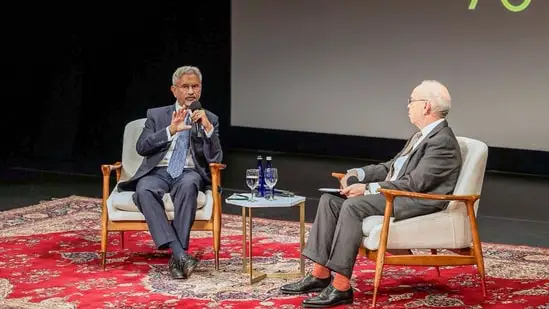
External affairs minister S Jaishankar said India-China relations have improved following the resolution of the border standoff, while noting that the prolonged tensions after the 2020 clash had affected ties between the two countries.
Speaking at an Asia Society event in New York, Jaishankar said if he was to compare the ties between India and China at present against before, his answer would be positive.
“If you asked me, compared to where you were in 2025, is the relationship better today? I would say yes. Compared to 2024, even more so…”
“After what happened in 2020 and the long standoff that we had on the border, the relationship had really been impacted… once the border standoff was resolved, it was natural that this would start to improve,” he said, as heard in the clips of his conversation shared by ANI news agency.
What India told China
Jaishankar said India had repeatedly conveyed to China that strained ties would not benefit either side. “We have long been telling the Chinese, personally at my level, that a standoff between us, a dip in our relationship, doesn’t help either of us. Third parties will take advantage of that…” he said.
“It took a little while for the Chinese side to agree with that, for whatever reason. But I don’t think that long standoff served our interests. It certainly didn’t serve theirs,” Jaishankar said, adding, “what we’ve had is that, as the border comes back more towards normalcy, the relationship comes back more towards normalcy… If it happens, it helps both of us.”
Listen in
On the broader changes in global diplomacy, Jaishankar said countries were increasingly engaging with multiple powers simultaneously, describing it as a move towards a multipolar world.
“…you’re dealing with China, you’re dealing with Russia, with Ukraine, with other parts of Asia, with Europe… what people used to say about us, Washington is today practicing with a great deal of gusto… that is the world which we are moving into,” he said.
“Everybody is openly dealing with everybody else. That is how we are heading towards multipolarity. This will be a universal gum. Everybody is going to be chewing it. And everybody is actually going to get the best deal that they can out of a given situation from a much sharper definition of their interest…” Jaishankar said.
“We may like it, we may not. But once Washington takes the lead on that, it becomes, in a way, a kind of a global trend. So that’s the reality,” he added.
India-US ties and the difficulties
Talking about India-US ties, Jaishankar said trade negotiations had been one of the more difficult areas, citing differences in the structure of the two economies.
“…much of the world has had a more difficult relationship with the US… In our case, one was the trade negotiation. If you look at the stakes involved, the complexity of it involved, bear in mind, India is a society of small producers, small agriculture producers, small factories. Apart from the per capita gap between India and the US, the nature of production and the nature of society are very different. A trade negotiation required a certain amount of patience and detailing to see it through…” he said.
Jaishankar said there was now “more or less an understanding” on the trade agreement, but a change in US tariff policy had created uncertainty.
“We have reached a situation where there is more or less an understanding on the trade agreement. But as my trade minister has said on more than one occasion, the issue is now what has changed on the American side. On the American side, reciprocal tariffs were struck down. So there’s now a new basis for tariff imposition, which is 301. And the 301 process is still in the works…” he said.
“That did create bumps last year for the relationship. If that agreement is closed out, that would be one point which would contribute to a better relationship,” Jaishankar added.