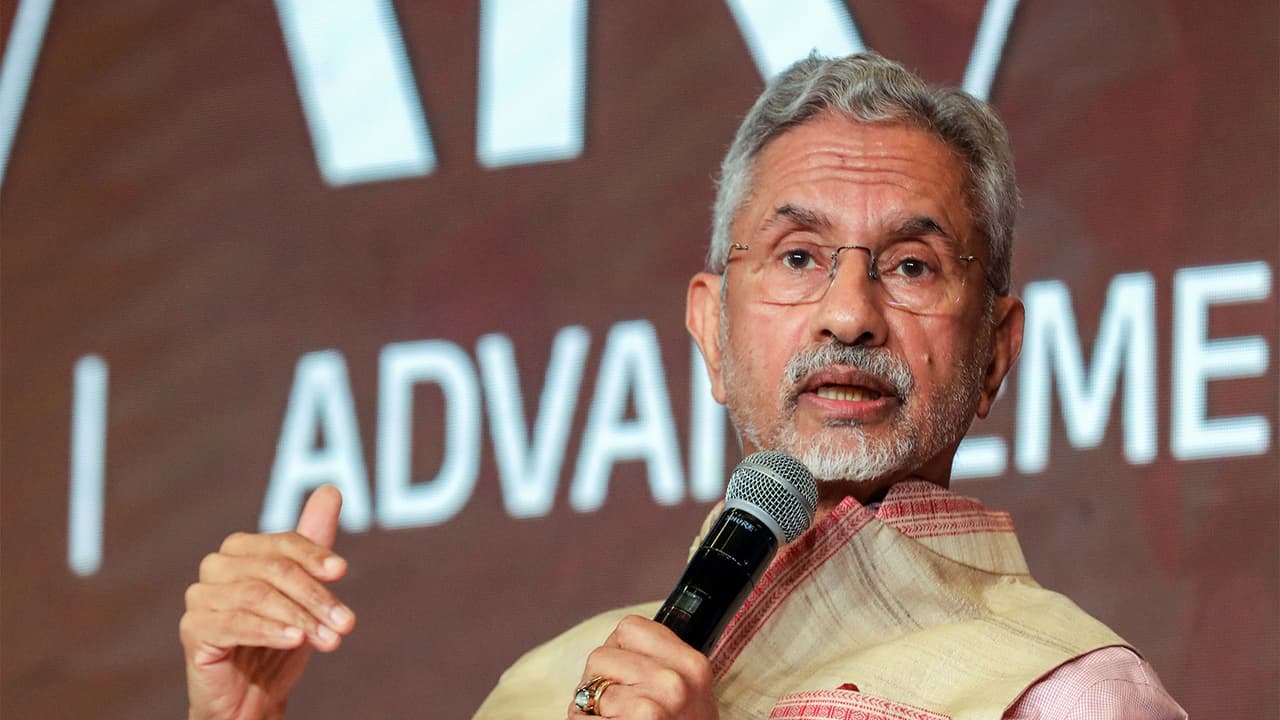
EAM S Jaishankar held separate talks with the foreign ministers of the UAE and Qatar to discuss the escalating West Asia conflict. He reiterated India’s call for dialogue and de-escalation while also highlighting India’s resilience amid global shocks.
Jaishankar Holds Diplomatic Talks Amid Regional Tensions
External Affairs Minister S Jaishankar on Sunday held separate high-level conversations with leaders from the UAE and Qatar to discuss the rapidly evolving situation in West Asia amid the regional conflict. In a post on X, Jaishankar stated that he spoke with the Deputy Prime Minister and Foreign Minister of the UAE, Abdullah bin Zayed Al Nahyan, reviewing ongoing developments in the region. “Discussed the evolving situation in West Asia with DPM & FM Abdullah bin Zayed Al Nahyan of UAE,” he wrote.
In a separate post, the External Affairs Minister said he also held a telephonic conversation with the Prime Minister and Foreign Minister of Qatar, Tamim bin Hamad Al Thani, regarding the ongoing conflict. “Had a telecon on the ongoing conflict with PM & FM Tamim bin Hamad Al Thani of Qatar this evening,” Jaishankar stated.
The back-to-back diplomatic engagements come amid heightened tensions in West Asia, with India closely monitoring the situation and maintaining regular contact with key regional stakeholders. India has consistently emphasised the need for dialogue, de-escalation, and the peaceful resolution of conflicts in the region.
EAM on India’s Resilience in a Turbulent World
Earlier on Saturday, Jaishankar noted that India has “solidly come through” the turbulent global environment amid the West Asian conflict and the Russia-Ukraine war, “managing domestic and external challenges successfully”.
Addressing the 15th Annual Convocation Ceremony of IIM Raipur, EAM Jaishankar called for “hedging, de-risking and diversifying” to secure India’s interests as he noted that the resources can be used as leverage amid shifting power structures across the globe. “The turbulence in the world currently is also structural in many ways. The global order is changing before our very eyes with visible shifts in the relative power and influence of countries. The politics of some societies find it difficult to come to terms with these changes. New developments in technology, in energy, in military capabilities, in connectivity and in resources have encouraged risk-taking in an increasingly competitive environment. Everything today is being leveraged, if not actually weaponised. The world is then confronted with the prospect of securing itself in an increasingly volatile and unpredictable environment. This has necessitated hedging, de-risk and diversifying. Whether this is a business choice or a foreign policy,” the EAM said.
“There is an optimism in our society that is lacking in many other parts of the world. Now you could ask, why is that? The last 10 years have been much better, giving rise to the confidence that the next 10 and those beyond will also be. We are, after all, now among the top five economies. No one can dispute that the multiple global shocks that have recently tested our resilience and that India has come through that solidly. We have managed both domestic and external challenges fairly successfully,” he added.
Conflict Background
The conflict in West Asia began following US-Israeli joint military strikes on Iran on February 28, which killed Iran’s 86-year-old Supreme Leader, Ayatollah Ali Khamenei. Tehran, in retaliation, targeted Israel and US assets in several Gulf countries, causing disruption in the waterways and affecting international energy markets and global economic stability.
(Except for the headline, this story has not been edited by Asianet Newsable English staff and is published from a syndicated feed.)