INSV Kaundinya, an indigenously built traditional stitched sailing vessel, completed its maiden overseas voyage from Gujarat’s Porbandar to Oman’s Muscat, reviving India’s ancient maritime legacy and shipbuilding genius.
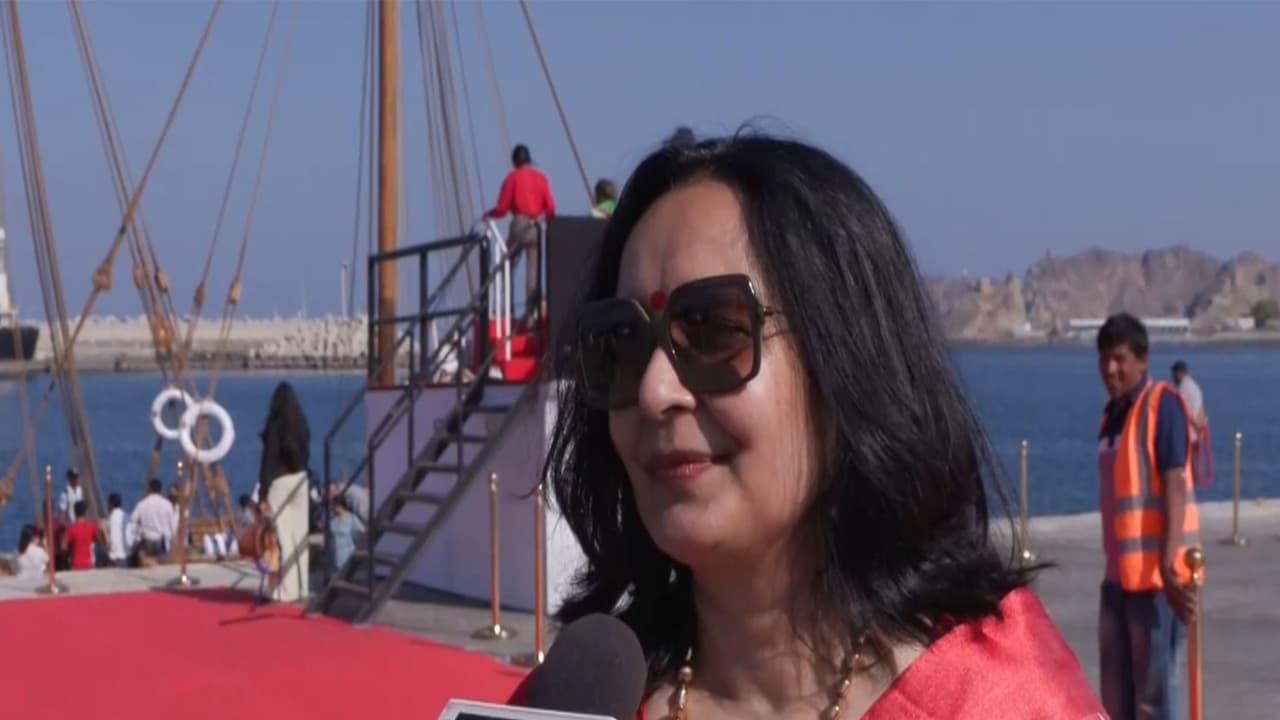
Smita Barooah, wife of INSV Kaundinya crew member and Prime Minister’s Economic Advisory Council member Sanjeev Sanyal, on Wednesday shared her emotions as the stitched sailing vessel completed its voyage, describing the journey as a dream and recalling how closely she followed the ship’s progress during the expedition. “It’s been like a dream. From the moment we went to look for the shipyard that would build her to the Keel Laying Ceremony, I have seen her at every stage. And then it’s one thing to see the ship and another to have her sail,” she said.
An Anxious but Proud Journey
Barooah spoke about the anxious initial days of the journey, saying, “So for the first maybe four nights, I didn’t sleep very well, especially because the winds were against them and they weren’t making much headway.”
She added that she tracked the ship continuously using an app. “I was fanatically tracking the ship because we had an app that showed her progress. And whenever there’d be a pause, again, the heart rate would go up,” she said.
Expressing pride in the effort behind the voyage, she said, “I’m so proud of them, and I’m so proud of the Navy for supporting this endeavour.”
She also credited the Prime Minister for backing the initiative, saying, “And most of all to the Prime Minister, without whose go-ahead this wouldn’t have happened. Imagine a leader saying, go do it and it happened.”
A Memorable Voyage
INSV Kaundinya crew member and Prime Minister’s Economic Advisory Council member Sanjeev Sanyal on Wednesday shared his experience of the vessel’s 18-day maiden international voyage from Gujarat’s Porbandar to Oman’s Muscat, describing the journey as memorable despite challenging weather conditions. “We had some gorgeous sunrises and moonrises, but we also had rain and storms. The Indian Navy crew is amazing,” Sanyal said while narrating his time on board the vessel.
Expressing excitement at the successful completion of the voyage, he added, “Absolutely thrilled to be here. It has been a dream. It is not just about being at sea for 18 days; it is about something that goes back 5 years.”
Historical Significance and Support
Highlighting the larger historical significance of the expedition, he said, “I think people underestimate the technologies used by ancient Indians and mariners.”
Sanyal also credited the Prime Minister for encouraging the initiative, saying, “Without the Prime Minister’s encouragement, this could not have started.”
Pointing to institutional support for the project, he said, “The Ministry of Culture financed this project.”
He further highlighted the Indian Navy’s role in the journey, saying, “The Indian Navy which supervised the building of the ship and then crewed it for this voyage and the crew.”
Sharing details about the next steps after the voyage, Sanyal said, “I will return home after this voyage, but the crew will remain here. The ship will be taken out of the water to be checked. After that, the crew will return to India.”
Reviving India’s Maritime Legacy
The voyage concluded with the crew of INSV Kaundinya celebrating the vessel’s arrival in Muscat after completing its maiden overseas voyage from Porbandar in Gujarat. Marking the successful completion of the journey, the Indian Navy’s indigenously built traditional stitched sailing vessel, INSV Kaundinya, was given a water salute on Wednesday.
As the vessel completed its voyage, Union Minister of Ports, Shipping & Waterways Sarbananda Sonowal hailed the mission, calling the ship “a shining example” of Prime Minister Narendra Modi’s effort to revive India’s maritime legacy.
Speaking on the significance of the expedition, Sonowal said, “INSV Kaundinya is a shining example of PM Modi’s visionary leadership. It was his resolve to revive India’s ancient shipbuilding genius and present it proudly before the world.”
Emphasising the symbolism of the vessel, the Union Minister added, “This ship represents the timeless strength of our maritime heritage marked by skill and enduring innovation.”
Highlighting the inspiration behind the vessel’s identity, Sonowal said, “The ship draws inspiration from a 5th-century vessel depicted in the Ajanta cave, and it is named after legendary sailor Kaundinya.”
Voyage Details
The ship departed from Gujarat’s Porbandar on December 29, 2025. The voyage was undertaken by a crew comprising four officers and 13 naval sailors, with the expedition skippered by Commander Vikas Sheoran and Commander Y Hemant Kumar serving as the Officer-in-Charge. Prime Minister’s Economic Advisory Council member Sanjeev Sanyal, who was part of the crew, shared daily updates about the ship on social media.
Recreating Ancient Shipbuilding Genius
INSV Kaundinya is a stitched sail ship, based on a 5th-century CE ship depicted in the paintings of the Ajanta Caves, reviving a traditional form of shipbuilding associated with India’s ancient maritime history.
Design, Construction, and Validation
The project was initiated through a tripartite agreement signed in July 2023 between the Ministry of Culture, the Indian Navy, and M/s Hodi Innovations, with funding from the Ministry of Culture.
Following the keel laying in September 2023, the vessel’s construction was undertaken using a traditional method of stitching by a team of skilled artisans from Kerala, led by master shipwright Babu Sankaran. Over several months, the team stitched wooden planks on the ship’s hull using coir rope, coconut fibre, and natural resin.
The ship was launched in February 2025 in Goa, after which the Indian Navy played a central role in overseeing the design, technical validation, and construction process. With no surviving blueprints of such vessels, the design had to be inferred from iconographic sources. The Navy collaborated with the shipbuilder to recreate the hull form and traditional rigging and ensured that the design was validated through hydrodynamic model testing at the Department of Ocean Engineering, IIT Madras, and internal technical assessments.
Cultural Significance and Symbolism
The newly inducted vessel incorporates several culturally significant features. Its sails display motifs of the Gandabherunda and the Sun, its bow bears a sculpted Simha Yali, and a symbolic Harappan-style stone anchor adorns its deck, with each element reflecting ancient Indian maritime traditions.
Named after Kaundinya, the legendary Indian mariner who sailed across the Indian Ocean to Southeast Asia, the ship serves as a symbol of India’s long-standing traditions of maritime exploration, trade, and cultural exchange. (ANI)
(Except for the headline, this story has not been edited by Asianet Newsable English staff and is published from a syndicated feed.)