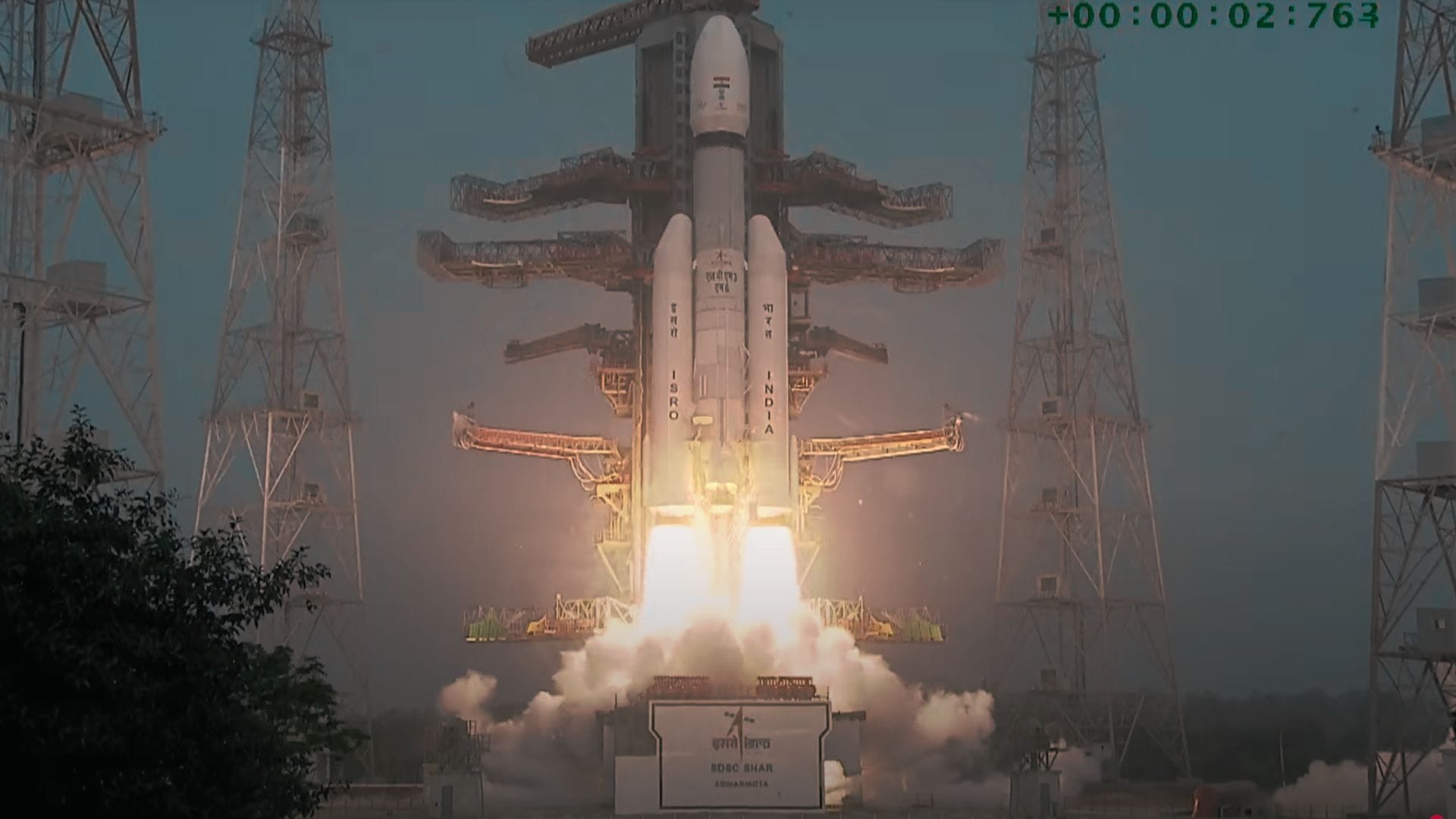
New Delhi: At 08:55 hours IST on 24 December 2025, India’s mightiest operational rocket lifted off from the Second Launch Pad at the Sriharikota payload, carrying the heaviest payload ever lifted to space from Indian Soil, at 6,100 kg. New Space India Limited (NSIL), the commercial arm of the Indian Space Research Organisation (ISRO) is providing the launch for US-based AST SpaceMobile. This was the third commercial mission for the Launch Vehicle Mark 3 (LVM3), which has a flawless record.
The 24 hour countdown was initiated on 23 December at 08:54 hours IST, so the flight was extended for about a minute and a half. ISRO had invited the general public to the launch viewing gallery to witness the launch. The flight took place in favourable weather conditions. The satellite on board is the first in the second generation ‘Block 2’ BlueBird satellites by ASTSpaceMobile, that provides direct cellular broadband coverage to mobile phones from satellites without the use of any modifications or special equipment. To make up for the distances to orbit, the satellites used large phased arrays measuring 223 square metres, making the BlueBirds the largest commercial communications satellites.
The Flight Profile
The LVM3 is a three stage to orbit launch vehicle, that first fires a pair of S200 strap-on boosters that use solid fuel, followed by the L110 core stage that uses liquid fuel. About 132 seconds into the flight, the pair of strap on boosters are separated. The payload fairing or nose cone of the rocket then opens up like the petals of a flower and drops off. The purpose of the payload fairing is to protect the satellite from the friction of the thick lower atmosphere. At an altitude of 115, it is no longer necessary so the extra weight is shed. 301 seconds into the flight, the core stage separates as well, after which the indigenously developed cryogenic upper stage takes over. The satellite will be deployed 15 minutes into the flight, at an altitude of 520 km.