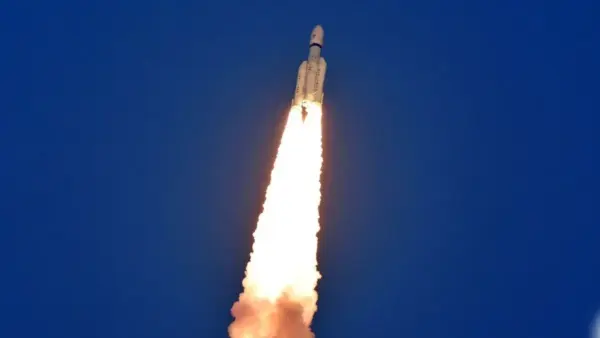
There is a shift happening in the Indian space program as ISRO slowly moves away from developing launch vehicles and ordinary satellites.
It is anticipated that the work of producing rockets will move from the hands of ISRO into those of private corporations and PSUs, making way for ISRO to concentrate on research and high technology.
This was highlighted by Dr Pawan Goenka, the Chairman of IN-SPACe while addressing the India @ 100 Economy Summit organized by Business Today.
ISRO To Stop Manufacturing Launch Vehicles
According to Goenka, ISRO is gradually shifting to a system where ISRO will not manufacture the rockets any more as a regular part of its activities.
Manufacturing the launch vehicles will be done by private companies and PSUs, while ISRO will focus on developing new technology and realizing the vision of India in the future in the space arena.
This has already begun with the SSLV. Technology and manufacturing rights of the rocket have been handed over to HAL after open bidding.
PSLV And LVM3 Could Follow
The next step in the transition process may require the involvement of two of India’s most crucial rockets: the Polar Satellite Launch Vehicle (PSLV) and Launch Vehicle Mark-3 (LVM3).
According to Goenka, it is expected that both of the launch vehicles would eventually shift to being manufactured in the private sector.
Unlike the transition of SSLV, it is not expected that public sector firms will be permitted to manufacture and operate the rockets. Private firms are expected to take charge.
Such a step would be quite revolutionary for India’s space industry considering the fact that PSLV is one of the most reliable launch vehicles operated by ISRO and the LVM3 is the most powerful rocket in India’s inventory.
ISRO To Focus More On Research And Science
The planned change does not mean ISRO will become less important. Instead, its role is expected to shift from being both a research organisation and manufacturer to focusing more heavily on research and development.
The agency will work on scientific missions, advanced technologies, specialised satellites and complex space infrastructure.
Once a technology reaches maturity, it can be transferred to private companies for commercial production and operations.
Goenka said ISRO has already transferred 120 technologies to the private sector, showing that the process of moving technology from the government space agency to industry is already underway.
Private Sector May Get New Launch Centre
There will also be a move by the government to increase participation of private firms in India’s launch capabilities. According to Goenka, the operations of the new launch site may be taken care of by a private firm that can be determined in the coming four to five months.
Such a step would result in the greater control of launch activities by the private firms, thus leading to increased number of commercial launches from India.
India Targets $44 Billion Space Economy By 2033
The changes are part of India’s larger plan to expand its space economy.
India’s space sector is currently valued at around $8 billion, and the government wants to increase this to approximately $44 billion by 2033.
Goenka said achieving this target will require growth in three key areas – government demand, greater use of space technology by industries outside the traditional space sector and expansion into international markets.
The government is expected to play the role of an anchor customer by creating demand for services and products developed by private space companies.
Defence Already Placing Orders With Private Firms
The defence sector is emerging as an important source of demand for India’s private space industry. According to Goenka, the Department of Defence has already placed an order for 31 satellites with private companies. ISRO is expected to build another 21 satellites under the wider programme.
India is also moving towards an ownership-based commercial model, under which private companies can own satellites and other space assets and generate revenue from their data and services.