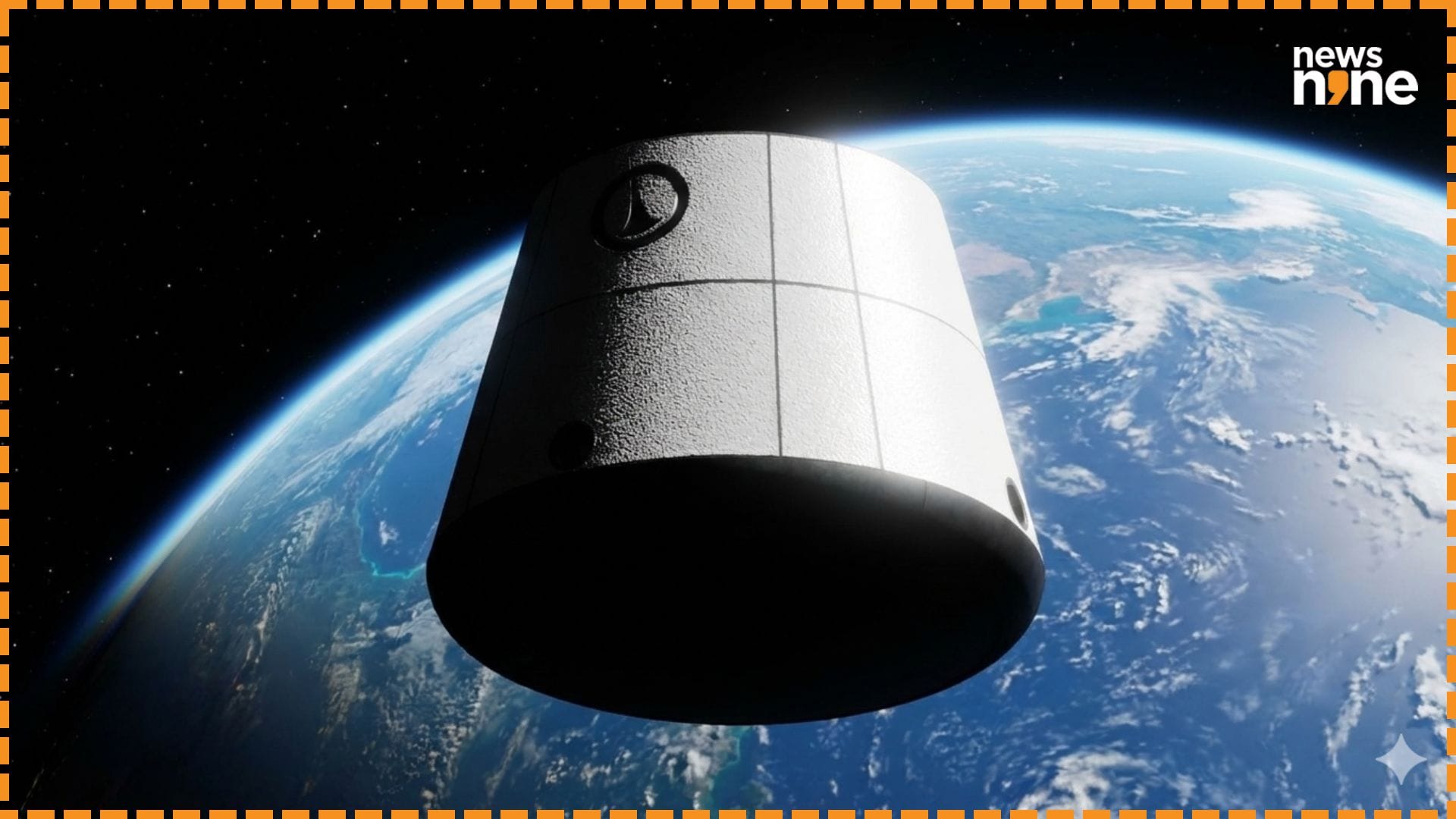
New Delhi: ISRO is aiming to bid farewell to 2025 with the PSLV-C62 flight, currently scheduled on 31 December to launch the EOS-N1 ‘Anvesha’ satellite for the DRDO. There are 18 copassengers on board, one of which is the Kestrel Initial Demonstrator (KID) cargo capsule for Orbital Paradigm, a New Space Startup based in Madrid, Spain. The technology demonstrator mission is the first flight on the roadmap of Orbital Paradigm to prove the technology. Orbital Paradigm aims to follow-up the mission with the ‘Learn to Fly’ mission in 2026, that scales up the capsule.

The Kestrel Initial Demonstrator. (Image Credit: Orbital Paradigm).
The hardware for the technology demonstration mission was developed within a budget of $1 million by a team of nine engineers within a year. Despite being a technology demonstrator mission, Orbital Paradigm is hosting payloads for customers! On board the capsules will be technology from space robotics company Alatyr, an academic payload for Leibniz University Hannover as well as a payload from an undisclosed customer. Because of the mass and cost, there is no parachute system on board and Orbital Paradigm will not be attempting to recover the hardware, but plans to collect data from the mission for as long as possible.
Why is a cargo capsule needed?
Most of the flights to space are one-way missions, where the hardware is discarded. For conducting microgravity experiments, it is necessary to recover the science payloads after the experiment has been conducted. The International Space Station provides some capacity for such experiments, as well as the Chinese Tiangong Orbital Complex. However, there is a tremendous global demand to return microgravity experiments to the ground, which Orbital Paradigm aims to cater to with its Kestrel Cargo Capsule, completing the space transportation chain. The Kestrel reusable cargo capsule is designed to routinely fly to space with up to 120 kg payloads, spending up to three months in orbit.