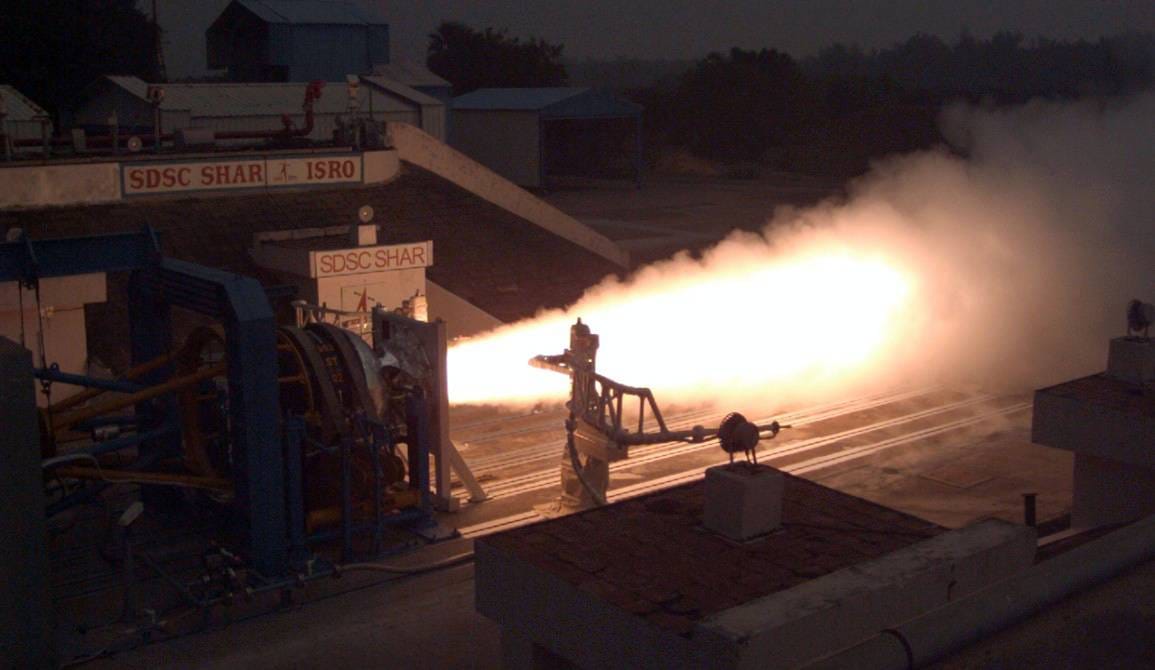
New Delhi: ISRO has successfully conducted a ground test of the third stage of its newest and smallest rocket, the Small Satellite Launch Vehicle. The test was conducted on 30 December at the Solid Motor Test Facility at the Satish Dhawan Space Centre in Sriharikota. The third stage was previously using a steel alloy case, with the test validating an improved version that uses a carbon-epoxy case. This reduces the mass of the stage, enhancing the payload capacity of the rocket. The high-strength carbon filament wound motor case was realised at the Composites Entity of Vikram Sarabhai Space Centre, with the solid motor being cast at the Satish Dhawan Space Centre.
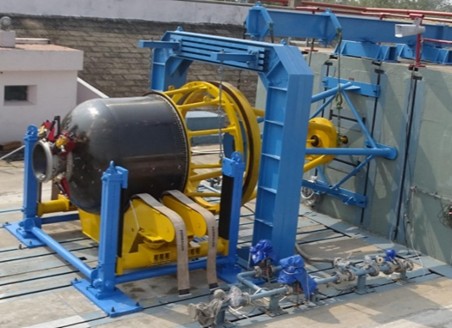
The SS3 motor at the test bed. (Image Credit: ISRO).
The stage was fired for a duration of 108 seconds. The motor was instrumented to capture parameters such as pressure, thrust, temperature and vibration, all of which were close to the predictions. To increase the capacity for producing solid rockets, ISRO set up new facilities at the spaceport itself. The indigenous 10-tonne vertical mixer is the largest solid propellant mixing equipment in the world. ISRO also set up facilities for testing the solid motors. With the successful testing, the improved version of the SS3 motor is qualified for induction.
ISRO’s Small Satellite Launch Vehicle
The SSLV has completed three developmental flights, and is now considered a part of ISRO’s fleet. However, the operational flight is supposed to take place by the first quarter of 2026, and is the SSLV-L1 mission to launch an unspecified payload. ISRO continuously improves its rockets, and has recently revealed the SSLV Module for in-LEO Experiment (SMILE) platform, that allows industries and academia to prove their hardware in orbit by providing communications and power for hosted payloads that are not released by the upper stage. This puts to use a part of the rocket that would otherwise be discarded.