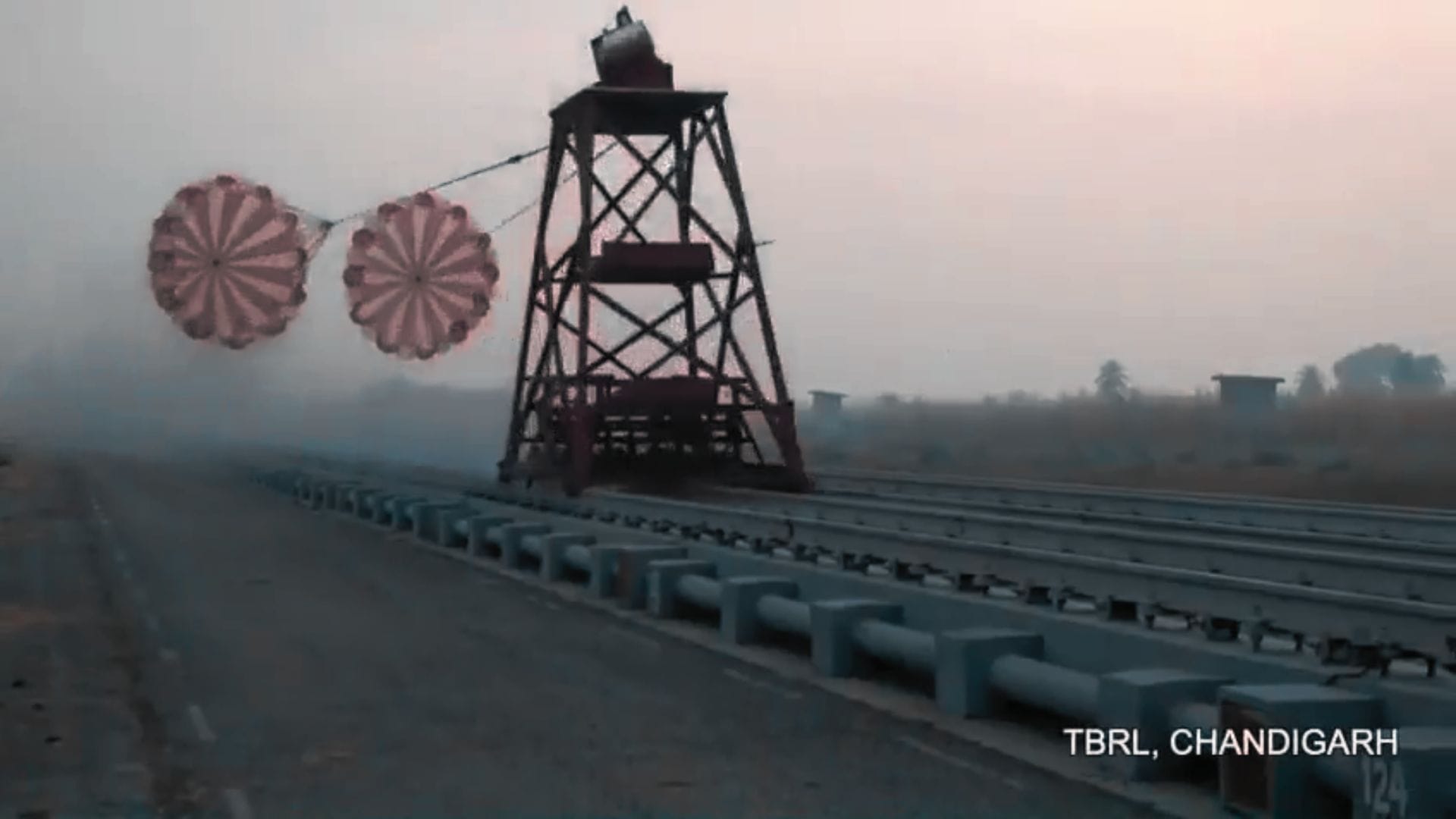
New Delhi: The Minister of State for Space, Jitendra Singh has revealed that ISRO has completed the campaign to test and validate the Drogue Parachute deployment system for the Gaganyaan Crew Module at the Rail Track Rocket Sled (RTRS) facility at the Terminal Ballistics Research Laboratory (TBRL) in Chandigarh. The parachute system was tested on a sled on rails propelled by a rocket to simulate the velocity of the returning Gaganyaan capsule after orbiting in Earth and reentering the atmosphere. The drogue parachute system was tested in a variety of simulated flight conditions and off-nominal situations, ensuring the reliability of the system.
ISRO will use a series of 10 parachutes of four different types to shed the velocity of the crew module and return the passengers safely to the surface. First a pair of apex cover separation parachute pull out the protective cover of the parachute compartment, after which the pair of drogue parachutes are deployed. These stabilise the crew module while reducing its velocity, and in turn pull out the three pilot parachutes, that then extract the three main parachutes that finally slow down the crew module sufficiently for an ocean splashdown. The test brings India one step closer towards building up the capabilities for the ambitious Gaganyaan programme.
The Gaganyaan Programme
The Gaganyaan Programme is an ambitious effort to develop the space transportation hardware necessary to regularly and reliably carry humans to Earth orbit and return them safely to the ground. There are eight Gaganyaan flights planned, with three demonstration flights, followed by two crewed flights, two dockings and the deployment of the first module of the Bharatiya Antariksh Station. In the crewed flights, one or two Gaganyatris will spend a few days in Earth orbit before splashing down into the ocean. The first uncrewed flight is currently scheduled for January 2026, with the first crewed flight in 2027.