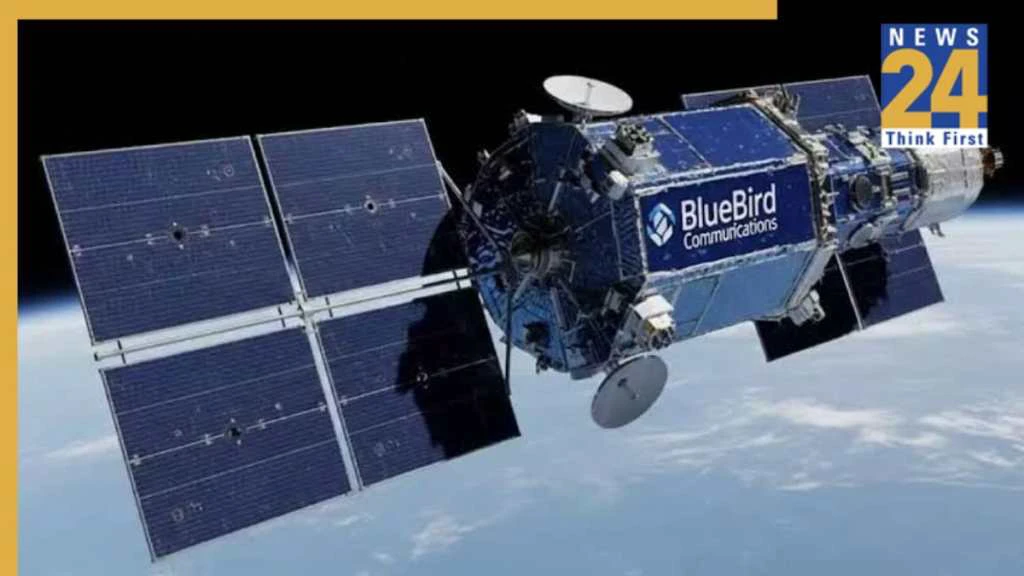
ISRO will launch a big American communication satellite called BlueBird-6 on 15 December from Sriharikota. This satellite is very heavy, making it one of the largest commercial satellites ever lifted by India.
The mission shows growing space partnership between India and the United States, with both countries working closer in space technology.
What does ISRO aim to achieve with the BlueBird-6 satellite launch?
The mission will use ISRO’s powerful LVM3 launch vehicle or rocket. This rocket will carry BlueBird-6 and place it in low-Earth orbit, which means close to Earth for faster communication.
Low Earth orbit means satellites fly close to Earth, about 160 to 2,000 kilometres above sea level, allowing faster signals, quicker data transfer, and easier control from the ground stations. The satellite weighs about 6.5 tonnes, which is as heavy as one fully grown elephant. It belongs to AST SpaceMobile, a US-based company from Texas.
The company builds mobile phone internet systems in space, meaning satellites that connect directly to normal mobile phones without using ground towers, even in remote areas. It has said that BlueBird-6 is officially licensed by the United States.
The company has confirmed the launch date as 15 December. This will be the first satellite of their new, next-generation series.
What makes BlueBird-6 special is its very large antenna, the biggest ever used in low-Earth orbit.
It covers 2,400 square feet, almost the size of a small house.
After reaching space, the antenna opens like a giant umbrella, allowing strong signal sending and receiving.
The earlier BlueBird-1 to BlueBird-5 satellites were much smaller. BlueBird-6 is a new Block-2 version, making it 3.5 times bigger and able to handle ten times more data than the older satellites.
At first, the service will be not available all the time. This means mobile signals from space appear only when a satellite passes overhead. As more satellites are launched, the service becomes more regular.
The company plans to launch five satellites by early 2026 and 45-60 satellites by the end of 2026, with launches every one or two months. Once enough satellites are in space, areas with weak mobile networks will get reliable signals.
What does this mission mean for worldwide internet coverage?
The network aims to reduce the global digital divide, meaning the gap between people who have internet access and those who do not. It plans to provide direct mobile internet from satellites straight to normal phones, without extra devices.
The system is designed for areas with weak or no ground-based mobile networks. It helps places where mobile towers and internet cables are missing or poor.
BlueBird-6 has about 10,000 MHz of bandwidth, which means it can carry a very large amount of data at the same time. This allows many phone calls, videos, and internet connections to work smoothly without slowing down.
It will work with existing mobile network companies like Airtel or vodafone or jio and helps improve signals in areas with poor coverage.
What lies ahead for ISRO and its LVM3 launch missions?
The launch is handled by NewSpace India Limited (NSIL). NSIL is the company that manages ISRO’s commercial launches for customers around the world.
LVM3 (Launch Vehicle Mark-3) is widely known as “Bahubali” due to its great strength and heavy-lifting ability. It is designed to launch very large satellites and has successfully carried missions such as Chandrayaan-2 and Chandrayaan-3 into space.
The LVM3 rocket weighs 640 tonnes at lift-off and stands 45.5 metres tall. It is a three-stage launch vehicle that uses solid, liquid, and cryogenic engines for powerful and stable flight. LVM3 can carry up to 8 tonnes to Low Earth Orbit or 4 tonnes to Geosynchronous Orbit (GEO). GEO is about 36,000 kilometres above sea level, where satellites remain fixed over one area of Earth.
LVM-3, the human-rated version, will be used for the Gaganyaan mission, meaning it is certified to safely carry Indian astronauts into space.
The BlueBird-6 satellite reached India from the United States on 19 October. It was then moved by road to Sriharikota, where it was attached to the LVM3 rocket, fuelled, and given final safety checks before launch.