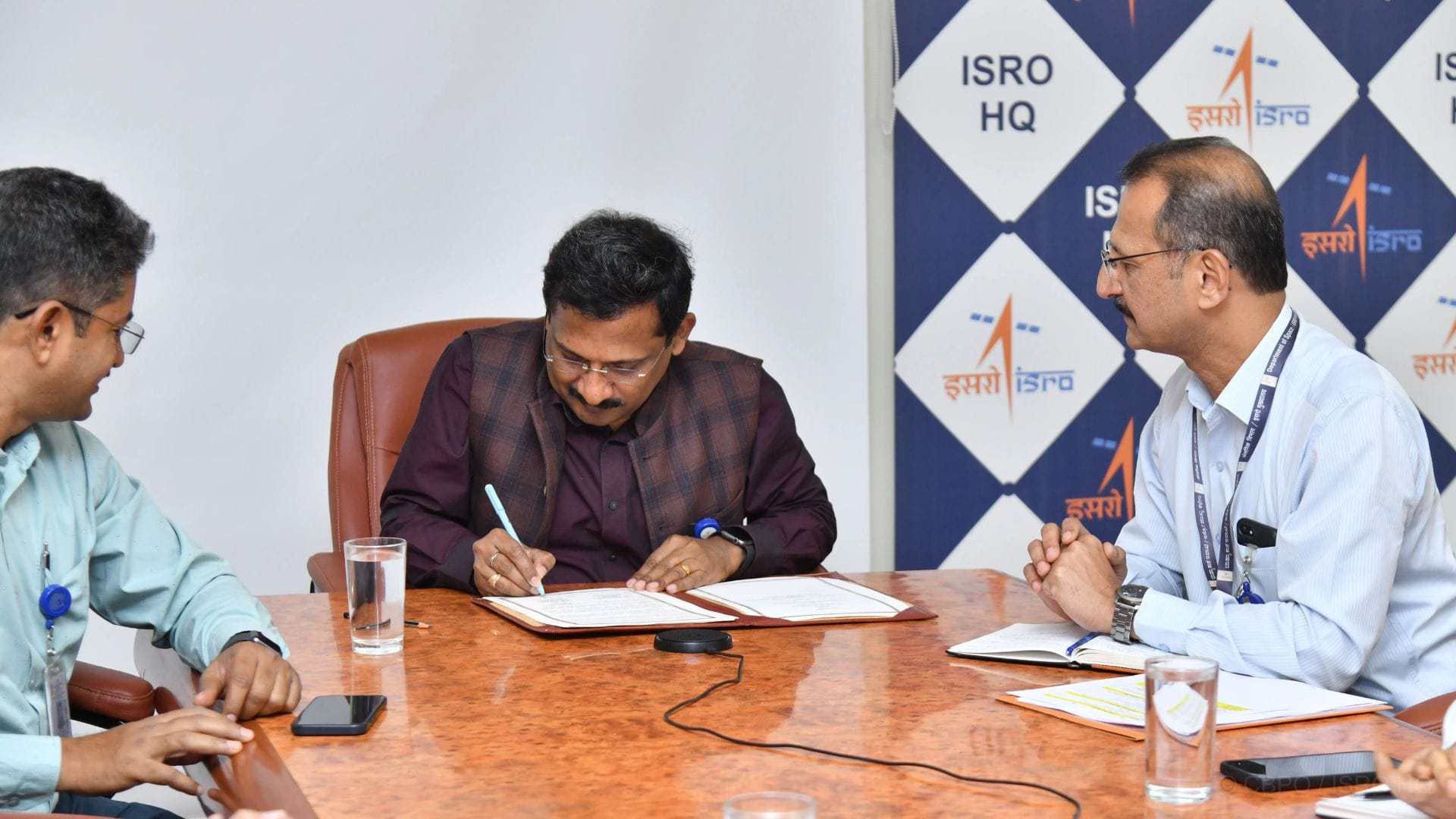
New Delhi: On 4 March, ESA and ISRO have signed an agreement towards joint calibration, validation activities as well as scientific studies for Earth Observation Missions. The agreement was signed after a virtual meeting. The agreement covers legacy missions that are already operational, as well as future opportunities. The agreement is timely considering the upcoming launches of the innovative Fluorescence Explorer (FLEX) mission slotted for launch later in the year, that will monitor the health of plants around the world.
The FLEX mission will be used to better understand the carbon cycle, how carbon moves from plants into the atmosphere, and the impact of photosynthesis on the carbon and water cycles, through the innovative Fluorescence Imaging Spectrometer (FLORIS) payload. This mission has a requirement for calibration and validation campaigns for subsequent valorisation, or gaining actionable insights. ESA and ISRO are both committed towards monitoring the health of the planet. The mission will be launched from ESA’s spaceport in Kourou, French Guiana on board a Vega C rocket. During the meeting, accomplishments in the field of Earth Observation, navigation, ground station support as well as human spaceflight were highlighted, showcasing the wide range of space activities that ISRO and ESA cooperate on.
ESA and ISRO collaboration
ESA and ISRO have a close partnership going back decades. ESA supported ISRO’s Aditya L1 and Chandrayaan 3 mission with its ground stations, which will also be used in support of the ambitious Gaganyaan Programme to lift humans into Earth orbit using Indian hardware and return them back to the surface safely. In the future, European astronauts may fly to the Bharatiya Antariksh Station, that ISRO plans to start assembling in 2028. ESA and ISRO scientists work closely together in the field of heliophysics, with coordinated observations by the Aditya-L1 and Proba-3 missions. ESA and ISRO also collaborated on growing crops in space during the Axiom 4 mission.