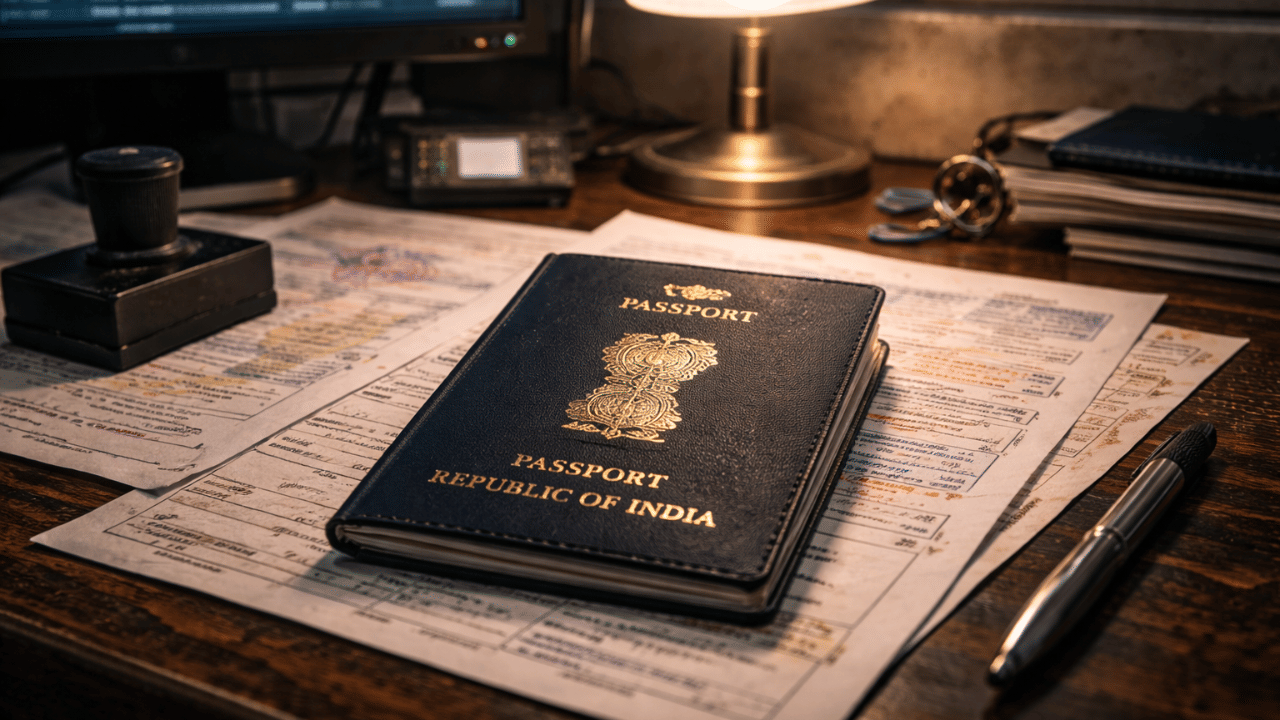
New Delhi: While reporting on the ongoing war in the Middle East, I had an experience that is not easy to fully describe in words. I was travelling from Muscat, the capital of Oman, to Dubai—without a camera, without a TV9 microphone, carrying only my mobile phone.
For Indian citizens holding a valid U.S. visa, the UAE provides visa-on-arrival facilities. So the journey appeared completely routine.
Around 11 PM on March 4, I reached the Hatta immigration checkpoint at the Oman–UAE border. The immigration officer checked all my documents. Everything was in order. The visa-on-arrival process was completed and after paying the 236 dirham fee, my passport was stamped for entry.
But then the officer noticed something on my passport — three Israeli visas.
And in that very moment, the atmosphere changed completely — as if an alarm had suddenly gone off.
Endless Questions from Intelligence Officers
After that, my passport was handed over to security officials. One after another, intelligence officers arrived, and the questioning continued throughout the entire night. Almost every question revolved around the same point:
“Why did you go to Israel?”
I explained that my most recent visit was to cover the visit of the Prime Minister of India. As a journalist, I have travelled to several countries as part of my professional assignments. But the questioning did not stop.
The interrogation continued relentlessly — almost like air defence systems deployed over Dubai attempting to intercept Iranian drones or missiles, constantly and without pause.
The officers repeatedly said that this is a time of war, and because I was a foreign journalist they had to exercise extra caution.
That Night I Remembered the Iranian Visa
During the interrogation, I was reminded of the Iranian Embassy in New Delhi. Some time ago, they had organized a visit to Iran for Indian journalists, but I was not included in that group.
At that time, I felt a little disappointed. But that night I felt that perhaps it was for the better.
At a time when Iranian drones and missiles were flying in the skies over Dubai and Abu Dhabi, I realized that if my passport had also carried an Iranian visa, the questions could have been even more intense.
Memories of the Russia–Ukraine War
For me, this experience was not entirely new.
During the Russia–Ukraine war, I had faced similar interrogations at border checkpoints that lasted for hours.
But that night one question kept returning to my mind:
If India, Israel and the UAE appear to stand on the same strategic side in many matters today, then why so much suspicion?
The reality is that these days having an Israeli visa in a passport often triggers additional scrutiny in several countries.
Last February, when I travelled to Washington during Prime Minister Narendra Modi’s visit to the United States, I assumed American officials would question me about my travels to Russia.
But surprisingly, they barely mentioned Russia.
Their first—and almost only—question was:
“Why did you go to Israel?”
Why Do Security Agencies Fear Journalists in the Mobile Age?
During the long night of questioning, one thought kept circling in my mind: Why are security agencies so wary of journalists?
In the age of smartphones, almost everyone has become a source of information.
Videos and images from conflict zones can spread across the world within minutes.
Take the recent incident in Kuwait where a U.S. fighter jet crashed. The images and videos that circulated globally were not shot by television reporters but by local people present at the scene. Those visuals later appeared on television screens and mobile devices around the world.
The truth is that the old system of controlling the flow of information has fundamentally changed.
Platforms like TikTok, X, Instagram and Telegram have made traditional ideas of narrative control almost irrelevant.
Finally Released After 26 Hours
Even after the overnight interrogation, the ordeal did not end immediately.
My mobile phone remained with security officials for more than 15 hours, and I was asked to unlock it so that it could be examined.
For nearly 20 hours I was not given any food, and for 10–12 hours I did not even receive water.
Finally, after more than 26 hours, I was allowed to proceed.
One thing became very clear during those hours:
For countries like the UAE, Israel today is both a friend… and not entirely one.