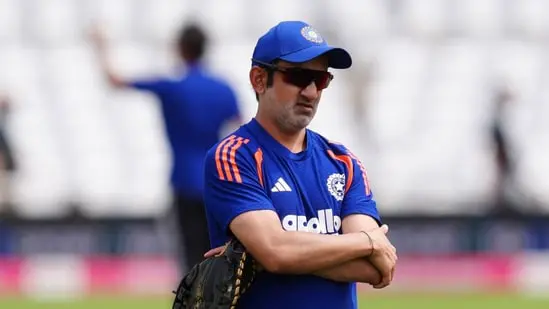
For Gautam Gambhir, the all-format cricketer is becoming an increasingly difficult idea to sustain. Speaking to JioStar, the India head coach said that while coaches and selectors would naturally prefer as many players as possible to feature across Tests, ODIs and T20Is, “you will have very few three-format players in the coming times” because rotation and format-specific preparation will increasingly compel teams to divide their resources.
It is an assertion that feels plausible in an age of relentless scheduling, but intuition alone tells us little. To examine it, we created a Three-Format Dependecy Index (TDI), designed not merely to identify cricketers who have appeared in all three formats, but to measue how extremely a team actually depends on them across all three.
The calculation is deliberately unforgiving. For every player, we measured the percentage of his country’s matches he played in Tets, ODIs and T20Is during a given year, before taking the lowest of those three percentages as his TDI. A player who features in 90 percent of Tests, 80 percent of ODIs but only 15 percent of T20Is therefore records a TDI of 15, because his least-used format reveals how genuinely “all-format” his role really is.
The all-fromat star was already rarer than memory suggests
India in 2018 provides a revealing baseline. Virat Kohli played 13 Tests, 14 ODIs and 10 T20Is that year; India had an unusually substantial programme across all three formats, including 20 ODIs. Kohli consequently remained a near-permanent Test presence, played 70 per cent of India’s ODIs and appeared in more than half of their T20Is, producing a TDI of 52.6.
That figure establishes what a genuine three-format cornerstone looks like. Kohli was not merely accumulating appearances across formats, he was indespensable in two and remained a substantial presence in the third. Yet even in a period remembered for ubiquity of all-format stars, that degree of universality was unusual rather than routine, with several apparent three-format players falling below 50-point threshold once their least-used format was brought into calculation.
The 2022 season sharpened the picture. India played seven Tests, 24 ODIs, and an extraordinary 40 T20Is, and Rishabh Pant emerged as the clearest all-format cricketer: seven Tests, 12 ODIs and 25 T20Is gave him TDI of exactly 50. Virat Kohli followed at 45.8 after playing six Tests, 11 ODIs and 20 T20Is, while Shreyas Iyer’s five Tests, 17 ODIs and 17 T20Is produced 42.5; Axar Patel, despite appearing in all three formats, fell to 33.3.
This is where Gambhir’s observation becomes more sophisticated than a simple narrative of extinction. Three-format players did not suddenly disappear after 2018, nor do the numbers reveal an uninterrupted downward slope. What has altered is the extent to which teams can ask one cricketer to remain permanently embedded in all three XIs, particularly as the T20I calendar has expanded and workload management has evolved from an occasional concession into a fundamental principle of selection.
2026 shows where India are heading
Through September 23, the architecture of India’s 2026 teams makes that evolution considerably easier to see. Shubman Gill has played Test and ODIs this year but no T20I; Jasprit Bumrah has appeared in ODIs and T20Is but not Tests; Axar Patel and Washington Sundar have similarly occupied the two white-ball formats without playing a Test. Kuldeep Yadav has technically crossed all three, but one Test, three ODIs and four T20Is hardly resemble the old model of uninterrupted all-format dependence.
India’s squads for the forthcoming West Indies series make the partition even more conspicuous. Gill, Rohit Sharma and Virat Kohli inhabit the ODI structure, while Shreyas Iyer, Abhishek Sharma, Vaibhav Sooryavanshi, Ishan Kishan and Sanju Samson populate the T20I batting group, only a limited collection of players, including Kuldeep Yadav and Nitish Kumar Reddy, bridge the two squads. India are no longer merely resting players between formats, they are increasingly constructing distinct ecosystems around them.
That distinction is essential to understanding what is actually disappearing. The three-format cricketer, defined loosely as somebody who collects an appearance in each form of international cricket, is not extinct and may never become so. The endangered figure is the three-format core playe: the cricketer whose country expects him to remain simultaneously central to is Test side, ODI side and T20I side.
Watch the three-match ODI Series of the West Indies tour of India, from September 27 to October 3, 2 PM onwards, LIVE on JioHotstar and Star Sports Network.