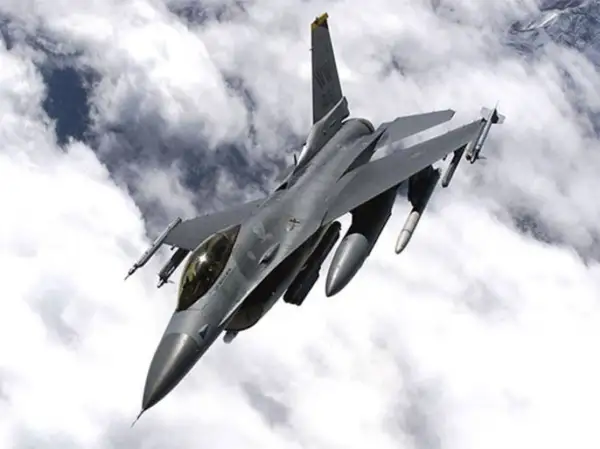
Tehran, November 27: Iran’s Islamic Revolutionary Guard Corps announced that its Aerospace Force fired warning shots to force a US F-16 fighter jet away from Iranian airspace southeast of Hengam Island in the Strait of Hormuz.
In a statement carried by Islamic Republic of Iran Broadcasting, the IRGC Aerospace Force’s public relations department stated that the American jet approached Iranian airspace while escorting and providing air cover for violating vessels in the waterway.
According to the IRGC, the aircraft encountered warning fire from the new and advanced air defence system of the IRGC Aerospace Force, prompting the pilot to perform a severe manoeuvre before changing course and retreating from the area.
Issuing a stern warning against attempts to bypass Iranian maritime traffic regulations in the Strait of Hormuz, the IRGC stated that any continuation of such actions is unacceptable and could result in heavier losses for the violators and the military forces supporting them.
The statement also warned US military commanders against repeated airspace violations near the strategic waterway, IRIB reported. The airspace of the Islamic Republic of Iran is the red line of the country’s armed forces, and if American fighter jets repeatedly violate this airspace, they will face a decisive defensive response; a response that could result in a fate similar to that of the targeted F-15 fighter jet and American drones, the IRGC statement read.
This comes as Iran has vowed to break the US naval blockade through the capabilities of its armed forces, with Iranian MP Esmaeil Kowsari claiming that Tehran exercises full control over the strategically important Strait of Hormuz and warning against any foreign military intervention targeting the country.
Speaking on Iran’s state broadcaster, a member of the National Security and Foreign Policy Commission of the Iranian Parliament, Kowsari said the country’s military had been preparing to secure control over the strategic waterway since 1987.
He maintained that Iran would not allow its adversaries to gain access or establish influence over the Strait of Hormuz, adding that the country’s missile and drone capabilities had altered the military calculations of the United States in the region.
The US naval blockade will be broken by the strategies and capabilities of Iran’s armed forces, and the timing and method of responding to enemy actions are at the discretion of the armed forces of the Islamic Republic of Iran, Kowsari said.
Attributing the withdrawal of American warships from the region to Iran’s military capabilities, he said the country’s strategic strength extended beyond its energy resources and included its ability to influence developments in the Strait of Hormuz.
Kowsari also cautioned neighbouring countries against allowing their territory or military infrastructure to be used for operations targeting Iran, warning that such cooperation would carry consequences.
Clarifying Tehran’s military position, Kowsari said Iran did not seek to initiate a war or prolong the ongoing conflict but remained prepared to respond decisively to any aggression. He added that removing foreign military forces from the region and holding those responsible for attacks accountable remained among Iran’s objectives.
Earlier on Wednesday, the Iranian Army claimed that its air defence systems shot down two US unmanned aerial vehicles, including an MQ-9 and a Lucas suicide drone, over the Strait of Hormuz.
According to Iranian state broadcaster, the Army said a US Lucas suicide drone was intercepted and destroyed over the western Strait of Hormuz, while an MQ-9 drone was also hit and destroyed in the skies over the eastern part of the strategic waterway.
The claims come amid heightened tensions between Iran and the United States, with Tehran increasingly challenging Washington’s military presence and economic restrictions targeting the country.