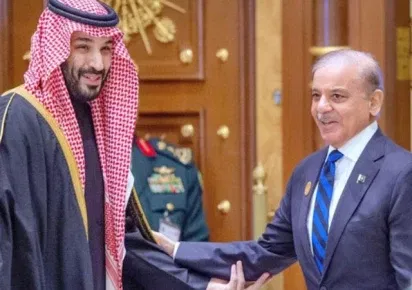
New Delhi: As the Israel-Iran war widens, tensions in West Asia are shifting from shadow exchanges to open confrontation. Saudi Arabia, being hit by Iranian missile fire, has quietly placed Pakistan under an uncomfortable spotlight. Does Islamabad’s much-publicised 2025 defence pact with Riyadh actually carry gravitas when the moment of testing and truth arrives? With the war spreading across the Middle East, the Saudi-Pakistan Strategic Mutual Defence Agreement is being read less as ceremonial text and more as a measure of Pakistan’s political resolve.
A conflict that has crossed thresholds
The region is passing through one of its most combustible phases in recent memory. The United States and Israel launched coordinated strikes on Iranian military and strategic sites, presenting them as pre-emptive. Tehran responded with missile attacks across the Gulf, with Saudi territory among the reported targets.
Air defences were activated across multiple Gulf states. Commercial airspace faced disruption. Major powers quickly lined up their positions. Russia criticised the strikes. European capitals called for restraint.
What had long simmered through proxies has now edged into direct state confrontation. That shift has inevitably revived attention on Riyadh’s security partnerships, particularly the relatively recent understanding with Islamabad.
What is the Saudi-Pakistan pact all about?
In 2025, Saudi Arabia and Pakistan signed a Strategic Mutual Defence Agreement stating that aggression against one would be treated as aggression against both. On paper, the phrasing carries familiar collective security weight.
Yet the publicly available framework remains notably flexible. There is no clearly defined automatic deployment clause. No fixed response timeline is spelt out. Nor is there any publicly known pre-committed combat structure.
Such ambiguity is not unusual in defence diplomacy. But it does allow considerable room for interpretation when crises unfold.
Riyadh walks its own tightrope
For its part, Saudi Arabia has so far tried to avoid being pulled directly into open conflict even as it maintains close security coordination with Washington. Public statements from Riyadh have stressed that Saudi territory should not be used as a staging ground against Iran, a position shaped by fears of becoming a primary retaliation target. At the same time, defence cooperation with the United States has continued to deepen through major arms and security arrangements.
However, now, after the attack on the Aramco refinery, Crown Prince Mohammed bin Salman has reportedly authorised the Royal Saudi Armed Forces to strike back against Iran if the attacks persist.
In some respects, the Saudi’s earlier approach mirrors Pakistan’s own preference for carefully layered positioning. Despite Riyadh and Tehran’s long-term rivalry over dominance in the region, and now with the Iranian missile strikes hitting the refinery, Riyadh has still exercised extreme restraint.
Political analysts view the Saudi-Pakistan agreement less as an automatic war clause and more as a political signal of strategic closeness. Such pacts often preserve room for calibrated responses rather than locking partners into immediate military escalation.
Can Pakistan evade the conflict?
Technically, Pakistan does not have to step in. In strictly legal terms, there is no automatic trigger as per the pact. Even if Riyadh were to formally invoke the agreement, Islamabad would still move through its own constitutional and strategic review before taking any concrete step. Defence pacts of this nature typically leave manoeuvring room for discretion and putting national interest first.
In this case, if Pakistan were to internally debate the Saudi pact, such a review in its internal spectrum would weigh several variables. These would include confirming the scale and nature of the Iranian strike, judging the danger of wider regional escalation, assessing domestic political mood, factoring in Pakistan’s working ties with Tehran and evaluating its own military capacity.
Islamabad will proceed carefully, and its caution rests on several hard constraints.
First is geography, with the territory adding a thick layer of caution. Pakistan is not a distant partner watching events from afar. It shares a long, sensitive and occasionally tense border with Iran. Any move that appears openly aligned against Tehran carries immediate regional risks. The shared border with Iran means any overt confrontation could quickly destabilise Pakistan’s western flank, where the security environment is already fragile.
Second is domestic sensitivity. Pro-Iran protests have surfaced in major Pakistani cities after the US-Israel strikes. Any direct military move against Tehran risks aggravating internal sectarian fault lines.
Third is capacity. Pakistan’s security establishment is already stretched managing tensions along its north-western frontier. Opening another front would place additional strain on resources.
What “supporting Saudi” could realistically look like for Pakistan
Even if Islamabad opts to demonstrate solidarity with Riyadh, past behaviour suggests the response could remain measured rather than kinetic. Pakistan has historically preferred low-visibility assistance to Gulf partners. Training teams, advisory roles and security cooperation have been its standard toolkit, carefully short of entering active combat.
In the present context, that could translate into intelligence exchanges, coordination on air defence, limited naval cooperation or assistance in protecting key Saudi installations.
Sending combat troops would mark a clear break from this cautious playbook. Such a decision would almost certainly demand broad domestic consultation and political buy-in.
A quiet test of credibility and litmus test of loyalty
So far, Pakistan’s public posture reflects a familiar hedging instinct.
It criticised the initial US and Israeli strikes on Iran as unwarranted. When Tehran responded with attacks across the Gulf, Islamabad again issued condemnation, this time calling Iran’s actions violations of sovereignty. The carefully balanced tone has been noted by regional observers.
Prime Minister Shehbaz Sharif’s conversation with Saudi Crown Prince Mohammed bin Salman reaffirmed solidarity and referenced the defence understanding. Yet the language remained deliberately measured. Pakistan also drew attention to the death of one of its nationals in the UAE, a humanitarian emphasis that subtly shifted focus away from military signalling.
The pattern is clear. Islamabad is expressing political support while keeping operational options open.
Islamabad’s quandary if Riyadh invokes the pact
None of the abovementioned factors renders the pact meaningless. If Saudi Arabia formally invokes the agreement as the conflict intensifies, global expectations from Pakistan will rise. Questions about Islamabad’s reliability, right now in hushed whispers, will grow louder.
For now, Pakistan appears to be following a familiar script. It is a finely calibrated posture, one Islamabad has historically preferred — expressing solidarity with Riyadh while simultaneously backing calls for de-escalation at the United Nations alongside China and Russia. But as the Israel-Iran confrontation widens, the space for careful ambiguity may narrow.
The Saudi-Pakistan pact was designed to signal strategic closeness. Whether it evolves into something more substantive will depend not on the wording of the agreement but on the choices that Islamabad makes, if the pressure truly mounts. At that point, the pact will serve as a litmus test of Pakistan-Saudi relations.