The Iran-America war has exposed the world more than it has changed it. This entire conflict made it clear that today’s global system no longer operates in the traditional ‘superpower versus superpower’ framework.
Explaining this changing scenario, Israeli strategic analyst Shay Gal has said an important thing. He said that in today’s world, the real power lies with that country which can talk to every side. And on this criterion, India seems to be standing at the forefront.
Gall’s analysis, written in the Eurasian Times, underlines that the war with Iran not only demonstrated military power, but also showed to what extent each country is connected to the global network. While America and its allies showed their respective strategic limitations, India emerged as a country which did not break any relationship, but maintained communication with everyone.
Often an attempt is made to understand India’s foreign policy from a western perspective, but this proves to be the biggest mistake. It is not a contradiction for New Delhi to buy oil from Russia on one hand and maintain security cooperation with America on the other. It is also normal for India to maintain a strategic partnership with Israel and also maintain its presence in Iran’s Chabahar Port Project.
India is making connections, not balance
In fact, India is not creating a ‘balance’ but is creating a ‘framework’. Gall writes, ‘The balance can be broken at any time, but the structure remains intact for a long time. This is the reason why India did not limit itself to any one camp, but created such a network in which every country is connected to it in some way or the other.
The glimpse of this entire strategy is clearly visible in Chabahar Port. It is not just a port, but an alternative route for India, which connects it to Central Asia and Afghanistan. This project ensures that India’s reach does not depend on any one country or block. This is the reason that despite American pressure, India did not abandon this project completely, but continued it in different forms.

At the same time, India’s relations with Gulf countries are also part of this ‘Connecting Power’ strategy. For Saudi Arabia and the United Arab Emirates, India is not just a trading partner, but also an ‘insurance’… a country which is a major consumer of energy, a center of investment, and also a source of labor force. This mutual dependence makes India essential for these countries.
India’s relationship with Iran should also be seen from this perspective. This is not an ideological or political proximity, but a geographical and strategic need. By maintaining relations with Iran, India ensures that its regional reach is not limited.
Similarly, India’s relations with America have become stronger than ever, but this relationship is not like a traditional ‘ally’. India does not want to make itself a part of any one camp at any cost. America also understands this reality, because amidst the increasing influence of China, India is the only country that can maintain a balance without being subordinated to anyone.
connector power of india
Another important thing emerges in this whole picture… India is still not a ‘superpower’ in the traditional sense. It is still dependent on external sources for energy, is moving towards self-reliance in defense equipment and its borders with China remain sensitive. But despite this, India fits into a new category… ‘Connector Power’.

Special features of India’s ‘Connecting Power’…
- Ability to maintain relations with opposing countries simultaneously
- independent foreign policy without joining any one group
- Power to negotiate and maintain dialogue with all parties
- Multidimensional diplomacy through politics as well as trade, energy, security and technology
- Important role in global supply chain and energy security
- Playing the role of ‘balancer’ and ‘bridge’ in times of crisis
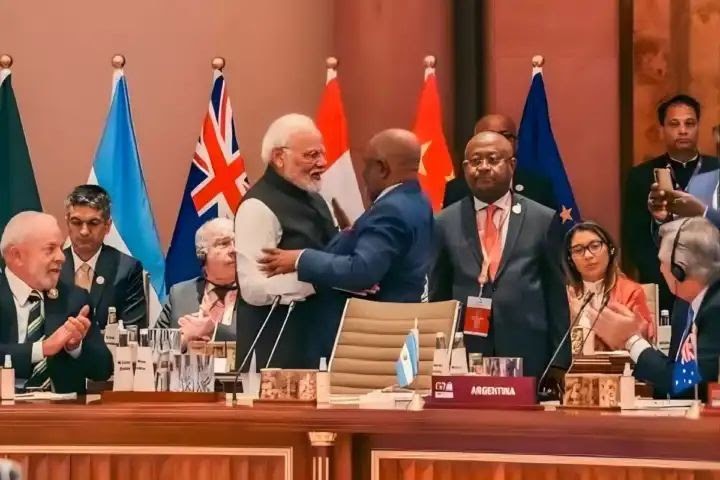
Connector power means a country which itself does not give orders, but without which no system can function. India seems to be reaching the same situation today. He neither imposes his conditions on anyone nor comes under anyone’s influence completely, but every party wants to be associated with him.
The Iran-America conflict has made this reality more clear.