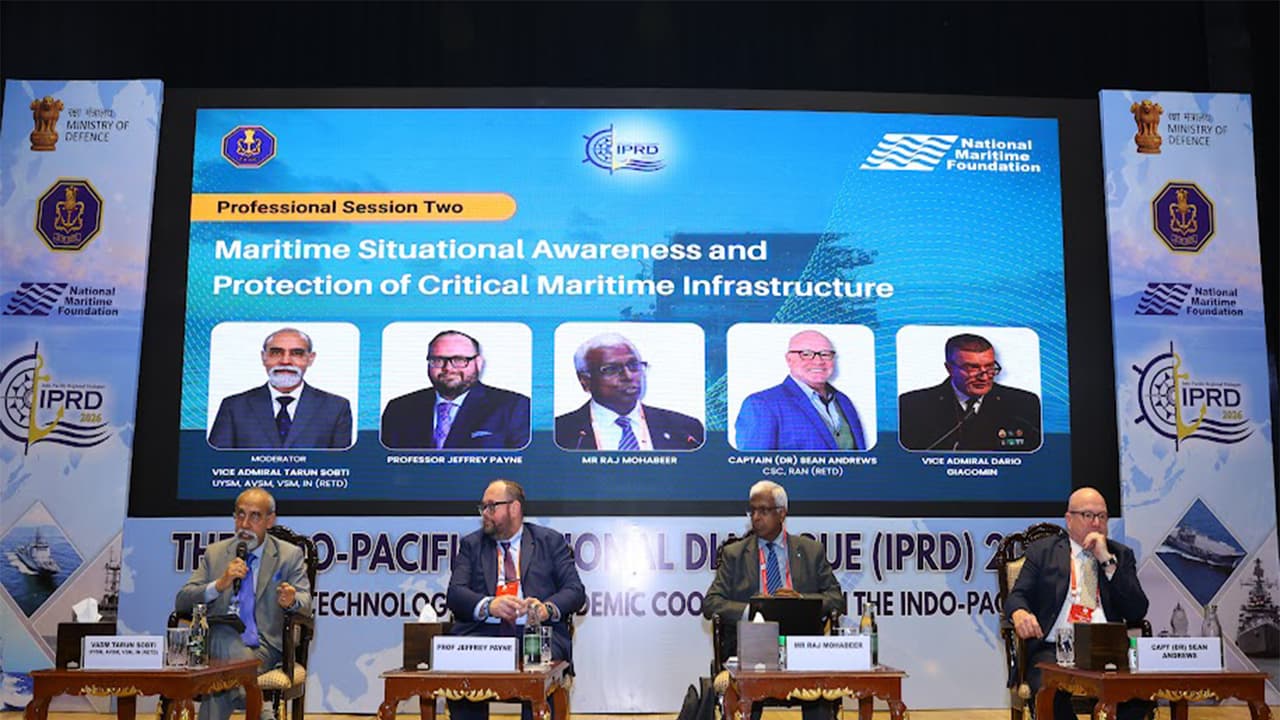
The Indian Navy’s IPRD 2026 kicked off in New Delhi, focusing on strengthening scientific and academic partnerships to enhance maritime security and regional resilience throughout the Indo-Pacific sector among diverse global stakeholders.
IPRD 2026 Begins in New Delhi
New Delhi [India], November 3 (ANI): The Indian Navy’s annual international strategic dialogue, the Indo-Pacific Regional Dialogue 2026 (IPRD-2026), commenced in New Delhi on Tuesday, bringing together maritime experts and representatives from partner countries to discuss science, technology and academic cooperation in the Indo-Pacific region. Organised in association with the National Maritime Foundation (NMF), the Navy’s knowledge partner, the three-day conference is being held on the theme, ‘Science, Technology and Academic Cooperation in the Indo-Pacific’.
The opening day focused on translating scientific advancements and institutional partnerships into practical regional cooperation, with discussions examining how the Indo-Pacific could strengthen maritime capabilities, institutional collaboration and shared regional resilience. The proceedings began with the inaugural address by Admiral Dinesh K Tripathi (Retd), Chairman of the NMF and former Chief of the Naval Staff. This was followed by a special address by Vice Admiral Biswajit Dasgupta (Retd), National Maritime Security Coordinator.
Academic Networks and Research
The first professional session focused on ‘Academic Networks, Research, and Human Capital Development’. Moderated by Vice Admiral Sanjay Mahindru (Retd), former Deputy Chief of the Naval Staff, the session featured perspectives from France, Indonesia, Japan and the Maldives. Discussions explored the possibility of establishing a wider Indian Ocean academic network, including cooperation among universities in Indo-Pacific coastal cities, as well as strengthening social-science research networks in the Indian Ocean region. The session also examined closer collaboration among think tanks, universities and governments. A monograph titled ‘Sea Blindness and Maritime Heritage in India’ was released at the conclusion of the session.
Maritime Infrastructure and Security
The second professional session, titled ‘Maritime Situational Awareness and Protection of Critical Maritime Infrastructure’, examined contemporary challenges associated with maritime awareness, protection of seaborne trade and safeguarding critical undersea infrastructure. Moderated by Vice Admiral Tarun Sobti (Retd), former Deputy Chief of the Naval Staff, the session discussed opportunities and challenges associated with the Indo-Pacific Partnership for Maritime Domain Awareness (IPMDA), particularly information-sharing requirements and the development of a cooperative regional architecture for underwater domain awareness. The session also featured perspectives from the Indian Ocean Commission (IOC) on cooperative approaches to protecting critical maritime infrastructure.
Together, the two sessions examined ways to strengthen maritime information-sharing, safeguard critical infrastructure, improve access to oceanographic knowledge and facilitate coordinated responses to climate-related risks through scientific and technological partnerships. The day’s programme also featured ‘Sahyog Ka Samvaad’, a special ambassadorial interaction with Sri Lankan High Commissioner Mahishini Colonne, Philippines Ambassador Josel F Ignacio and Norwegian Ambassador May-Elin Stener. The interaction was hosted and moderated by Vice Admiral Pradeep Chauhan (Retd), Director-General of the National Maritime Foundation. The first day concluded with enthusiastic participation from the audience, which presented several actionable policy recommendations on regional cooperation in science and technology and knowledge-sharing through academic collaboration. (ANI)
(Except for the headline, this story has not been edited by Asianetnews Editorial staff and is published from a syndicated feed.)