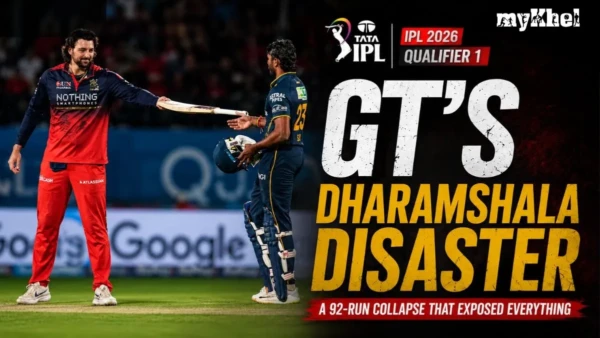
Royal Challengers Bengaluru are now headed to their fifth IPL final after dismantling Gujarat Titans by 92 runs on Tuesday (May 26) in Qualifier 1 at Dharamsala – the second-biggest win by runs in IPL playoff history.
The emphatic triumph further strengthened RCB’s standing among the IPL’s elite playoff teams. Only Chennai Super Kings and Mumbai Indians have now featured in more IPL finals than RCB, who booked their fifth appearance with one of the most dominant knockout performances the tournament has witnessed.
The margin of defeat also underlined the sheer scale of Gujarat Titans’ collapse. Only Rajasthan Royals’ 105-run demolition of Delhi Capitals in the inaugural IPL playoffs in 2008 stands above this defeat in terms of playoff winning margins. That statistic alone captures how badly things unravelled for Gujarat on a night where almost every tactical weakness surfaced simultaneously.
What made the defeat especially alarming was that the conditions were hardly unfamiliar or unmanageable. The Himachal Pradesh Cricket Association Stadium pitch was exactly what it advertised itself to be – flat, hard and ideal for strokeplay. RCB adapted instantly and embraced the conditions with complete clarity. Gujarat Titans, however, appeared tactically hesitant from the outset.
This was not merely a case of one team outperforming another. It was a playoff collapse built on under-preparation, poor execution and a dangerous over-reliance on a fragile batting structure.
Gujarat Titans Looked Underprepared From the Start
The warning signs emerged almost immediately during RCB’s innings.
On a batting-friendly surface where proactive bowling was essential, Gujarat’s plans lacked conviction. Their lengths were inconsistent, yorkers repeatedly missed execution and the field placements often appeared reactive rather than attacking.
RCB quickly sensed the uncertainty.
Once Virat Kohli and Phil Salt established rhythm inside the powerplay, Gujarat’s bowling attack looked increasingly devoid of answers. The Titans persisted with predictable pace-off deliveries without setting appropriate boundary riders, while the hard lengths that could have challenged batters on the Dharamsala surface disappeared for extended phases.
More concerning was the overall energy level in the field.
Playoff cricket is often defined by intensity and sharpness, but Gujarat appeared flat under pressure. The body language suggested a side struggling to regain control once momentum started slipping away.
Rajat Patidar’s Reprieve Changed the Entire Match
The defining moment arrived when was dropped on just 20.
On a surface where 200-plus totals were clearly attainable, offering an extra life to a batter of Patidar’s calibre was effectively fatal. The RCB captain punished Gujarat mercilessly thereafter, producing one of the finest playoff innings in recent IPL history.
His unbeaten 93 off just 33 deliveries completely altered the scale of the contest.
What made Patidar’s knock particularly devastating was the timing of his acceleration. Gujarat briefly appeared capable of restricting RCB around the 210-220 mark before Patidar exploded through the death overs. The missed chance psychologically deflated the Titans, and their bowling plans unravelled further with every boundary that followed.
By the end of the innings, RCB had stormed to 254/5 – a total that instantly transferred enormous scoreboard pressure onto Gujarat.
GT’s Chase Collapsed Before It Even Began
Chasing 255 in a playoff match demands calmness and tactical clarity. Gujarat Titans displayed neither.
Rather than building the chase methodically, the innings descended into panic almost immediately. Shubman Gill never looked comfortable against Bhuvneshwar Kumar’s movement before edging behind cheaply, while Sai Sudharsan’s bizarre hit-wicket dismissal perfectly captured Gujarat’s mental disarray.
The top order, which had carried the franchise throughout the season, suddenly looked overwhelmed by scoreboard pressure.
By the end of the powerplay, GT were already 51/5 and effectively out of the contest.
What stood out was not merely the wickets themselves, but the manner in which they fell. Several dismissals came from rushed decision-making and frantic strokeplay rather than calculated risk-taking. Gujarat looked like a side trying desperately to catch up with the game far too early instead of pacing the chase intelligently.
Qualifier 1 rapidly transformed from a high-stakes playoff battle into damage control.
Gujarat’s Biggest Structural Weakness Was Finally Exposed
For much of IPL 2026, Gujarat Titans’ exceptional top order had masked deeper structural concerns within the batting lineup.
Gill, Sudharsan and Jos Buttler formed arguably the tournament’s most productive top-three combination, regularly winning matches before the middle order even entered pressure situations. Because at least one member of the trio consistently delivered during the league phase, Gujarat’s batting fragility below them remained largely hidden.
Playoff cricket, however, exposes weaknesses ruthlessly.
Once all three premier batters failed inside the powerplay, GT’s middle order looked alarmingly underprepared to rebuild a demanding chase. Jos Buttler briefly threatened momentum with a chaotic 29 off 11 deliveries, but once he departed, the innings lost all attacking structure.
There was no stabilizing presence capable of absorbing pressure while simultaneously keeping the required run rate alive.
That imbalance became the defining tactical flaw of Gujarat’s campaign.
Rahul Tewatia Lone Fighter for GT
If Gujarat found any positive from the wreckage, it came through Rahul Tewatia.
His fighting 68 off 43 deliveries prevented a complete collapse and showed far greater composure than many specialist batters ahead of him. Tewatia adapted better to the conditions, rotated strike effectively and attacked selectively despite the impossible scoreboard scenario.
Yet, his lone resistance also reinforced the larger issue.
When Gujarat’s top order fails, the batting unit lacks enough flexibility and depth to sustain a high-pressure chase. Tewatia’s innings highlighted resilience, but it also exposed how isolated the middle order becomes once the marquee names collapse early.
RCB’s Fearlessness Exposed GT’s Tactical Hesitation
While Gujarat’s flaws were glaring, full credit must also go to RCB for producing a near-perfect playoff performance.
Their batting approach remained fearless from the outset despite the enormity of the occasion. Even after posting a huge total, RCB’s bowlers attacked aggressively rather than retreating defensively. Bhuvneshwar Kumar’s early spell set the tone for the chase, while the field placements reflected a side determined to dominate rather than merely protect runs.
That contrast in intent between the two teams became impossible to ignore.
RCB looked emotionally prepared for playoff pressure. Gujarat looked reactive once momentum shifted away from them.
Qualifier 2 Now Becomes a Psychological Challenge
The biggest challenge facing Gujarat Titans ahead of Qualifier 2 may no longer be tactical alone – it is psychological.
Heavy playoff defeats tend to linger because they expose weaknesses publicly and brutally. Gujarat must now recover confidence quickly while reassessing both their middle-order stability and fielding standards before returning to knockout cricket.
Because Dharamsala revealed a truth that opposition teams will now target aggressively:
When Gujarat Titans’ top order fails, the entire structure suddenly looks alarmingly vulnerable.