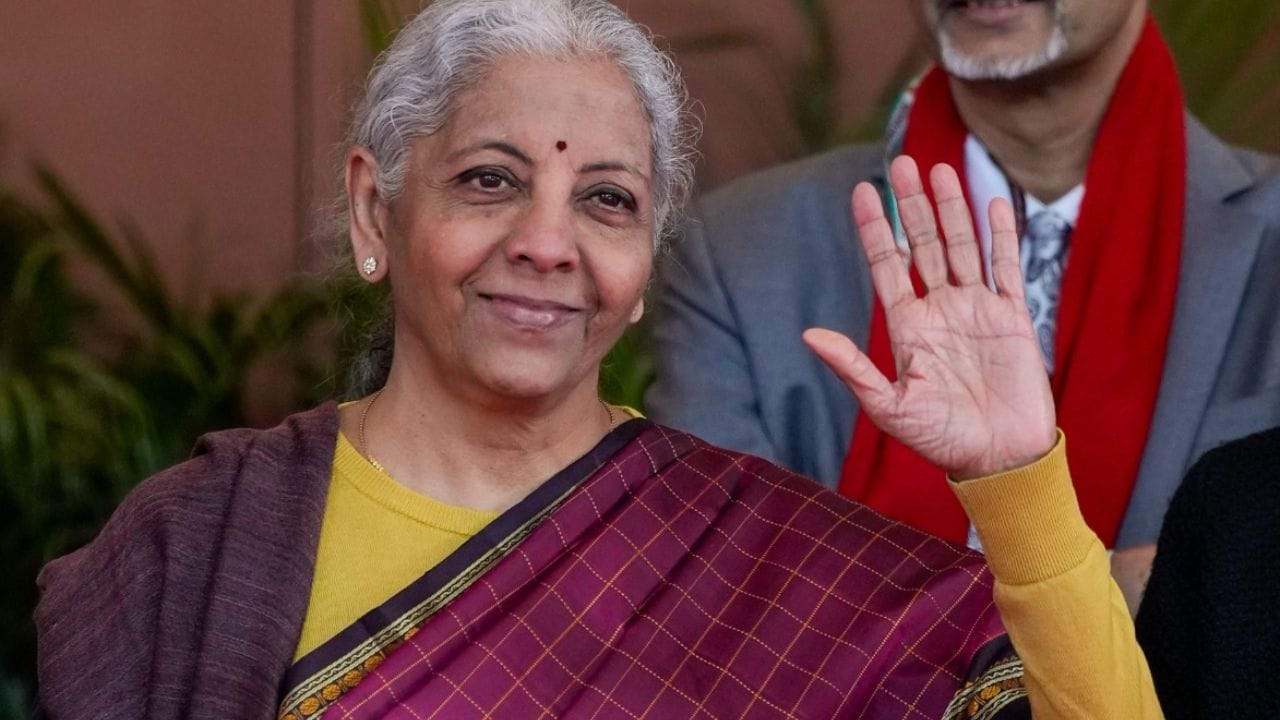
Finance Minister Nirmala Sitharaman
Finance Minister Nirmala Sitharaman said on Sunday that the purpose of increasing the Security Transaction Tax (STT) in Future and Options (F&O) is to curb high-risk speculation. He said that this decision was taken to discourage innocent investors who were losing huge amounts of money in the derivatives market. In the budget, it has been proposed to increase STT on future contracts from 0.02 percent to 0.05 percent. Apart from this, there is a proposal to increase STT on option deals to 0.15 percent. Till now STT was 0.1 percent on option premium and 0.125 percent on option trading.
Finance Minister gave the reason
At a press conference held after the budget, Sitharaman said that the government is not against F&O business, but she wants small investors facing huge losses to stay away from the speculative F&O market. Sitharaman said that this modest increase is completely targeting betting. We are not against it (F&O business), but if small investors are suffering losses, then how can we remain silent. Therefore, this increase in STT on F&O is to deter such investments.
What does SEBI’s study say?
According to SEBI study, more than 90 percent of retail investors suffer losses in the F&O segment. The market regulator has already taken minimal steps to reduce trading in this segment. Market experts believe this move could help discourage excessive speculative activities and promote a more balanced market structure. However, some have warned that this could impact the participation of foreign portfolio investors (FPIs) in the near term.
Small investors were facing losses
Earlier, Revenue Secretary Arvind Srivastava said that the purpose of increasing STT in the F&O segment is to discourage speculative tendencies and manage systemic risk. Srivastava said that small and retail investors were suffering losses due to speculation in F&O. He further said that the government intends to discourage betting tendencies, and that is why the rate has been increased. He said this is mainly to handle systemic risk in futures-options markets. Srivastava said that even after this increase, STT rates will remain nominal compared to the volume of transactions.
These important announcements were made in the budget
Sitharaman said the capital expenditure of Rs 12.22 lakh crore announced for 2026-27 is 4.4 percent of the gross domestic product (GDP) and is the highest ever. The capital expenditure for financial year 2026-27 is 10 percent more than the budgeted capital expenditure of Rs 11.11 lakh crore announced for financial year 2025-26. He said that we have announced that public expenditure of Rs 12.22 lakh crore will be made.
This time it is 4.4 percent of GDP. This is the highest in at least the last 10 years and if you look at the data for the previous period, it is probably the highest.
Capital expenditure was 2.5 percent of GDP in fiscal year 2021-22 and about 4.0 percent in 2024-25. The government’s capital expenditure in the financial year 2015-16 was Rs 2.35 lakh crore. Sitharaman said that the fiscal deficit target of 4.3 percent for the financial year 2026-27 is realistic.