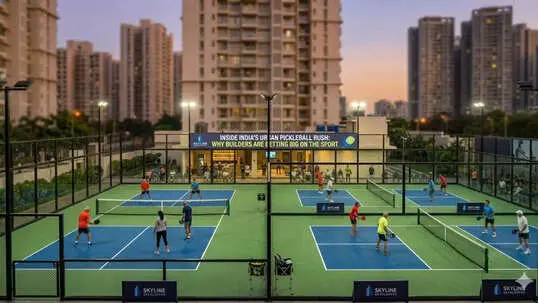
In India’s rapidly evolving urban landscape, the modern residential complex is no longer being sold merely through square footage, skyline views, or clubhouse luxury.
Increasingly, developers are promoting something far more intangible – community. And in that emerging playbook, pickleball, the buzzing sport of the time, has become one of the most strategic tools.
Among the corporates entities recognising that shift early is M3M India, a Gurugram-based real estate giant. It has embraced pickleball as its unique offering to residential complexes. But the company’s penchant for the racquet sport is not limited to business goals alone. It sees pickleball as the future sport to invest in.
Over the years, it has made bold moves that resonated strongly across New Delhi and the National Capital Region (NCR) in Gurgaon and Noida. From constructing courts within housing developments to owning the Indian Pickleball League (IPBL) franchise Capital Warriors Gurgaon and backing the lawyers-only LawStrings Pickleball League as title sponsor, M3M’s growing involvement with pickleball reveals how India Inc. is beginning to view the sport. Not merely as recreation, but as a scalable infrastructure investment for social engagement, wellness, and aspirational branding.
For Robin Mangla, the president of M3M, the appeal of pickleball lies in its extraordinary efficiency as an urban sport. “Pickleball is not just another amenity for us – it’s one of the most efficient and inclusive sports we’ve seen emerge in recent years. It combines low space requirements with high engagement, which makes it ideal for urban developments,” Mangla told Pickleball Now.
For M3M, realising the potential early was important. And they made a studied move to be a market leader in 2023. “What inspired us was the clear gap between rising interest in the sport and the lack of accessible, high-quality infrastructure. We saw an opportunity to step in early and help build that ecosystem in a meaningful way,” said Mangla.
While it is difficult to quantify the exact value of pickleball in real estate development, the sport has now moved to the top of builders’ priority lists.
Valuable and social
His observations capture a larger phenomenon unfolding across India’s metropolitan cities. In urban areas, where land remains scarce and lifestyles increasingly sedentary, pickleball offers developers something valuable: a compact, highly social, and visibly active sport capable of activating community spaces without the infrastructural burden of larger sporting facilities.
Unlike major sports amenities that often remain underused – with many people struggling to participate due to limited technical knowledge or agility-related challenges – pickleball has become their go-to sport because of its accessibility. Courts are smaller, entry barriers are lower, and the sport encourages participation across age groups.
Perhaps pickleball’s biggest advantage lies in its ability to make people move while allowing them to experience the unbridled joy of sport without placing excessive stress on the body. Unlike physically intimidating disciplines that demand high athletic agility from the outset, pickleball offers a slower, aerobic form of exercise that remains engaging and social.
At the top level, however, pickleball is still an intensely demanding sport where skill, reflexes, strategy, and precision determine success. Yet, such is the sport’s competitive unpredictability that achieving sustained consistency at the highest level remains extraordinarily difficult.
Focus on nurturing a culture
Having a business goal with a focus on profitability alone cannot inspire a good deed, and M3M realised that early. For residential developers like M3M, this translates into an opportunity to woo new homebuyers. Mangla said that intergenerational accessibility is central to the sport’s cultural power.
“Pickleball has the rare ability to bring together first-time players, seasoned athletes, and entire families on the same court. That kind of cross-generational engagement is extremely powerful in residential communities. The sport can be picked up by a ten-year-old to a 70-year-old,” said Mangla.
“At M3M, we see it not just as a sport, but as a social connector – one that activates spaces, builds routine engagement, and enhances the overall vibrancy of a development,” he added.
M3M has introduced pickleball courts at its flagship Golf Estate in Gurgaon, with several more installations in the pipeline.
Making pickleball accessible
That idea of “activated spaces” has become increasingly important in modern urban planning. Residential projects today compete not only through architecture, but through experiences that encourage belonging and sustained interaction. In that context, pickleball serves as both wellness infrastructure and community theatre – a visible, participatory activity that organically draws residents together.
M3M’s approach, however, extends beyond simply adding courts as premium amenities. The company has consciously attempted to position pickleball as a grassroots community sport rather than a lifestyle marker.
“Our approach has been to democratise access to the sport. Instead of limiting it to premium clubs, we are integrating pickleball courts within residential ecosystems where participation can grow organically. At a grassroots level, this is about familiarity – getting people to pick up a paddle for the first time, creating local communities of players, and gradually building a culture around the sport,” he said.
Their philosophy mirrors the trajectory through which pickleball exploded in the United States, the country where the sport was invented and where it developed its recreational as well as professional culture. Pickleball in the US became a hugely popular sport not because of its high-end academies or local governments’ initiatives to build courts in local parks and complexes to make it a neighbourhood sport.
The Indian adaptation of that model appears increasingly tied to real estate ecosystems, where developers possess both land and captive communities.
The early response, according to Mangla, has already validated that strategy. “The response has exceeded expectations, particularly from people who had never played a racquet sport before. Pickleball’s simplicity makes it easy to adopt, and we’re seeing consistent repeat engagement once people are introduced to it. Resident-led games, weekend matches, and informal tournaments are already becoming a regular feature across our developments,” he said.
Those resident-driven approaches are perhaps the strongest indicator of pickleball’s long-term viability as a community sport. Unlike heavily structured sporting formats that require advanced training or significant physical conditioning, pickleball flourishes through repetition, spontaneity, and sociability. In many ways, its strongest currency does not lie in competitions, but participation. The Indian Pickleball Association (IPA) has reinforced the movement by hosting year-round domestic tournaments across the country.
Backing the professional growth
M3M, however, has not restricted its pickleball engagement to community-level adoption alone. The company’s ownership of Capital Warriors Gurgaon in the IPBL reflects a parallel understanding – that for the sport to mature commercially, grassroots participation must be accompanied by visibility and aspirational structures.
“For us, infrastructure is only one part of the ecosystem. If the sport has to scale meaningfully, it needs visibility, structure, and aspirational pathways. Our involvement with leagues and team ownership is aimed at supporting that larger ecosystem – helping build credibility, attracting talent, and accelerating mainstream acceptance of the sport in India,” said Mangla.
That ecosystem-building exercise has also extended into niche professional communities. M3M’s association as title sponsor of the recently concluded LawStrings Pickleball League – a community-based league exclusively for lawyers – underlined how pickleball is increasingly being positioned as a networking and lifestyle platform across urban professional circles.
In many ways, this is where corporate India sees the sport’s deepest strategic value. Pickleball exists at the intersection of fitness, leisure, networking, and branding. It is competitive without being intimidating, social without being passive, and aspirational without being exclusionary. For developers, that combination aligns perfectly with the lifestyle narratives modern housing projects increasingly seek to project.
Beyond its core interest, M3M also expressed keen interest in nurturing pickleball players and coaches to help the sport grow and expand. “We see our role evolving into enabling access to coaching frameworks, beginner programmes, and eventually supporting pathways for more serious players – all within environments that are accessible and community-driven,” said Mangla.
That long-term thinking reflects an understanding that India’s pickleball boom is still in its formative stages. Infrastructure may ignite curiosity, but sustained ecosystems require coaching, organised play, competitive pathways, and cultural legitimacy. And Mangla insists: “We see ourselves as long-term partners in the sport’s growth – not just developers building courts, but contributors to the entire ecosystem.”