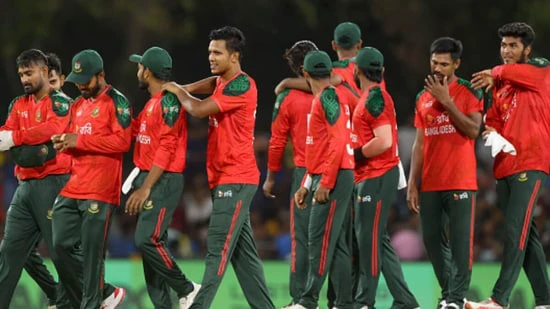
Asif Nazrul, the Bangladesh government’s sports adviser, met with national cricketers on Thursday, though no attempt was made to consult the players on the matter.
“The purpose of the meeting was simply to explain to the players why the government took this decision and give them the context. I believe they understood. That was the purpose – nothing else,” Nazrul told reporters.
The International Cricket Council (ICC) is awaiting a formal response from the Bangladesh Cricket Board (BCB). The ICC board on Wednesday gave the BCB more time to reconsider its stance, with no 24-hour deadline set, contrary to earlier reports.
The ICC board has rejected the BCB’s request to change its group and relocate its matches to co-host Sri Lanka. The decision followed independent reviews indicating no threat to Bangladesh players, media, officials and fans at tournament venues in India.
Bangladesh are placed in Group C with England, Italy, Nepal and the West Indies, and are scheduled to play three matches in Kolkata and one in Mumbai.
While Scotland is likely to replace Bangladesh, an ICC official said requisite replacement protocols must be followed, which may take time. Bangladesh players, reportedly dejected by the development, must now wait for the situation to change following national elections next month.
Ties between the neighbours have deteriorated significantly following the ouster of former Prime Minister Sheikh Hasina in August 2024. The regime change in Dhaka precipitated a rise in anti-India rhetoric and reciprocal accusations regarding the safety of minorities, creating a hostile environment that has increasingly spilled over into sporting ties.
Nazrul emphasised that the final call lay with the administration. “Let me tell you clearly. It is the government’s decision not to play in India due to security concerns,” he said.
BCB president Aminul Islam accused the ICC of double standards, noting that a similar demand by the Board of Control for Cricket in India (BCCI) was accepted for the Champions Trophy last year.
“The ICC tried to tell us about incidents in 1996 and 2003 but we pointed out their recent steps in a similar matter. When a country refused to travel to another country for the Champions Trophy last February, the ICC organised a neutral venue for them,” Islam said.
“The team played all their Champions Trophy matches in that neutral venue. They played on one ground, staying in one hotel. It was a privilege.”
Islam’s comments, likening Bangladesh’s demands to the India-Pakistan situation, are unlikely to aid the BCB.
“There is a well accepted flexibility exercised in India-Pakistan matters, given the commercial value of the India-Pakistan contest to an ICC world event,” an ICC board member said.
The BCB finds itself isolated in the ICC after the board rejected its demands 14-2. Even the Pakistan Cricket Board has not pursued the matter further after voting in favour of the BCB in a show of symbolic solidarity.
In Indian cricket circles, the BCB’s stance is seen as retaliatory after the BCCI removed Bangladesh pace bowler Mustafizur Rahman from the Indian Premier League (IPL).
“The Indian government made no effort to convince us by saying the incident involving Mustafizur was isolated, or that they were sorry, or that they were taking steps. They made no effort to contact us, no effort to reassure us about the safety of our journalists, spectators and players. Therefore, there is no scope for changing our decision,” Nazrul said.
The ICC rejected the link to the Mustafizur incident.
“The BCB maintained its position, repeatedly linking its participation in the tournament to a single, isolated and unrelated development concerning one of its player’s involvement in a domestic league. This linkage has no bearing on the tournament’s security framework or the conditions governing participation in the ICC Men’s T20 World Cup,” the ICC said in a statement.