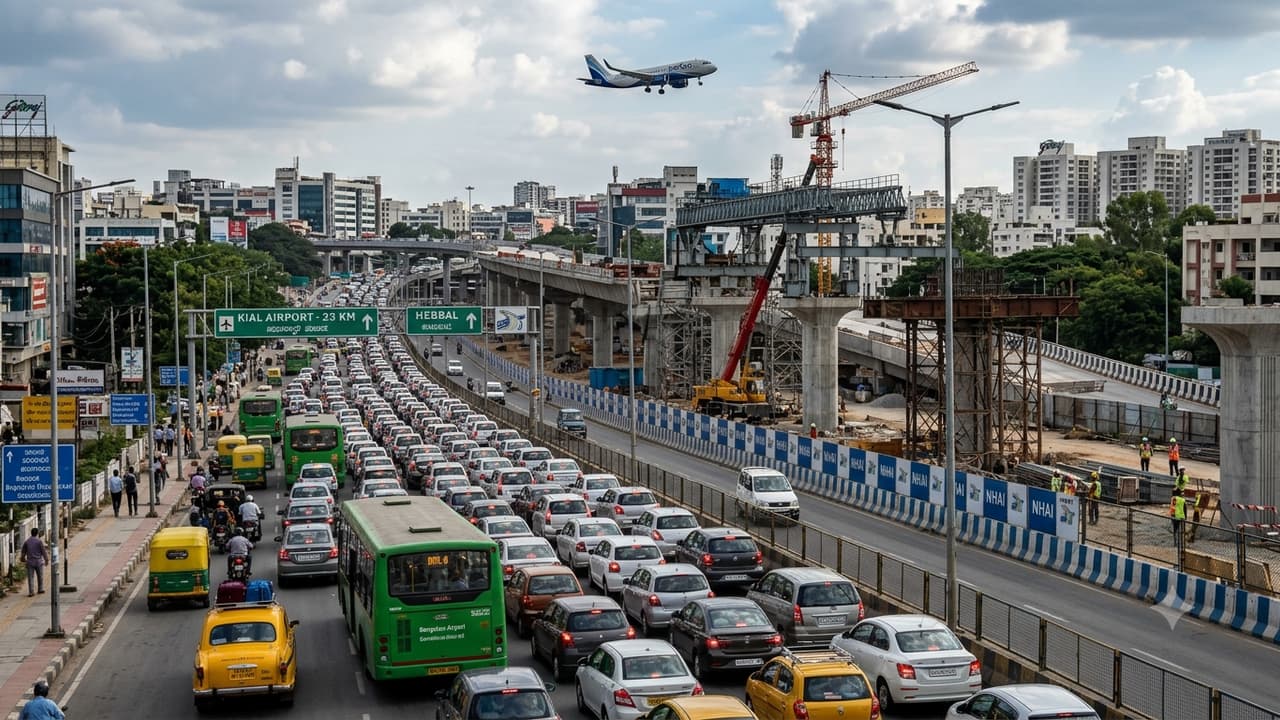
As India prepares for its first Census in 16 years, questions are growing over whether traditional classifications can keep pace with rapidly changing settlement patterns and expanding urban economies.
India’s 2027 Census will continue using long-established criteria to determine whether a settlement qualifies as urban or rural. While the approach ensures consistency with previous enumerations, it is increasingly colliding with a reality in which economic activity, population growth and infrastructure expansion often extend far beyond official municipal boundaries.
Under the Census framework, a settlement is classified as urban if it is designated a statutory town by a state government or satisfies three conditions: a population of at least 5,000, density exceeding 400 persons per square kilometre, and at least 75 per cent of male workers engaged in non-agricultural activities. Areas that do not meet these standards are counted as rural.
The classification appears administrative, but its implications are significant.
Urban status influences planning frameworks, municipal governance, infrastructure provision, public finance allocations, environmental regulation and eligibility for government programmes. As a result, how settlements are classified can shape their access to resources and future development trajectories.
India’s urban landscape has expanded considerably since the last Census in 2011, which counted 377 million urban residents across roughly 8,000 towns and cities. Since then, states have added approximately 1,000 statutory towns, while urban expansion has increasingly spilled into surrounding areas beyond official city limits.
The country’s urban growth is highly uneven. Small towns account for the overwhelming majority of urban settlements, while a large share of the population remains concentrated in major cities. Yet rapidly growing peri-urban regions are emerging as some of the fastest-changing parts of the country.
Recent policy signals suggest growing recognition of this reality.
The Economic Survey argued that India may be far more urban in functional terms than official definitions suggest. Recent fiscal measures have also increasingly focused on broader city regions rather than individual municipal boundaries.
Changes introduced by the Finance Commission and central government programmes indicate a shift toward recognising economic regions and transitional settlements that do not fit neatly into conventional rural and urban categories.
Planning And Governance Challenges Extend Beyond Traditional Boundaries
Many settlements undergoing rapid transformation remain governed under rural institutions despite displaying economic and demographic characteristics commonly associated with urban areas. This can create administrative mismatches when local bodies are expected to manage challenges involving land use, waste management, transport, infrastructure and environmental protection.
Planning gaps also remain substantial.
Large numbers of statutory and census towns continue to operate without comprehensive master plans, limiting their ability to guide growth, coordinate infrastructure and respond to emerging climate risks. Much of India’s planning architecture was designed for an earlier phase of urbanisation and often struggles to accommodate today’s expanding rural-urban continuum.
Policy experts increasingly argue that urbanisation should be understood as a process rather than a fixed legal category.
Under this view, settlements do not simply transition from rural to urban overnight. Instead, they evolve gradually through changing employment patterns, population growth, land-use shifts and expanding economic integration with nearby cities.
A proposed National Urbanisation Policy is increasingly being discussed as a mechanism for addressing these challenges.
Supporters argue that such a framework could improve coordination among existing institutions while providing common principles for classification, planning, financing and governance. Rather than creating new layers of administration, it could help align existing systems with contemporary patterns of urban development.
Key proposals include updating settlement classifications more regularly, expanding regional planning, strengthening municipal finances, improving institutional coordination and ensuring that governance structures better reflect functional economic geographies.
The broader issue is no longer whether India is becoming more urban. That transition is already underway.
The central challenge is whether governance systems, planning institutions and fiscal frameworks can adapt quickly enough to manage growth occurring in places that often fall between traditional definitions of rural and urban. As India prepares for the 2027 Census, that question is becoming increasingly difficult to ignore.