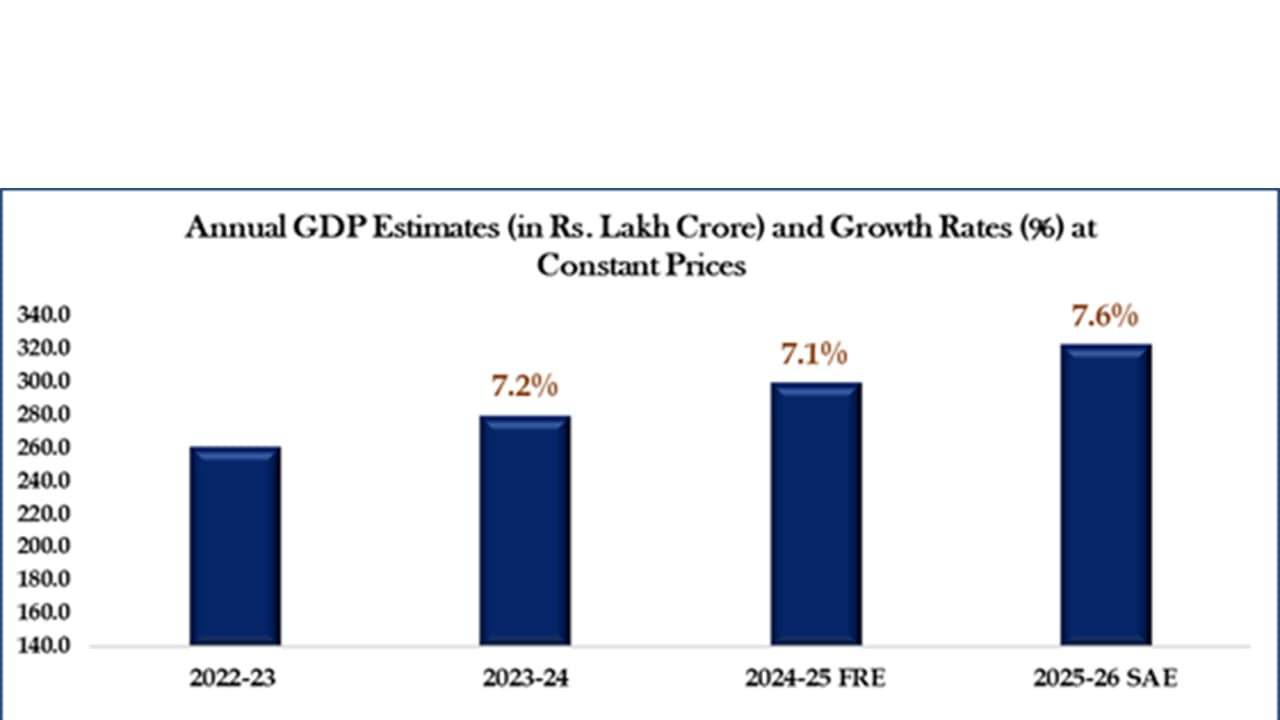
India’s real GDP is projected to grow by 7.6% in FY 2025-26, with nominal GDP at 8.6%, as per MoSPI data. The strong outlook is supported by robust Q2 and Q3 growth and a double-digit expansion in the manufacturing sector.
India’s real GDP is estimated to grow by 7.6 per cent in the current financial year 2025-26, Ministry of Statistics and Programme Implementation (MoSPI) estimates showed Thursday. Nominal GDP, which includes consumer inflation, is pegged at 8.6 per cent, the government said.
Overall economic performance in 2025-26 is primarily on account of robust real growth observed in the second quarter (8.4 per cent) and the third quarter (7.8 per cent). In the October-December quarter, the economy grew 7.8 per cent, in real terms, data showed.
Sustained Performance and Sectoral Drivers
The Indian economy has exhibited sustained performance, recording real GDP growth rates of 7.2 per cent and 7.1 per cent respectively during 2023-24 and 2024-25. Nominal GDP has registered 11.0 per cent and 9.7 per cent growth rates during 2023-24 and 2024-25, respectively. The manufacturing sector has been the major driver in contributing to the resilient performance of the economy in the consecutive three financial years after rebasing. This sector has attained double-digit growth rates in 2023-24 and 2025-26. Secondary and tertiary sectors have boosted the performance of the economy by registering above 9.0 per cent growth rate in 2025-26.
Base Year for National Accounts Revised
The Ministry of Statistics and Programme Implementation (MoSPI) released the New Series of Annual and Quarterly National Accounts Estimates with a base year of 2022-23, which replaces the previous series with a base year of 2011-12. As per the International best practices, base year revision is undertaken periodically and differs from regular revisions in National Accounts primarily because of the nature of changes.
In Annual revisions, changes are made only based on updated data becoming available without making any changes in the conceptual framework or using any new data source, to ensure strict comparison over years. In case of base year revisions, changes are made to capture structural changes in the economy, incorporate the latest data sources, improve estimation methodologies, and enhance coverage and accuracy.
The Financial Year (FY) 2022-23 has been selected as the base year, as it represents a recent normal year (after COVID), with availability of robust and comprehensive data across sectors of the economy, making it an appropriate benchmark for the new series of Annual and Quarterly National Accounts Estimates. The Ministry of Statistics and Programme Implementation is revising the base year for key macroeconomic indicators–CPI, GDP, and IIP. In late 2025, the International Monetary Fund (IMF) assigned India a ‘C’ rating on national accounts, citing outdated data. The base year was perceived to be outdated by the IMF.
India’s Economic Transformation
According to official data, the economy grew 8.7 per cent and 7.2 per cent, respectively, in 2021-22 and 2022-23. India has made quite a turnaround, climbing the ladder of economic growth. This can be gauged from the progress in terms of the size of the economy. India was placed 11th in 2013-14 and is now the fourth-largest economy.
India has surpassed many countries in terms of economic size over the past decade and now needs to continue making progress in terms of per capita income. In 2013, India was placed in the league of ‘Fragile 5’ economies.
The term ‘Fragile 5’ was coined by a Morgan Stanley analyst and referred to a set of five emerging countries, including India, whose economies were not doing well. The other four countries were Brazil, Indonesia, South Africa, and Turkey. Today, India is one of the fastest-growing major economies. (ANI)
(Except for the headline, this story has not been edited by Asianet Newsable English staff and is published from a syndicated feed.)