Free Trade Agreement between India and European Union (EU)
The coming Tuesday i.e. January 27, 2026 can be written in golden letters in the history of India. The moment for which the Indian market and industry was waiting for the last decade is now very close. According to a report by Reuters, the much awaited Free Trade Agreement between India and the European Union (EU) is finally going to be ratified. This is not just a paper agreement, but the doors of Europe, one of the world’s largest markets, are going to open for India. From the point of view of global diplomacy, this step is so big that the eyes of the entire world including US President Donald Trump are currently focused on New Delhi and Brussels.
Indian business will get new momentum
This agreement is also special because its foundation was laid long ago, but the talks remained in cold storage for almost a decade. When talks started again in the year 2022, the world had changed. Amidst the changing global circumstances and the chaos regarding the supply chain, both sides felt that it is necessary to come together now.
According to an official of the Commerce Ministry, during the talks, the emphasis was not only on increasing trade, but there was also a big challenge of protecting our domestic policies. This is the reason why both the sides were moving slowly. If we look at the figures, there will be a bilateral trade of about 130 to 136 billion dollars between India and EU in the year 2024-25. The EU is today one of India’s largest export markets, where India has sent goods worth about $75 billion in recent years.
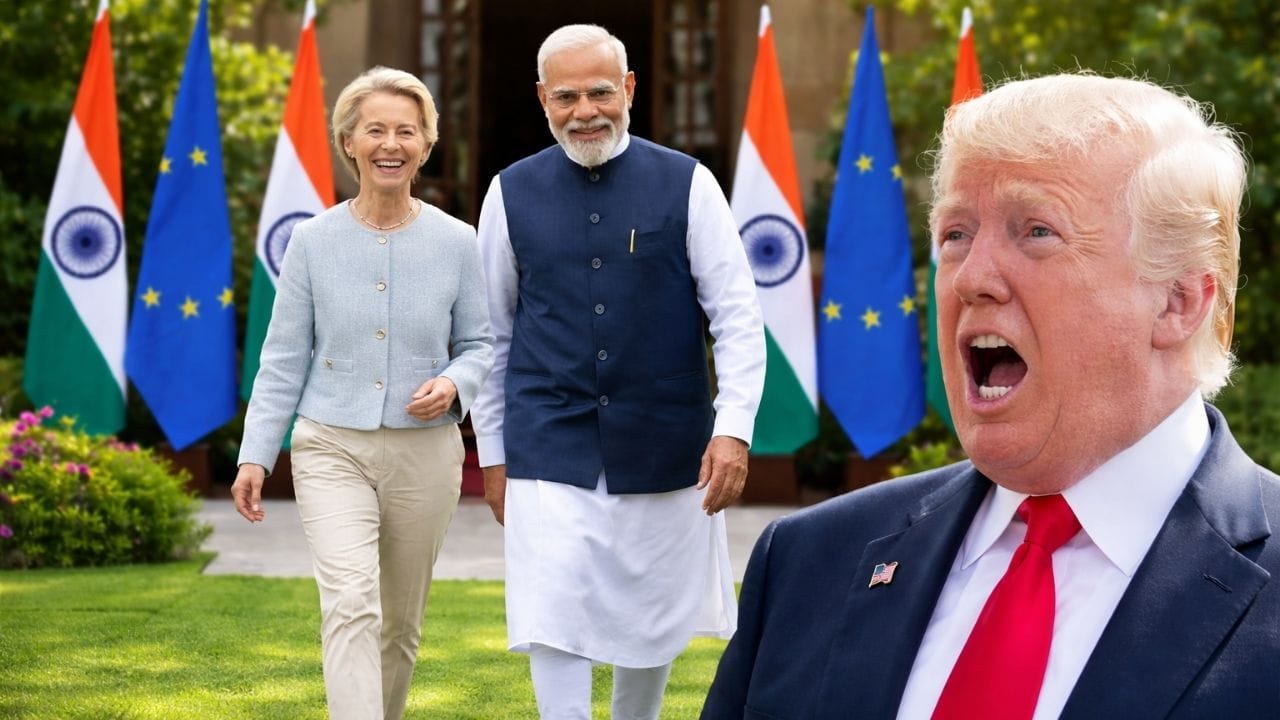
Trump will just keep watching
The most interesting aspect of this agreement is its ‘timing’. It has often been seen on the global stage that western countries want to do business on their own terms. But this time India has shown that it can stick to its terms. America often follows the policy of “America First”, but by locking this deal with Europe, India has proved that it has no dearth of options. When this agreement is signed on January 27, it will also be a big signal to Washington that India is now a global power capable of taking big decisions for its interests.
Farmers will not be affected
The biggest obstacle in the way of this deal was the business of ‘farming and milk’. European countries wanted their milk and agricultural products to be easily sold in the Indian market. But India has drawn a strict ‘Lakshman Rekha’ here. Indian negotiators clearly said that there will be no compromise with the interests of crores of our small farmers and dairy producers. To protect its manufacturing, India also set a condition to reduce the tax on foreign goods gradually instead of reducing it suddenly, which was ultimately accepted.
It became a matter of Europe also
At the same time, Europe is eyeing India’s rapidly growing consumer market. Brussels (EU headquarters) continued to pressurize India to reduce taxes on European cars, auto components and machines. Also, they want their service providers to have more freedom to work in India.
But the biggest problem was on the rules related to ‘climate’ i.e. climate change. Europe is very serious about its ‘Green Deal’ and Carbon Border Adjustment Mechanism (CBAM). He made it clear that there will be no compromise on his strict standards related to the environment while doing business. Earlier India had asked for some relaxation in this, but the EU did not change its stand. The meaning is clear, Indian exporters will have to follow the strict environmental rules of Europe in future.
What impact will this deal have on the common Indian?
Now the question is, what impact will this huge deal have on the common Indian? The government is trying to ensure that sectors like textile, leather industry and engineering get a bigger market in Europe through this agreement. These are the sectors where maximum jobs are created. If Indian goods reach Europe without high taxes, production here will increase and new employment opportunities will be created. Also, India hopes that it will be able to become a part of the European value chain, which will pave the way for foreign investment to come into the country.