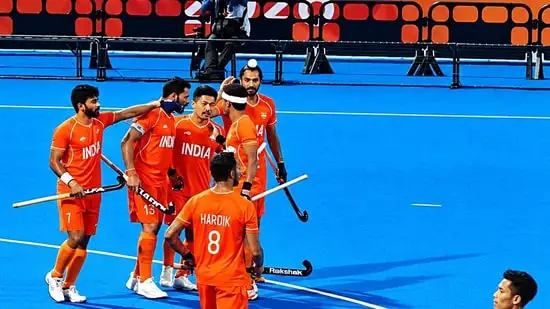
Ayear largely shaping up to be below par for the Indian men’s hockey team. And the women were nursing the wounds of a major slump and disunity in the ranks.
Yet, once they landed at the Asian Games, both squads swept away their blues. And for the first time, the Indian men’s and women’s hockey teams won the gold medal in the same Games.
The men for the first time also defended the title, while the women ended a 44-year wait-their only title had come in the 1982 New Delhi Asiad where women’s hockey made its debut. This they did by toppling favourites and holders China. Having booked their tickets to the 2028 Los Angeles Olympics, the teams can look forward to starting a promising era.
If the men’s gold was expected, yet it was a story of redemption, and the victory was hard fought. In the Pro League-typically a testing ground- India languished in eighth place out of nine teams, avoiding relegation that befell Pakistan.
Those struggles were carried to the grand stage in August when the Harmanpreet Singh-led outfit crashed out of the World Cup, finishing a dismal eighth. Despite being the only team to medal at the last two Olympics, the Craig Fulton-coached squad looked bereft of answers.
But in Japan, the recalibration finally clicked. India stormed through the tournament unbeaten. The turnaround wasn’t just about mentality, but clinical execution.
“The big area was in attack, final third and finishing a lot of what we started collectively, not just individually,” chief coach Fulton told HT on Sunday, reflecting on the team’s revival after the World Cup.
“We wanted to improve our penalty corner (PC) attack and keep as many clean sheets as we possibly could. Our PC attack and defence were excellent. But (at the World Cup) we weren’t scoring enough goals because we were still conceding one or two. That ended up being the difference.”
Fulton dispelled the notion that Asian dominance is a given for India. “People are getting so used to us winning games in Asia now. But when I first joined (2023), we had won one gold medal in the previous 24 years,” said the South African.
“You can see how difficult it is to compete and win gold in this tournament. We wanted to make our own piece of Indian hockey history. The cherry on the cake was that the girls went and won their final.”
The women’s triumph was some resurrection. They landed in Japan as next best to world No.4 China, though there were signs of revival when they held the Paris Olympics silver medallists to a draw at the World Cup.
India women had endured a period of failure. After missing qualification for the 2024 Paris Olympics, they endured a volatile period marked by the exit of their Dutch coach Janneke Schopmann and her successor Harendra Singh. They were also demoted from the Pro League.
The catalyst for turnaround was the return in January of Sjoerd Marijne, the Dutch architect of India’s brilliant fourth place at the 2021 Tokyo Olympics. With a renewed focus on fitness and backed by sports scientists, Marijne orchestrated a rapid revival.
India secured a lifeline by qualifying for the World Cup, then won the Nations Cup to return to the Pro League. At the World Cup, India’s transformation was already under way. They drew against China, Australia and England, thrashed South Africa and beat Germany to finish fifth.
That momentum led to an unblemished run at the Games. India dismantled every opponent before edging out China.
Former India chief coach Neil Hawgood, who guided the women to the 2016 Olympic qualification after 36 years, praised Marijne.
“Sjoerd got them to peak at the Games, which was a priority while preparing and playing at the World Cup,” the Aussie told HT from Perth. “This time (two years) is a unique opportunity Sjoerd has created for his push to the Olympics.”
Hawgood said the next steps must help sustain the momentum. “Expose the talent from below and the wider squad, with a few tours to each one of them, so that you can compare what a player may look like with 24 months of growth, compared to maybe some that have reached their ceiling, but are still contributing,” he said.
Fulton said: “We’re looking to bring in a few younger players. We will see who needs a break or rest.”
For decades, the women had seen ups and downs. Now, alongside the men, they have time to target the biggest accolade: Olympic success.