Bihar recorded India’s lowest per capita government healthcare expenditure at Rs 1,126 in 2023-24, according to the latest National Health Accounts estimates. Uttar Pradesh followed at Rs 1,399, while Sikkim topped the state rankings with Rs 16,026.
Over the past decade, India has witnessed a notable shift in healthcare financing, with the government’s share of total health expenditure rising from 28.6 per cent in 2013-14 to 43.5 per cent in 2023-24, according to National Health Accounts data. During this period, total government healthcare spending more than tripled from Rs 1.30 lakh crore to Rs 4.14 lakh crore, while per capita public health expenditure climbed from Rs 1,042 to Rs 2,959. It accounted for 43.5 per cent of India’s total health expenditure and 1.43 per cent of GDP.
Driven by public health schemes such as Ayushman Bharat and Jan Aushadhi Kendras, this expansion helped reduce households’ out-of-pocket medical expenditure by roughly 21.5 percentage points over the decade, compared to a 5 percentage point drop between 2004 and 2014, easing the direct financial burden of healthcare on families.
However, Bihar recorded the lowest government healthcare expenditure per person among Indian states, with just Rs 1,126 spent on each resident during the financial year 2023-24. The figure highlights the significant gap in public healthcare spending across the country, with Chandigarh and Sikkim reporting some of the highest per capita expenditure, according to the National Health Accounts (NHA) Estimates for 2023-24.
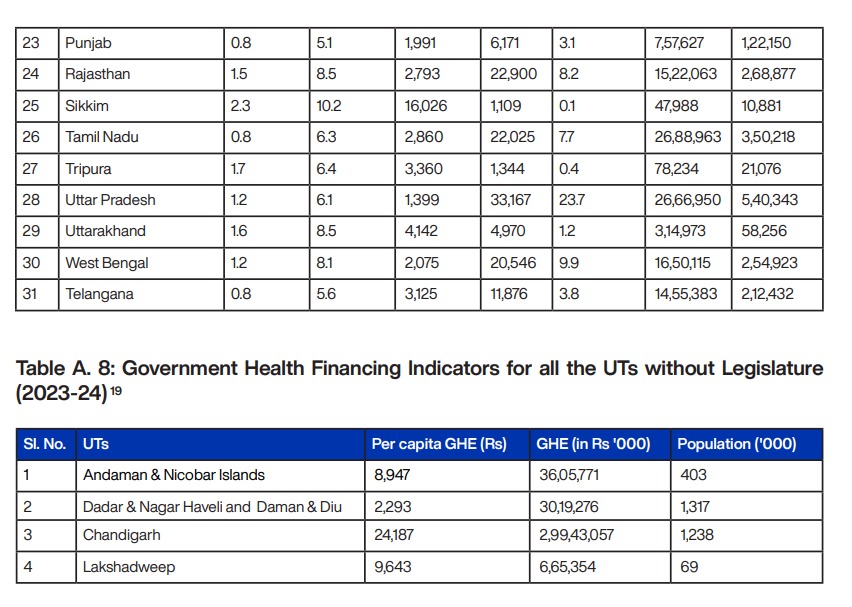
The difference is particularly striking when compared with Chandigarh, where government health expenditure stood at Rs 24,187 per person. Sikkim recorded the highest spending among states at Rs 16,026 per person. The figures point to wide differences in the resources available for public healthcare across regions.
Bihar and ,Uttar Pradesh, lag behind other regions
Bihar’s per capita government health expenditure was lower than that of Uttar Pradesh, which recorded Rs 1,399 per person. Together, Bihar, Uttar Pradesh, Madhya Pradesh and Jharkhand reported a population-weighted average of just Rs 1,651 per person.
This was less than half the average of Rs 3,501 recorded across the eight northeastern states. The average for Union Territories was considerably higher at Rs 7,209 per person.
The figures suggest that some of India’s most populous and economically weaker states continue to spend relatively little on public healthcare for each resident.
Southern states remain close to national average
Government health expenditure across southern states averaged around Rs 2,960 per person, almost matching the national average of Rs 2,959.
Kerala recorded expenditure of Rs 3,396 per person, followed by Andhra Pradesh at Rs 3,347 and Telangana at Rs 3,125. Tamil Nadu spent Rs 2,860 per person, while Karnataka recorded Rs 2,446.
The northeastern region also showed considerable differences between states. Assam spent Rs 2,282 per person and Tripura Rs 3,360. In comparison, Mizoram recorded Rs 9,320, Arunachal Pradesh Rs 8,885 and Meghalaya Rs 7,533. Manipur and Nagaland reported expenditure of Rs 5,507 and Rs 4,585, respectively.
Why does government health spending vary?
Differences in state finances, population size, existing healthcare infrastructure and political priorities help explain the uneven spending, TOI quoted health policy specialist Dr Chandrakant Lahariya.
He pointed out that economically weaker states with large populations face greater pressure on their resources. Northeastern states, meanwhile, often have higher healthcare delivery costs because of difficult terrain and scattered settlements.
Infrastructure and other fixed costs also remain high even when relatively few people use a particular facility. This can push up per capita expenditure in smaller states and regions with dispersed populations.