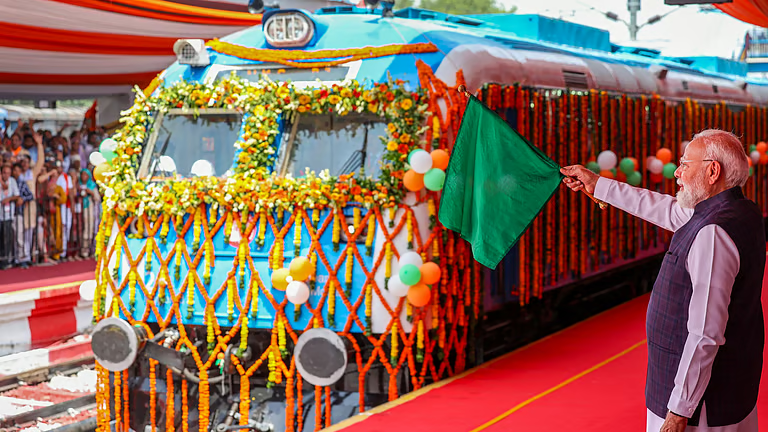
India entered the hydrogen rail era on July 17 when Prime Minister Narendra Modi flagged off the country’s first hydrogen-powered train in Haryana. The significance of the launch extends beyond adding another train to the railway network. It marks Indian Railways’ first attempt to deploy hydrogen as a transport fuel—a technology that could eventually provide a cleaner alternative to diesel on routes where electrification is difficult, environmentally sensitive or uneconomical.
Unlike diesel trains, hydrogen fuel-cell trains emit only water vapour at the point of use while offering greater range and faster refuelling than battery-powered alternatives. If the technology proves commercially viable and hydrogen becomes more affordable, it could reduce India’s dependence on imported fossil fuels, strengthen energy security and help decarbonise sections of the railway network that are harder to electrify.
Milestones
- India’s first hydrogen-powered train was flagged off in Haryana on July 17, 2026.
- The train begins operations between Jind and Sonipat, covering 89 km.
- India’s largest railway hydrogen refuelling facility is set up at Jind.
- Indian Railways plans to explore hydrogen technology on heritage railways, including the Kalka-Shimla route.
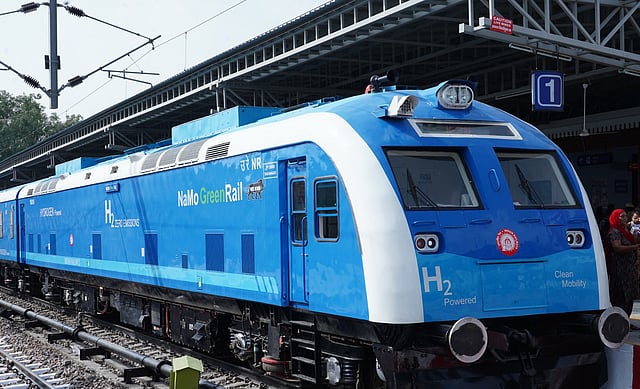
Between which stations was India’s first hydrogen-powered train launched?
The first hydrogen-powered train operates on the 89-km Jind-Sonipat section in Haryana.
How fast is the train and how long does the journey take?
The 10-coach non-AC train runs at an operational speed of 75 kmph on this route, although it has been designed for a maximum speed of 110 kmph. It takes nearly two hours to complete the journey.
Will it cost more to travel on the train? What is its carrying capacity?
No. The fare is the same as that of DEMU services, ranging between ₹10 and ₹25. The train can accommodate up to 2,600 passengers.
If Indian Railways is rapidly electrifying its network, why does it need hydrogen trains?
Indian Railways has already electrified almost its entire broad-gauge network. Hydrogen trains are not intended to replace conventional electric trains on these routes. Instead, they are being evaluated for sections where extending overhead electric lines is technically difficult, environmentally sensitive or economically unviable, such as heritage railways, hilly terrain and some remote routes.
How does a hydrogen-powered train work?
The train has two hydrogen-powered driving cars, one at each end, each producing 1,200 kW of traction power. Hydrogen stored onboard in high-pressure cylinders reacts with oxygen from the air inside a Proton Exchange Membrane (PEM) fuel cell to generate electricity. Unlike a diesel engine, there is no combustion. The electricity powers the traction motors, while water vapour and heat are the only direct by-products.
Where does the train get its hydrogen and what is the process?
The train is refuelled at Indian Railways’ largest hydrogen refuelling facility at Jind in Haryana. Hydrogen is produced on site through electrolysis, in which water is split into hydrogen and oxygen using electricity before being stored in dedicated tanks.
The hydrogen is compressed to 500 bar, allowing more gas to be stored in a smaller volume. It is then dispensed through two independent dispensers at a regulated pressure of 350 bar, enabling both hydrogen-powered driving cars to be refuelled simultaneously and reducing turnaround time.
Is the hydrogen used ‘green hydrogen’?
Electrolysis itself does not automatically make hydrogen environmentally friendly. If the electricity used comes from renewable sources such as solar or wind, it is known as green hydrogen and has very low lifecycle emissions. If fossil-fuel-based electricity is used, the overall carbon footprint is higher, although the train itself still emits only water vapour.
How safe is the train, given that hydrogen is highly inflammable?
The train and the refuelling plant are equipped with multiple safety systems that continuously monitor for hydrogen leaks, heat, flames and smoke. Continuous ventilation prevents hydrogen from accumulating, while automatic shut-off systems isolate the hydrogen supply if any abnormality is detected.
Hydrogen is the lightest gas and disperses rapidly into the atmosphere, reducing the risk of gas pooling. However, it requires sophisticated monitoring and safety systems.
The loco pilot’s cabin has additional safeguards, including an emergency operating mode and a real-time health monitoring display. The Jind hydrogen plant is similarly equipped with leak detectors, flame detectors, automatic shutdown systems, water sprays and fire alarms.
How environmental friendly is the train?
At the point of use, the train produces no smoke or tailpipe carbon emissions. The only direct by-products of the fuel-cell reaction are water vapour and heat. However, the overall environmental benefit depends on how the hydrogen itself is produced.
Will the train have sufficient power during acceleration?
Yes. The train uses a hybrid system that combines hydrogen fuel cells with lithium iron phosphate batteries. The batteries provide additional power during acceleration and store energy recovered during braking or while the train is idling.
What are the advantages of hydrogen-powered trains over conventional trains?
Unlike electric trains, hydrogen-powered trains do not require overhead electric wires. This makes them particularly useful on routes where electrification is difficult or prohibitively expensive.
However, they are not expected to replace conventional electric trains on India’s heavily used electrified network, where electric traction remains more efficient and economical.
If hydrogen is so promising, why isn’t everyone using it?
Hydrogen-powered rail technology is still at an early stage globally. Fuel cells, hydrogen storage systems and refuelling infrastructure remain expensive, while producing green hydrogen at scale is still costly. Wider adoption will depend on technological improvements and falling costs.
How extensively will Indian Railways deploy hydrogen-powered trains?
For now, Indian Railways is exploring the use of hydrogen technology mainly on heritage and selected non-electrified routes, including the Kalka-Shimla railway. Future expansion will depend on operational experience, economics and the availability of affordable green hydrogen.
Which countries currently operate hydrogen-powered trains?
Hydrogen-powered trains remain at a nascent stage globally. Germany was the first country to introduce commercial hydrogen passenger trains, while France, Italy, China and Japan are operating pilot projects or limited services. Most such trains have two to four coaches designed for regional operations. India is the first country to operate a 10-coach hydrogen-powered passenger train.
Will hydrogen replace diesel and electric trains in India?
Not in the foreseeable future. Electric traction will remain the backbone of Indian Railways because it is more efficient and economical on heavily used routes. Hydrogen is expected to complement, rather than replace, electrification by serving routes where installing overhead electric infrastructure is difficult or uneconomical. Whether it expands beyond these niche applications will largely depend on the cost of producing hydrogen, particularly green hydrogen.