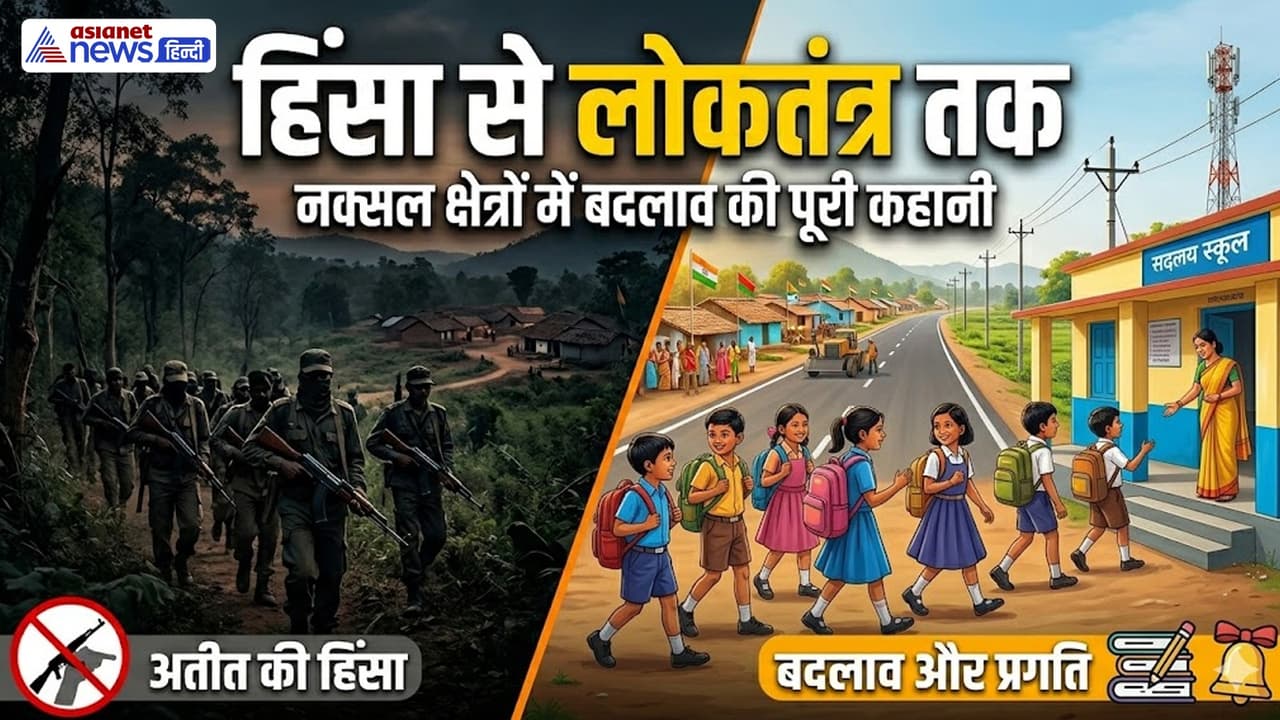
There has been a huge decline in leftist extremism in India. Violence is now negligible compared to 2,213 incidents in 2010. This has been made possible not just by security operations but also by development works like roads, schools and health, due to which militancy has become irrelevant.
New Delhi: For years, left-wing extremism in India was seen as a law and order problem. In reality it never existed. It was a void. Where the state did not exist, something else came in—and for decades that “something else” continued to rule large parts of the country with fear. What has changed in the last two decades, especially the last one, is not just a reduction in violence. He is the filling of that void.
The data tell this story with extraordinary clarity…
In 2010, when the insurgency was at its peak, India recorded 2,213 violent incidents and 1,005 deaths. Civilian casualties numbered 720, and 285 security personnel lost their lives. This was not isolated unrest—it was a sustained, organized conflict spanning a wide geography.
Now see where we stand…
Incidents reduced to 401 and deaths to 100 in 2025
There have been only 42 incidents and 6 deaths in 2026 (till March 24)
Civilian deaths reduced from 720 in 2010 to 64 in 2025 and to 5 so far in 2026
Casualties of security forces to decline from 285 in 2010 to 36 in 2025, and to only 1 so far in 2026
This is not a gradual decrease. This is the structural degradation of violence. The extent of influence has also been limited with equal intensity. In 2004, Left Wing Extremism affected 86 districts. By 2025 this number has dropped to 32, and in 2026 (as of March) only 11 districts are affected. The number of police stations under its influence has reduced from 482 to 20. But the real sign of change lies elsewhere—in the number of people who chose to move away.
A total of 16,496 cadres have surrendered over the years. In 2024 alone, 2,337 people laid down their arms—one of the highest annual figures ever.
Chhattisgarh saw 9,573 surrenders, followed by Andhra Pradesh with 3,423, while significant numbers also came forward from Telangana, Maharashtra and Odisha. The trend continues in 2025 (633 surrenders) and early months of 2026.
Movements do not end simply when they are defeated. They end when people stop believing in them. And this is where the real story begins – because all this did not happen just because of security actions. For decades, these areas struggled with lack—of roads, of schools, of health services, of the basic presence of the state. Now that deficiency has been systematically removed.
A 240-bed super specialty hospital in Jagdalpur, field hospitals in Bijapur and Sukma, and treatment of over 67,500 patients since 2017—health services have now reached places where life was previously uncertain. Financial inclusion has also gained momentum. Since 2014, 6,025 post offices with banking services, 1,804 bank branches, 1,321 ATMs and 75,000 banking correspondents have been activated in these areas. This has broken the hold of the informal and pressure based financial system.
Education has expanded on a large scale. 9,303 schools have been built, 258 Eklavya Vidyalayas have been approved (179 operational), as well as 11 Kendriya Vidyalayas and 6 Navodaya Vidyalayas have been established. This is not just infrastructure—this is long-term security against extremism.
Connectivity has probably been the biggest game changer. 17,500 km of roads, 9,000 mobile towers (of which 2,343 were upgraded to 4G), and new rail lines connecting south Bastar to central Chhattisgarh—including 95 km from Dallirajhara to Raoghat and 140 km from Raoghat to Jagdalpur, with plans for further expansion. Surveys for a 180 km rail line from Dantewada to Munuguru in Telangana have also been initiated—bringing connectivity to areas that were once completely disconnected. Segregation has been systematically eliminated.
Welfare schemes have now started reaching the people directly. The number of beneficiaries of Pradhan Mantri Awas Yojana increased from 92,847 in 2024 to 2,54,045 in 2025. MNREGA beneficiaries increased from 8,19,983 to 9,87,204 during the same period.
At the same time, governance has also come closer to the communities. More than 70,000 Mitanins—over 80% of whom are from underprivileged or tribal backgrounds—are now part of the community health system. 12,927 special health camps have covered 7,66,585 beneficiaries. Women-led groups are working not only on health but also on issues like food security (74.1%), sanitation (70.8%) and gender violence (60.8%). Water management has also changed—under Jal Jeevan Mission 2.0, the Gram Panchayat-based model is handing over the governance of their water systems to local communities. Forest rights laws have given communities rights over land and resources—rebalancing both power and accountability.
The social fabric is also changing in ways that go beyond mere structure. In 2025, Balod district became the first child marriage free district in the country under the ‘Child Marriage Free India’ initiative. In September of the same year, Surajpur district declared 75 gram panchayats free of child marriage. These are not just administrative achievements. These are signs of a society that is beginning to reinvent itself.
And then comes the most important change – participation
In Bastar, voter participation increased from 66.04% in 2019 to 68.29% in 2024. The trend was similar in other affected districts—an increase of 1.81% in Kanker, 1.22% in Rajnandgaon, and 0.37% in Mahasamund.
People who once lived in fear are now participating in the democratic process.
Put it all together and the picture becomes clear.
Violence has come down from 2,213 incidents to 42.
Deaths have dropped from 1,005 to single digits.
The affected districts have reduced from 86 to 11.
And more than 16,000 people have surrendered.
Along with this, thousands of kilometers of roads, thousands of schools, widespread banking access, health services, welfare schemes and community-based governance have been established. For decades, these regions remained trapped in a cycle—isolation fueled by lack of development, isolation fueling insurgency, and insurgency fueling neglect. That cycle has now been broken. India did not fight leftist extremism alone. He made him irrelevant.
And this is a more permanent victory than any victory achieved by force.