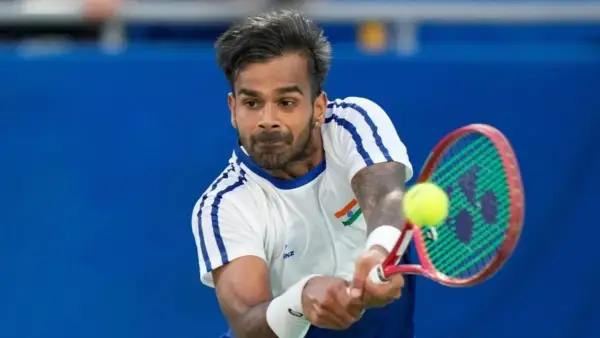
India has won a tennis medal at every single Asian Games since 1990. That streak is over. Sumit Nagal’s quarterfinal exit in Nagoya didn’t just end India’s campaign – it ended a run of podium finishes stretching back four decades, and the warning signs were visible well before the final match was played.
Nagal, India’s top-ranked men’s singles player and the country’s last realistic shot at a medal, lost 4-6, 4-6 to China’s Wu Yibing (seeded third) in the quarterfinals, with the match running one hour and 38 minutes. With that defeat, India’s tennis campaign officially ended without a single medal – the first time that’s happened since 1986, a streak of podium finishes at every edition from 1990 through Hangzhou 2022 now broken.
How Everything Else Had Already Fallen Away
Nagal wasn’t India’s only hope, but he became the last one standing after everything else collapsed earlier in the tournament. Dhakshineswar Suresh reached the third round of men’s singles, beating Indonesia’s Gunawan Trismuwantara 7-5, 7-6 before losing 3-6, 4-6 to sixth seed Chun-Hsin Tseng of Chinese Taipei.
India had no entry at all in women’s singles – the squad’s only two women, Ankita Raina and Rutuja Bhosale, were selected purely for doubles events.
The doubles campaigns, which many expected to carry India’s medal hopes given recent history, fell apart just as quickly. Top seeds N Sriram Balaji and Anirudh Chandrasekar lost an agonizingly close men’s doubles quarterfinal – winning the first set 7-6(4), losing the second-set tiebreak 6-7(7), then falling 8-10 in the deciding match tiebreak against China’s Jiang Fumin and Zhang Tianhui.
Fifth seeds Yuki Bhambri and Dhakshineswar Suresh lost in straight sets to Chinese Taipei’s pairing in the same round.
Women’s doubles ended even earlier – Raina and Bhosale lost in the opening round to Kazakhstan’s Anna Danilina and Yuliya Putintseva. Mixed doubles offered no reprieve either: Balaji and Raina lost in the first round to Hong Kong’s Eudice Chong and Kairan Thompson, while Bhambri and Bhosale, after a first-round bye, fell in the second round to Chinese Taipei’s Su-Wei Hsieh and Chun-Hsin Tseng.
Nagal’s Run, in Context
To his credit, Nagal’s path to the quarterfinals wasn’t easy. He opened with a 6-4, 6-0 win over South Korea’s Hong Seong-chan before beating Uzbekistan’s Sergey Fomin 6-3, 6-2 to reach the last eight.
That he created multiple chances against Wu before ultimately losing in straight sets speaks to how competitive the match actually was – this wasn’t a blowout so much as a missed opportunity at the crucial moments.
A Pattern, Not a One-Off
This result extends a worsening trend rather than marking a sudden collapse. India already missed out on singles medals at the 2023 Hangzhou Games, where Nagal also exited in the quarterfinals, and Ramkumar Ramanathan went out in the third round. The last Indian singles players to actually medal were Prajnesh Gunneswaran and Ankita Raina, both taking bronze back in 2018. Rohan Bopanna’s retirement removed the other pillar of recent success – he’d won doubles gold in both 2018 (with Divij Sharan) and 2022 (mixed doubles with Bhosale), medals India’s current doubles pairings were expected to replicate but couldn’t.
The Coach’s Honest Assessment
India coach Ashutosh Singh didn’t dress up the disappointment. “We obviously would have wanted stronger results, particularly given the quality and experience within the team,” he told PTI. On Nagal specifically: “Sumit Nagal competed hard in his matches. First beating Hong for the first time in his career, then overcoming Fomin, he did what was required. Even today, Sumit managed to create multiple opportunities but somehow was unable to convert them.”
Singh also pointed to a developmental gap in Dhakshineswar Suresh’s game, framing it as the next real test for India’s depth: “DK has shown his playing level on the Tour but needs more work to sustain his short bursts into good performance through a physically demanding multiple week national campaign if he sees himself as being the torch bearer of the team.”
On the doubles losses, Singh acknowledged the difficulty of the draw without treating it as an excuse: “Yuki and Rutuja were beaten by the Grand Slam champion Hsieh who brought all her high level experience and her partner too was playing very attacking tennis.” He was clear about where accountability sits: “As a team, we take responsibility for the results. There is no point in looking for excuses. At the same time, a proper assessment has to consider the conditions, scheduling, preparation and the quality of opposition rather than looking only at the final scorelines.”
AITA’s Response
AITA interim Secretary General Sunder Iyer struck a measured tone, acknowledging the federation’s own role in what comes next: “Players have tried to do their best. We reached three quarter-finals and were close to medals. As an association we need to see how to give more support to our players, juniors and professionals enabling them to do better.” He also credited the squad’s conduct through a difficult campaign: “There were difficult moments, selections and combinations that naturally bring pressure but the team maintained professionalism and supported one another throughout the campaign.”
The Age Problem Nobody Can Ignore
The most pressing structural issue hanging over Indian tennis is generational. Nagal is already 29, and by the time Doha hosts the next Asian Games in 2030, he’ll be 33 – likely past his competitive peak at this level. With no clear successor having stepped up at these Games, the pressure now falls on AITA to identify and fast-track the next generation immediately, rather than waiting for the next cycle to force the issue.
What This Means Going Forward
Four decades of continuous medal-winning ended in Nagoya not because of one bad match, but because every single contingency – singles, both men’s doubles pairs, women’s doubles, and mixed doubles – failed at a similar stage simultaneously. That breadth of collapse is what makes this result a genuine inflection point rather than a one-off disappointment, and why the conversation now shifts almost entirely to rebuilding before Doha 2030 arrives.