New Delhi: India’s generative AI boom is entering a decisive phase. After months of aggressive free promotions and discounted plans, global tech companies are now scaling back incentives to see how many users will actually pay. The world’s fourth-largest economy has delivered explosive user growth. But revenue remains thin.
According to data from Sensor Tower, India is projected to move to the top of the generative AI app downloads market globally in 2025. The number of installs increased by 207 percent annually, which increased the lead of the country over the United States. Tech giants such as OpenAI, Google, and Perplexity flooded the market with longer premium plans and reduced-price packages. The emblematic approach to monetisation was to gain users and monetise later.
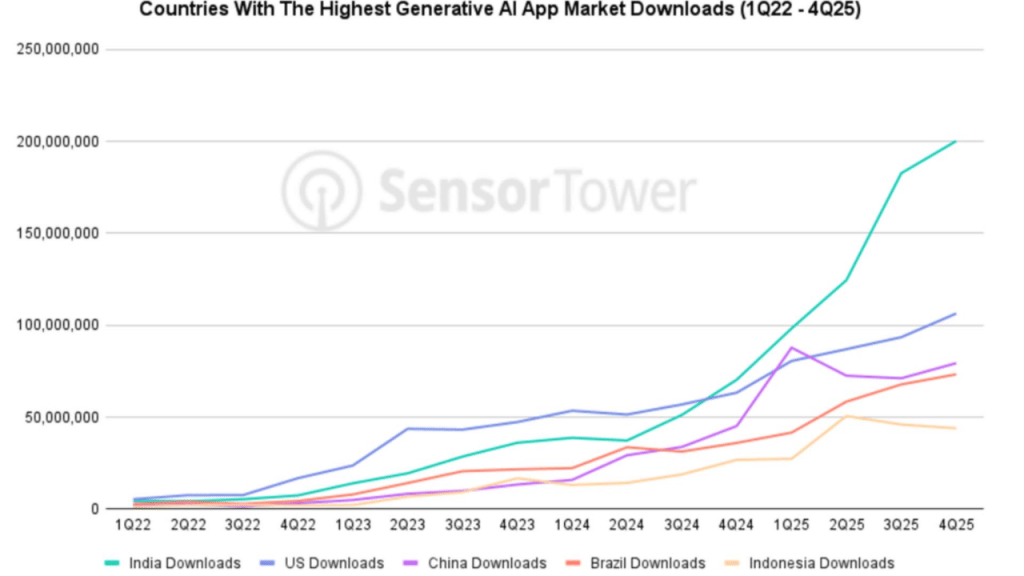
India became the largest market globally for generative AI app downloads. (Image Credit: Sensor Tower)
Free AI wave drives massive adoption
The high growth rate in India was through promotions and product innovation. New entrants like DeepSeek and Grok came into the market, and old ones like ChatGPT, Gemini, Claude, and Perplexity got improved. Another significant role was played by the viral AI-generated content. In India, seven of the 20 most downloaded GenAI apps in 2025 will be content creation and editing apps.
In 2025, India is expected to have about 19 percent of the global user base of popular AI assistant applications, compared to 10 percent in the United States. ChatGPT was still the market leader in terms of monthly active users and downloads. The CEO of OpenAI recently reported that the chatbot had over 100 million weekly active users in India. The adoption magnitude cannot be ignored.
Revenue lags despite download surge
Yet the revenue picture tells a different story. India is producing approximately 1 percent of the world’s GenAI in-app purchases, even though the country generates approximately 20 percent of the world’s downloads. The difference between monetisation is severe.
The in-app purchase revenue of AI apps in India fell by 22 percent and 18 percent month-on-month in November and December 2025, respectively. The revenue of ChatGPT dropped even more dramatically in the period by more than 30 percent following the release of its free ChatGPT Go sub-$5 plan. The marketing push increased users at the expense of short-term revenue.
ChatGPT continues to dominate over 60 percent. in-app revenue of GenAI in India. That dominance implies that OpenAI determines the performance of the financial market at large through the pricing decisions it makes.
Turning point as promotions wind down
The free ride is now slowing. In January, Perplexity terminated its bundle Pro deal with Airtel. The free access to ChatGPT Go by OpenAI is no longer available in India. These actions are the start of a critical conversion. Businesses are now forced to experiment with the capacity of the huge user base in India to spend.
India is also an attractive AI battlefield. Internet penetration is more than a billion people, and there are approximately 700 million smartphone users in the country. Still, mature markets are still ahead of engagement. The time spent on major AI chatbot applications goes up by approximately 21 percent per week, and the number of sessions increases by 17 percent on average compared to Indian users, reported by TechCrunch.
Analysts believe that the revenue growth will probably go up slowly as AI begins to penetrate work processes. Nonetheless, the pressure of pricing will be great. The Indian value-conscious younger generation of users prefers low-end pricing, telecom packages, and micro-payment systems.
By the year 2026, the Indian market is dominated by ChatGPT, with approximately 180 million monthly active users. Gemini of Google then has 118 million, followed by Perplexity and Meta AI. The figures point to the massive opportunity as well as the increasing challenge: converting downloads into long-lasting dollars.