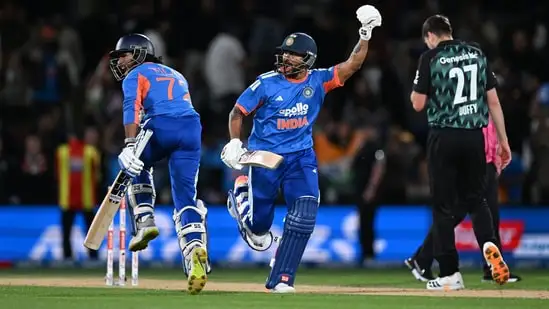
India needed 68 runs in their last five overs to win the second T20I against New Zealand at Christchurch’s Hagley Oval on Saturday.
The catch was that they were already six wickets down. But Tilak Varma and Nitish Reddy stitched together an unbeaten 69-run partnership and ensured that India registered their 200th T20I victory in their 300th match (206 wins if tied games clinched via tie-breaker are added). Courtesy of Varma’s 51 off 26 and Reddy’s 26 off 13, India crossed the line with one ball to spare.
Nearly 20 years ago, another T20I ended with India finishing in 19.5 overs. There have been many games in between that finished at exactly the same mark. Then what was so special about that evening in Johannesburg?
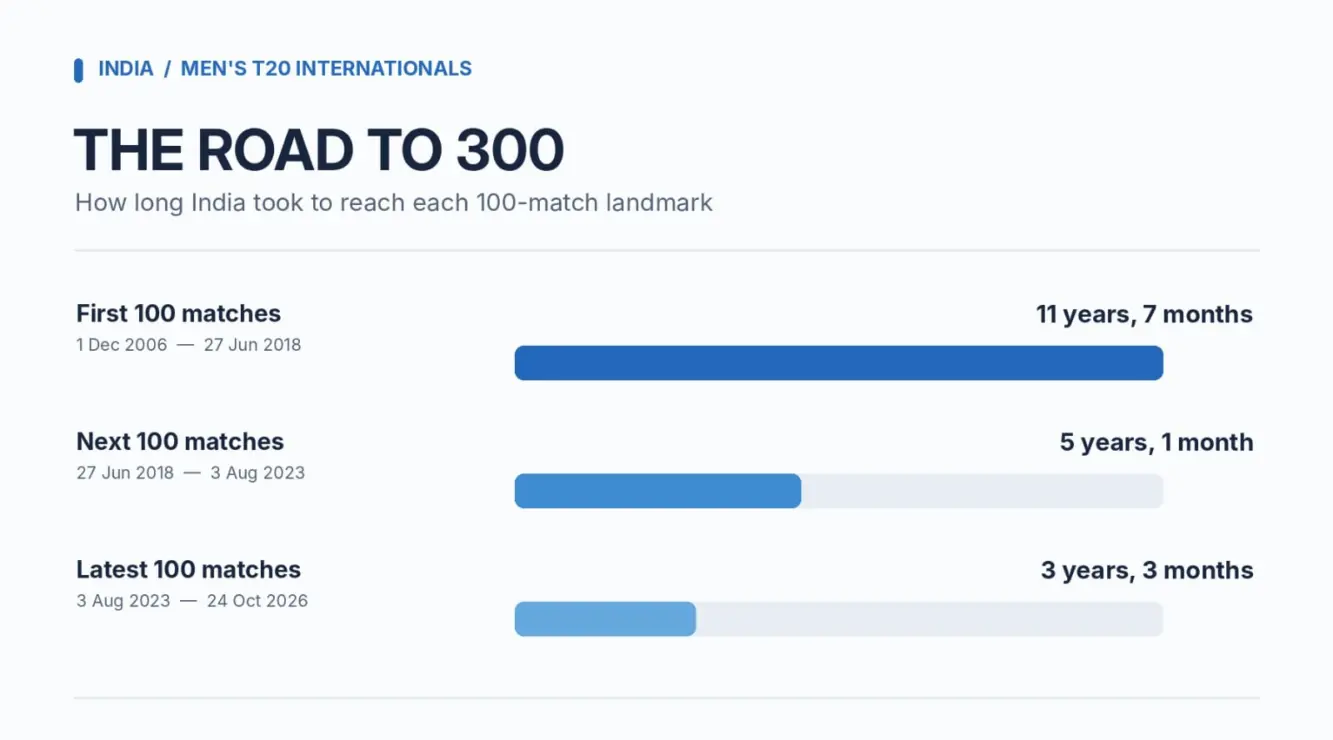
On December 1, 2006, India played their first-ever T20I under the captaincy of Virender Sehwag. India fielded first and restricted the hosts to 126/9, led by Zaheer Khan’s 2/15 and Ajit Agarkar’s 2/10. Sehwag gave India a brisk start during the chase with 34 off 29 balls; Dinesh Mongia stabilised the innings with a contribution of 38 off 45. India needed nine runs from the final over when Dinesh Karthik (31 off 28) struck a six and then a boundary off the penultimate delivery of Robin Peterson. India finished on 127/4, winning the game by six wickets with one ball to spare.
Since that match, it took India 11 years and seven months to play their first 100 T20Is. Their journey from 200 to 300 has been completed in just three years and three months, with the latest match being their 37th in 2026. There is also an intriguing Tilak Varma connection between the 200th and the 300th matches.
The triumph that changed Indian T20 cricket
India are nowadays considered a giant of the T20I format. However, the cricket-mad nation did not embrace this new format with open arms in its initial stages. It took a dramatic inaugural T20 World Cup victory under MS Dhoni’s leadership for the format to gain widespread popularity in India. Talk about the 2007 tournament, and every Indian fan will have their own recollection of Sreesanth taking the final catch of Misbah-ul-Haq off Joginder Sharma’s bowling.
But after that inaugural triumph, India found themselves chasing the evolving format. In 2016, they reached the semifinals before losing to the West Indies; in 2021, they were eliminated in the group stage; and in 2022, India suffered a humiliating 10-wicket defeat to England in Adelaide.
There were some memorable individual performances, like India’s first century in the format from Suresh Raina, Virat Kohli’s exploits in the 2016 World Cup and his unforgettable knock against Pakistan in 2022, but as a whole, India were unable to establish themselves as a consistently formidable T20 team.
The evolution of India’s T20 identity
Rohit Sharma and Virat Kohli paved the way for a more aggressive, daring generation of batters. While Sharma amassed 4,231 runs in the format, Kohli finished with 4,188. Sharma scored five centuries in his career, while Kohli’s career was an example of rare consistency, averaging 48.69.
The path carved by this previous generation of batters was crucial for the youngsters to reach a stage where India could score 297/6 against Bangladesh in October 2024. India scored at a rate of 14.85 runs per over while hitting 22 sixes in the game. This heralded a new identity for India in the form of sustained aggression across multiple batting positions.
While the evolution in batting has been a defining feature of India’s rise to dominance, bowling has quietly played its part. Jasprit Bumrah has been a defining figure in Indian bowling in the format. His prowess in the death overs, combined with his variations and gradually evolving arsenal, has made him a legend of T20 cricket. Alongside Bumrah, India have witnessed the brilliance of Bhuvneshwar Kumar and the guile of Yuzvendra Chahal. Deepak Chahar also played a significant part in this history, taking the first-ever T20I hat-trick for India against Bangladesh in November 2019, finishing with figures of 6/7. At present, Arshdeep Singh stands as India’s highest wicket-taker in T20Is, with 148 dismissals in 101 matches.
From a 17-year wait to consecutive World Cup titles
After the 2007 T20 World Cup win, India had to wait 17 years for the next trophy to arrive. The jinx was finally broken under Rohit Sharma’s captaincy in 2024 in Barbados. But by then, India had prepared a formidable supply chain of dangerous batters tailor-made for the modern game. The result was India defending their title and winning the 2026 tournament at home under Suryakumar Yadav’s leadership. Kohli, Sharma and Jadeja had evidently passed the baton into capable hands with the 2024 triumph.
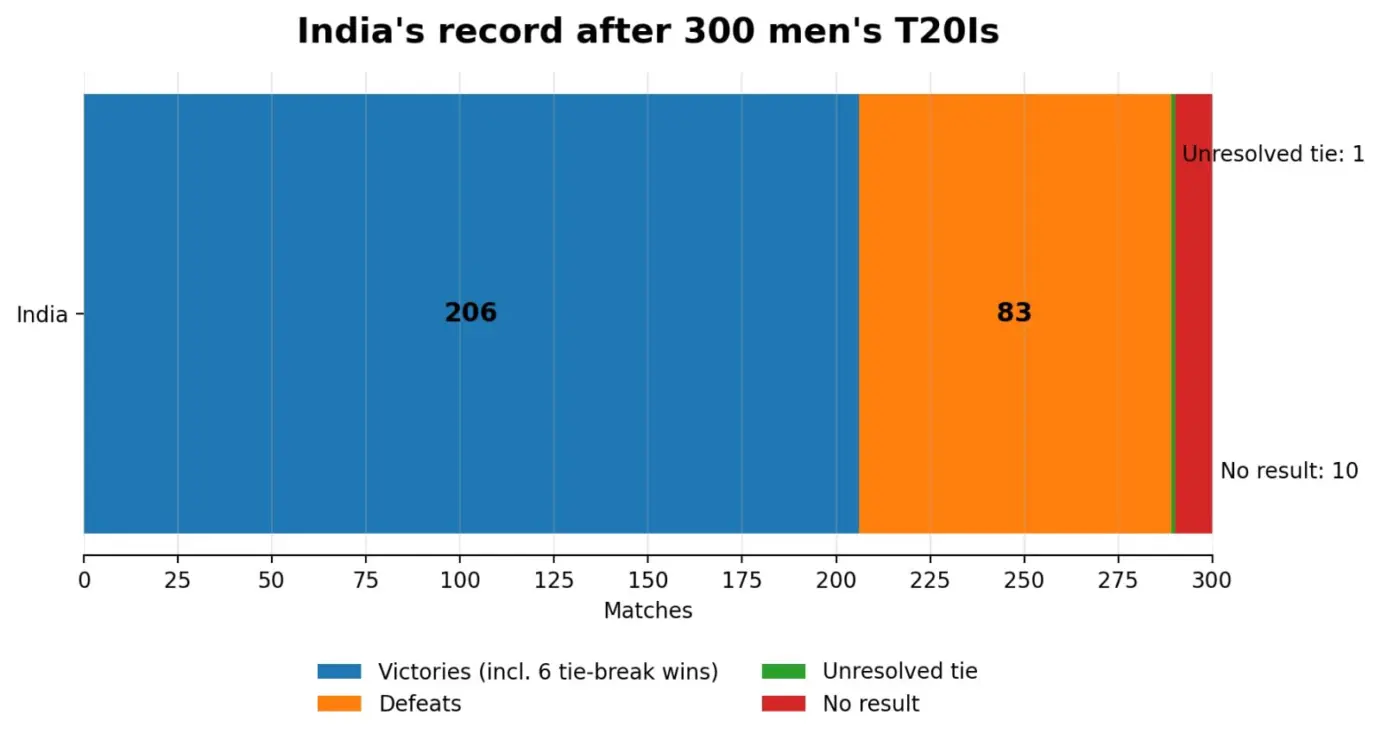
After 300 matches, India have registered 206 victories, including six secured through tie-breakers. They have suffered 83 defeats, while seven matches ended in a tie and 10 produced no result. Six of those seven ties were won by India and are already included in their victory tally. They are now only the second nation, after Pakistan, to have played 300 T20Is. India’s arch-rivals have played 304 matches so far, winning 177 and losing 119, including matches decided through tie-breakers. India have won 68.67% of their matches, compared to Pakistan’s 58.22%.
Now coming back to Tilak Varma. In India’s 200th T20I, the left-hander made his debut, scoring 39 runs off 22 balls in a four-run defeat to the West Indies. A hundred games later, he has evolved into one of their biggest match-winners. Just like his journey, India’s 20 years of T20I cricket have witnessed many such transformations, as they have powered through the ranks to become the pre-eminent team in the format.