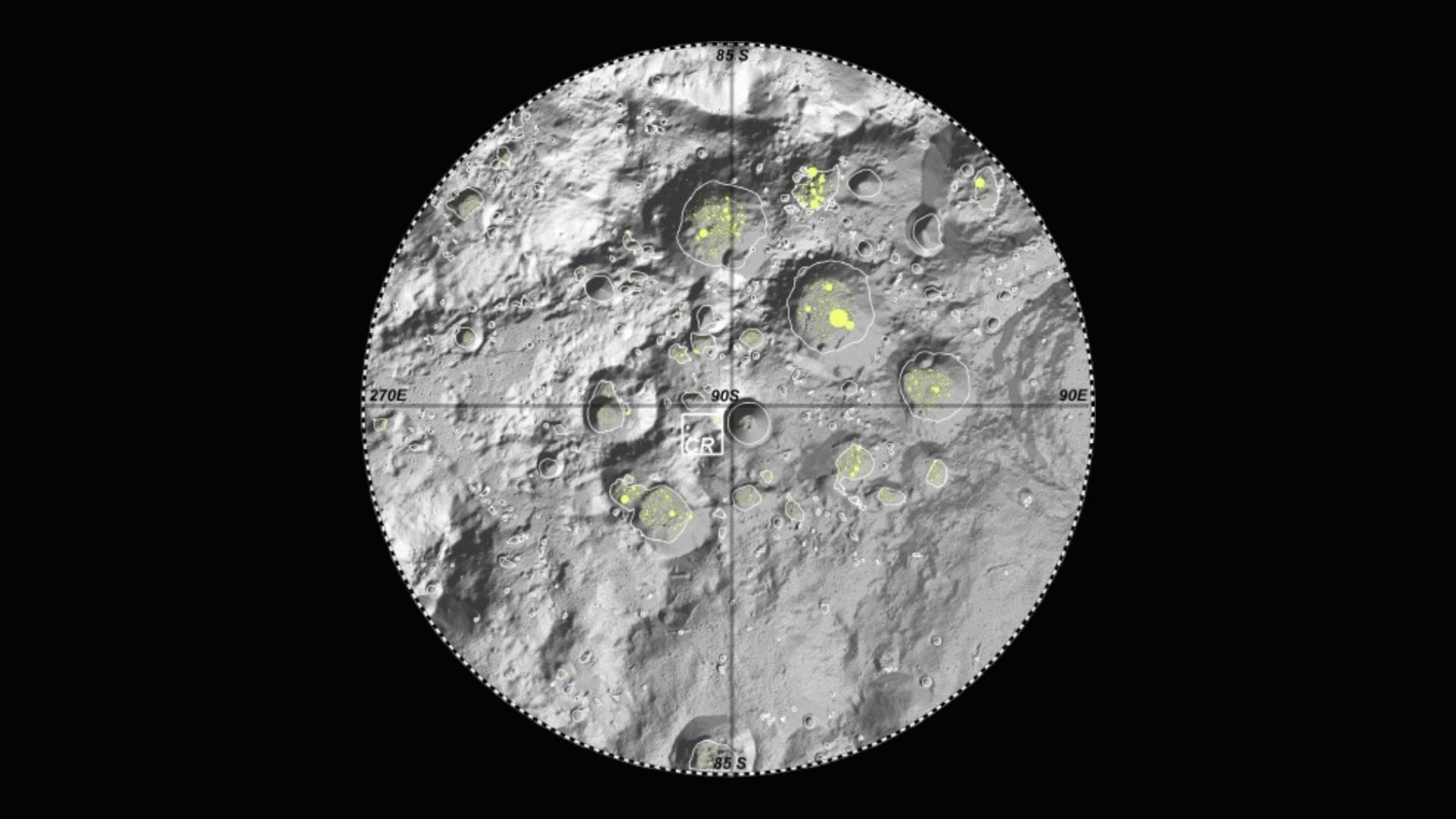
New Delhi: A team of researchers from the Physical Research Laboratory (PRL), Anna University, the Indian Institute of Science Education and Research (IISER), Bharathidasan University, the Chikkaiah Government Arts and Science College and the University of Twente in Netherlands have investigated impacts into the permanently shadowed craters in the highlands surrounding the south pole of the Moon. These are deep pockets where the sunlight never reaches, where scientists believe that water delivered during the chaotic infancy of the Solar System still persists, stored in the form of ice over billions of years. This is why all major spacefaring nations are headed to the south pole of the Moon.
The findings suggest that impacts act like a double-edged sword for lunar ice. When a space rock hits the Moon, it can destroy the ice by directly vapourising it, or exposing ice to the vacuum of space, where it sublimates. These impacts also stir the lunar soil or regolith in a process termed impact gardening. This process can protect the ice by burying it under layers of ejecta, which then insulate the ice against the harsh environment of space. Computer simulations indicated that the larger impacts, those over 00 metres wide, can dig up ice from deep underground and toss it to the surface, where it can get trapped in nearby cold traps.
Most of the crater floors are undisturbed by impacts
The researchers estimate that millions of small impacts may have excavated roughly 452 million kilograms of ice over the last billion years. The team mapped over 87,000 craters, and developed a model that indicated that there were actually 24 million small craters between one and 20 metres wide, in the permanently shadowed craters. While this sounds like a lot, the researchers also found that nearly 74 per cent of the shadowed areas remain untouched by direct hits. Both the undisturbed areas and the mixed soil are now top targets for upcoming lunar landings, as they offer the best chance to find water needed for establishing a sustained presence on the Moon. A paper describing the research has been published in NPJ Space Exploration.