New Delhi: Researchers from the Indian Institute of Technology Bombay and the Indian Institute of Science Education and Research in Trivandrum have developed a lightweight, wearable fabric that absorbs sunlight, stores it in the form of heat, and then releases the heat in the dark, all without the use of wires, electricity or bulky components. The thermal batteries can be used for sustainable clothing that keeps people warm in winters, beyond merely trapping the body heat. Thermal batteries store heat energy while charging, and release the heat while discharging, offering robust, reversible operation over multiple cycles, while being easy to manufacture, maintain and use.
Over 60 per cent of global energy use is in the form of heat, and yet most of it comes from burning fossil fuels. Decarbonising heat is essential for climate action. While solar energy is abundant, storing heat remains a challenge. The scientists stitched together alternate chains of a thermally soft, flexible polymer known for its high heat storage capacity, polyethylene glycol (PEG) and polystyrene co-allyl alcohol for structural cohesivity and stability. The single combined polymer behaves like a solid even though the PEG chains become fluid. With the rise in temperature, segments of the polymer chains transitioned from a crystalline arrangement to an amorphous one,
Direct solar-to-heat conversion
The addition of graphene oxide in this matrix introduced a crucial function, the direct conversion of solar energy to heat. One of the researchers working on the material, C Subramaniam says, “This gave us a multifunctional material that can capture sunlight, convert it into heat, spread that heat efficiently, and store it reversibly — all within a single solid composite without any wires or electrodes”. A paper describing the research has been published in Small. When tested as a solar-thermal battery, the material heats rapidly, reaching operating temperatures of 69°C. Subsequently, moving to the dark reverses the process, releasing the thermal heat energy at values that surpass targets set by the US Department of Energy for phase-change thermal storage materials, which is rare for a polymer-based system.
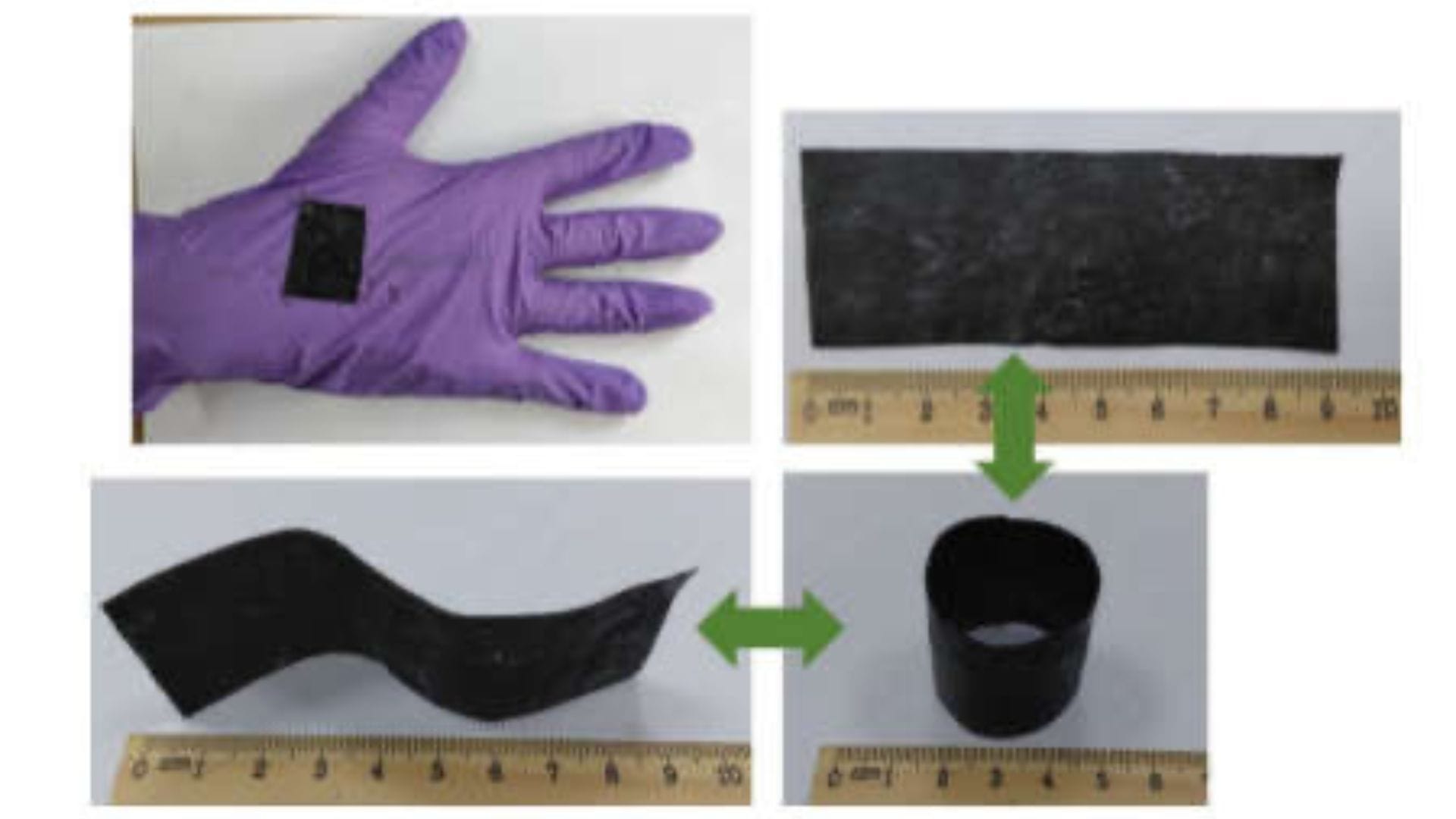
The researchers have made a wearable prototype to demonstrate the material. The polymer composite was coated directly onto cotton fabric and integrated into a glove. Another researcher associated with the research, Sandip Saha says, “Since all the individual components are bio- compatible, the polymer composite is safe to contact with human skin or clothing.” The material can be used for wearable systems that warm people as against entire rooms, reducing energy consumption.