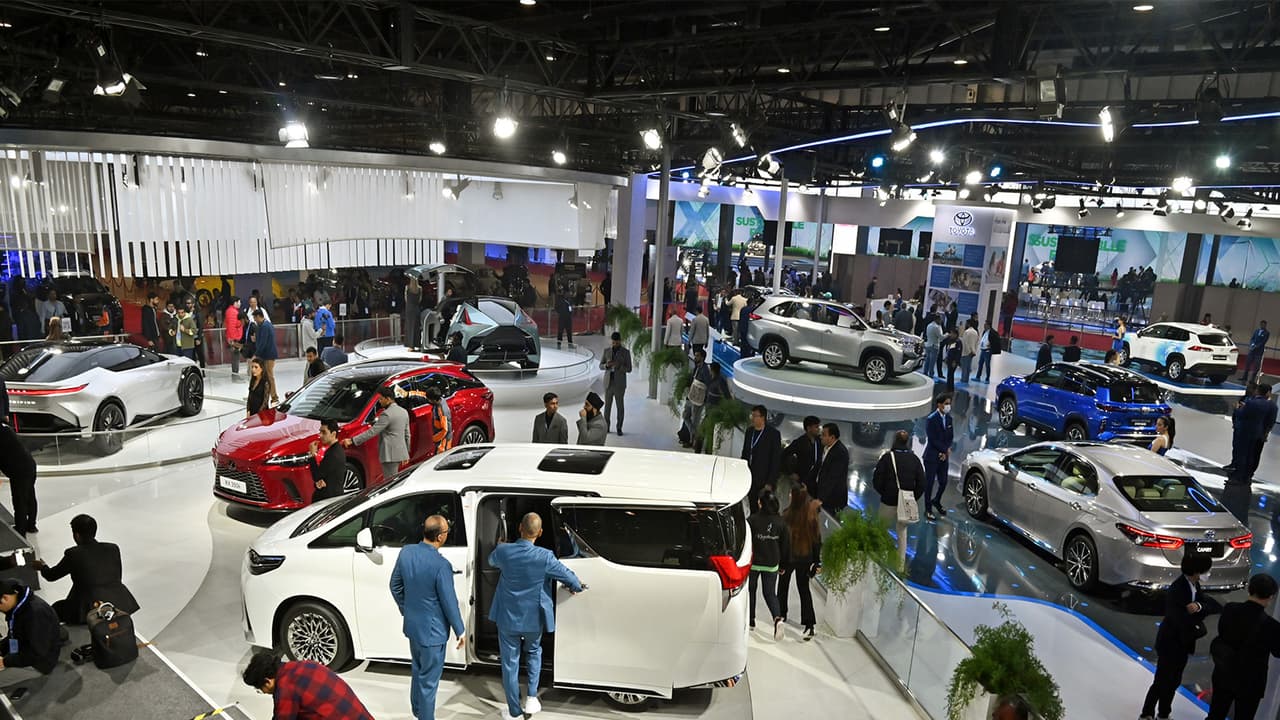
Indian auto retail sales reached a historic 2.96 crore units in FY26, a 13.3% YoY growth, FADA reports. This record performance, driven by a post-GST 2.0 surge, saw five of six vehicle categories achieve all-time highs.
Indian automobile retail reached a historic milestone in the financial year ending March 2026, recording total sales of 2,96,71,064 units. Data released by the Federation of Automobile Dealers Associations (FADA) showed a 13.30 per cent year-on-year growth, bringing the industry to the brink of the 3-crore mark.
Record Sales Across Categories
This performance was driven by record-breaking sales across nearly all vehicle categories and a significant surge in demand during the latter half of the year. Two-wheeler sales stood at 2,14,20,386 units (+13.40%), and three-wheeler sales touched 13,63,412 units (+11.68%), whereas passenger vehicles and commercial vehicles stood at 47,05,056 (+13.00%) and 10,60,906 units (+11.74%) respectively. Tractors were the year’s standout performers with 10,50,077 units (+18.95%), while construction equipment took a downturn to 71,227 units (- 11.70%).
A Year of Two Halves
The year was characterised by a distinct two-phase trajectory. The first five months remained muted as consumers navigated pre-GST 2.0 uncertainty and general caution. However, the implementation of GST 2.0 in September triggered a decisive upshift in momentum. Five out of six vehicle categories established all-time annual records, with two-wheelers finally surpassing their pre-COVID peaks and tractors crossing the 10-lakh unit threshold for the first time in history.
FADA on Landmark Achievement
FADA President C S Vigneshwar described the performance as a landmark achievement that signals a shift in the industry’s growth story. He highlighted that the industry is now approaching a milestone that seemed distant only two years ago. “FY 2025-26 has been a landmark year for Indian auto retail — delivering an all-time high of 2,96,71,064 units with a broad-based 13.30% YoY growth that saw five of six vehicle categories set new annual records. This is not just a number — it represents the industry approaching the 3-crore mark, a milestone that would have seemed distant just two years ago,” Vigneshwar said.
The recovery of the two-wheeler segment was a major contributor to the total volume, with sales exceeding 2.14 crore units. Passenger vehicles also hit a new high, crossing the 47-lakh mark. While most sectors flourished, construction equipment was the sole outlier, witnessing an 11.70 per cent decline due to project delays and a high base from the previous year.
Regarding the mid-year shift in momentum, Vigneshwar noted that the “turning point arrived in September with the implementation of GST 2.0. The rate rationalisation — which meaningfully reduced the effective tax burden on mass-segment two-wheelers, small cars, three-wheelers, and select commercial categories — improved real affordability at a time when the consumer was already positioned to respond. From September onwards, we witnessed a clear inflection.”
Emerging Trends and Market Correction
The year also saw a deepening of the fuel-mix transition. Electric vehicles now account for over 60 per cent of the three-wheeler market, while CNG has strengthened its foothold in the passenger vehicle segment at nearly 22 per cent. Furthermore, inventory levels for passenger vehicles corrected significantly, dropping from 52 days in March 2025 to a healthy 28 days by the end of the current fiscal year.
“FY’26 closes as a year of vindication for the India growth story in auto retail — where the right policy intervention, coupled with an improving macro backdrop and a confident consumer, delivered record volumes and set the stage for the next phase of structural expansion,” Vigneshwar stated. (ANI)
(Except for the headline, this story has not been edited by Asianet Newsable English staff and is published from a syndicated feed.)