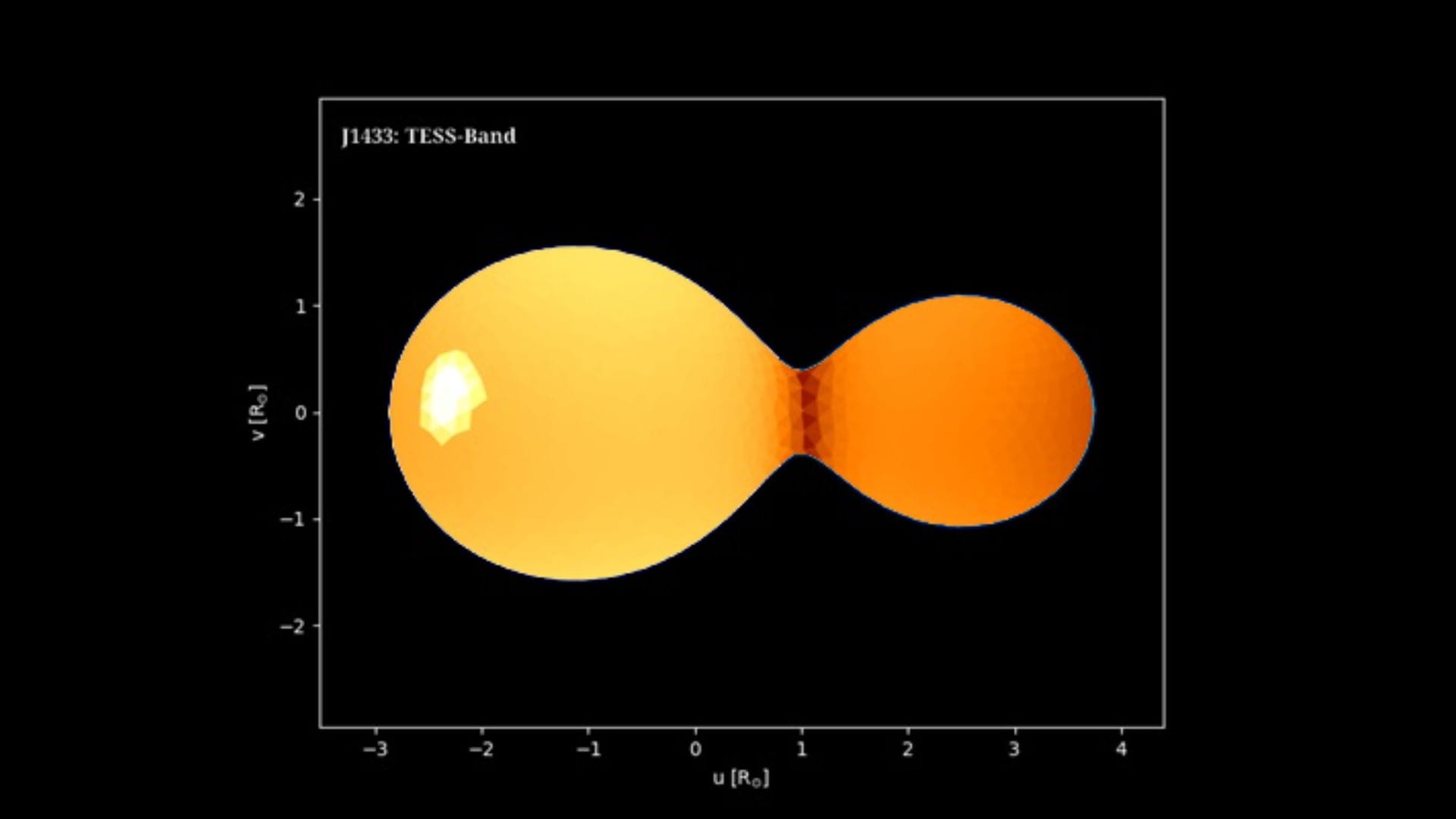
New Delhi: Astronomers from the Aryabhata Research Institute of Observational Sciences (ARIES) and the Physical Research Laboratory (PRL) have investigated a type of binary system called W Ursae Majoris-type (W UMa) contact binaries. The researchers investigated four such systems using the ground-based 1.3 metre Devasthal Fast Optical Telescope (DFOT) in Nainital along with data from NASA’s Transiting Exoplanet Survey Satellite (TESS) to track the variation in the light signatures from the binary systems. These W UMa stars have short orbits, and are shaped like dumbbells because the pair of stars are so close together, that they share a common atmosphere.
The researchers were able to track changes in the orbits of the stars within the contact binary systems, the transfer of mass between the stars, and even evidence of surface activity such as star spots. The detailed modelling of the light patterns indicated that the stars were tugging and pulling on each other, resulting in subtle shifts in the orbits. The researchers also discovered that some contact binaries appear to be lopsided, with one side outshining the other. The unevenness of the luminosities indicate that the stars have dark magnetic spots similar Sun spots. As these spots rotate in and out of view, they create bumps in the light curves.
Findings from careful analysis of light
The contact binaries are so close to each other that they have orbital periods of less than one day. This means that the periodic variations in the luminosities of the system can be tracked over very short periods. Carefully examining the light from these systems allowed astronomers to track specific activity on the stars. The scientists also discovered H-alpha and H-beta signatures, that showed the activity in the outer layer of the stars, as well as their links to magnetic events such as star spots and stellar flares. A paper describing the research has been published in The Astrophysical Journal.