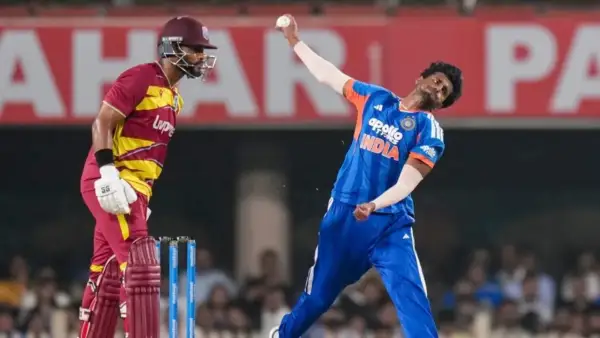
Yuzvendra Chahal has questioned the lack of assistance for bowlers on flat pitches, arguing that modern T20 cricket is increasingly tilted in favour of batters after West Indies chased down 250 against India to level the five-match series 1-1 in Ranchi.
Speaking on JioStar’s ‘Haier Cricket Live’, the India leg-spinner criticised the combination of batting-friendly surfaces, dew and smaller boundaries, pointing to the growing frequency of high-scoring chases in the IPL and international cricket. Chahal argued that bowlers need some assistance from the pitch to make their skills count in an increasingly batter-dominated format.
“On such wickets, there’s nothing for the bowlers,” Chahal said. “So, either you have to have something for the bowlers in the wicket, or else just install a bowling machine.”
The comments came after Shai Hope’s unbeaten century helped West Indies chase down India’s target of 250 in 18.3 overs, ending the hosts’ 10-match winning streak and bringing the series level.
Yuzvendra Chahal Questions Lack Of Assistance For Bowlers
Chahal highlighted how dew and the condition of the ball can make run-scoring easier as a T20 innings progresses, leaving bowlers with limited room for error.
“When the ball gets old, there’s dew, the ball comes nicely onto the bat, and the grounds are getting smaller,” he said, pointing to the trend of increasingly high-scoring matches.
The leg-spinner also cited the IPL, recalling instances of teams chasing totals of around 260 in 19 overs. He argued that the Impact Player rule has further shifted the balance towards batting by allowing teams to strengthen their batting resources.
Chahal contrasted the current scoring rates with an earlier era of T20 cricket, when totals of 170-180 could be competitive and scoring 50 runs in the powerplay was more common than the 70-80 runs he says teams can now accumulate in the first six overs.
His argument was that bowlers need conditions that reward variations, accuracy and tactical execution rather than being forced to defend large totals on surfaces offering little assistance.
Varun Aaron Criticises India’s Bowling Plans Against West Indies
Former India pacer Varun Aaron credited Hope and Sherfane Rutherford for their counter-attacking partnership but felt India abandoned their bowling lengths too quickly once the West Indies batters gained momentum.
Aaron argued that India turned to yorkers, slower balls and bouncers too early instead of continuing to test the batters with deliveries on a good length.
He pointed out that Mayank Yadav claimed three wickets, with two coming from deliveries on a proper length, and suggested India could have followed the same approach for longer.
Aaron also highlighted the missed opportunity against Rovman Powell, who appeared uncomfortable early in his innings but benefited from full tosses as India attempted to execute yorkers.
The former pacer believed the early wickets should have encouraged India to maintain their discipline rather than change their plans under pressure.
Sunil Gavaskar Questions India’s Bowling Changes
Sunil Gavaskar felt India could have used either Arshdeep Singh or Mayank Yadav in the 18th over instead of Kuldeep Yadav.
Gavaskar acknowledged that Arshdeep had conceded heavily in his final over but argued that Mayank’s three wickets made him a potential option at a crucial stage of the chase.
He suggested that another breakthrough could have disrupted the West Indies innings by forcing a new batter to settle at a decisive point in the game.
Gavaskar also questioned India’s decision to give Shivam Dube the ball in the ninth over, suggesting that bringing Kuldeep into the attack while the batters were still settling might have been a better option.
Aakash Chopra Praises Mayank Yadav’s Return To High Pace
Aakash Chopra praised Mayank for the way he bowled after returning from injury, highlighting the importance of his three-wicket performance beyond the immediate match result.
Chopra singled out the dismissal of Shimron Hetmyer as a particularly impressive delivery and noted that Mayank approached speeds close to 150 km/h.
He also reflected on the mental challenge of returning after a lengthy rehabilitation period, when the possibility of another injury can remain in a player’s mind.
For Chopra, Mayank’s performance was significant because it offered reassurance that he could once again bowl at high pace and trouble international batters.
India vs West Indies: What Happens Next?
West Indies’ successful chase of 250 brought an end to India’s 10-match winning streak and levelled the five-match T20I series at 1-1.
The third T20I is scheduled for October 11, with the match set to be broadcast live on the Star Sports Network and streamed on JioHotstar from 7 PM IST.
India will look to address their bowling execution after conceding a high total, while West Indies will take confidence from a chase led by Hope and supported by Rutherford’s aggressive approach.
Chahal’s criticism has also placed the spotlight on a broader question in T20 cricket: how teams and administrators can preserve the contest between bat and ball as scoring rates continue to rise.