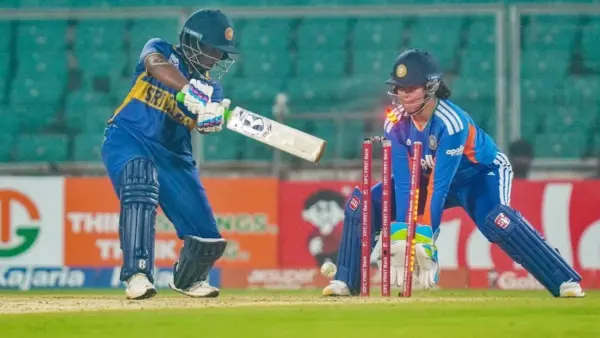
India walks into Sunday’s Women’s Asia Cup final having beaten every team they’ve faced with room to spare. Two years ago, they walked into a final with the exact same confidence – and Sri Lanka took the trophy anyway.
That result isn’t ancient history. It’s the single most relevant data point for what’s about to happen in Dubai.
India won the toss, batted first, and posted 165/6 – a total that looked more than competitive on paper. Smriti Mandhana anchored the innings with a composed 60 off 47 balls, with Jemimah Rodrigues and Richa Ghosh adding late cameos of 29 and 30. By any normal read of a T20 total, India had given themselves a genuine chance.
Sri Lanka simply didn’t treat it that way. After losing an early wicket in the second over, Chamari Athapaththu and Harshitha Samarawickrama took the game away from India entirely – Athapaththu smashing 61 off 43 balls, Samarawickrama finishing unbeaten on 69 off 51.
Their partnership reduced India’s bowling to a formality, and Sri Lanka cruised home at 167/2 in just 18.4 overs, winning by eight wickets with eight balls still in hand. Samarawickrama took Player of the Match; Athapaththu closed out the tournament with Player of the Tournament honors. Kavisha Dilhari’s 16-ball 30 not out at No. 4 sealed how thoroughly the chase had gotten away from India – there was no phase of that innings where India looked back in control.
Why This Defeat Still Stings
Context makes Dambulla worse than a single bad night. India had been the dominant force in this tournament for years, and that loss was only the second time in nine final appearances that India had failed to win the title. For Sri Lanka, it wasn’t just an upset – it was their maiden Asia Cup championship, won on home soil, against the tournament’s benchmark side.
The Uncomfortable Pattern in India’s Current Campaign
Here’s what makes 2026 feel less like a clean slate and more like a rerun waiting to happen: India’s batting through this tournament has leaned on individual moments rather than collective performance. Against Hong Kong, only Mandhana’s century carried the innings. Against Bangladesh, it was Shafali Verma standing alone. Against Thailand – their tournament opener – India were cruising at 91/1 after 8.9 overs before stumbling to just 159/9, with Verma again the lone serious contributor. Add in shaky running between the wickets, including a poor run-out involving Mandhana against Thailand, and occasional dropped catches, and the picture is of a team that’s been winning comfortably against weaker opposition without actually being tested on execution.
What’s papered over those cracks so far has been India’s bowling. Deepti Sharma sits as the tournament’s joint-highest wicket-taker, with Shree Charani and Prema Rawat backing her up, while pacers Nandani Sharma and Kranti Gaud have also delivered. That’s been enough against Thailand, Hong Kong, Pakistan, and Bangladesh. It’s a different question entirely against a Sri Lankan top order that includes Athapaththu, Samarawickrama, and Dilhari – the exact trio that dismantled India’s spin-heavy attack in Dambulla.
Both Sides Arrive Unbeaten, But by Different Routes
India comfortably reached this final, beating Bangladesh in the semifinal to extend their run to a record 10th consecutive Asia Cup final. Sri Lanka had a far harder route – chasing 131 against Pakistan, they slipped to 33/4 before staging the kind of recovery that’s become their trademark this tournament. That contrast matters: Sri Lanka have already proven under pressure this campaign that they can be written off and still find a way back, which is precisely the skill set that beat India in Dambulla in the first place.
What India Actually Needs to Fix
A big total alone won’t be enough, and Dambulla is the proof – India posted a genuinely defendable score two years ago and still lost by eight wickets with two overs unused. The real requirement is a batting unit that converts starts into a properly team-wide total rather than relying on one player carrying the innings, combined with bowling disciplined enough to stop Sri Lanka’s experienced top three from dictating terms the way they did last time. Sharper running between the wickets and cleaner fielding aren’t secondary details either – both were problems in this tournament, and both were exactly the kind of small margins that turned Dambulla into a rout rather than a contest.
Regional rivalries carry a specific danger: teams that play each other repeatedly tend to know each other’s weaknesses better than outsiders ever could, and Sri Lanka has already shown they know exactly how to expose India’s on a final’s biggest stage. For India, Sunday isn’t simply about winning an eighth Asia Cup title. It’s about erasing the specific memory of the night their dominance ended – and doing it against the same opponent, with largely the same warning signs still sitting there unresolved.