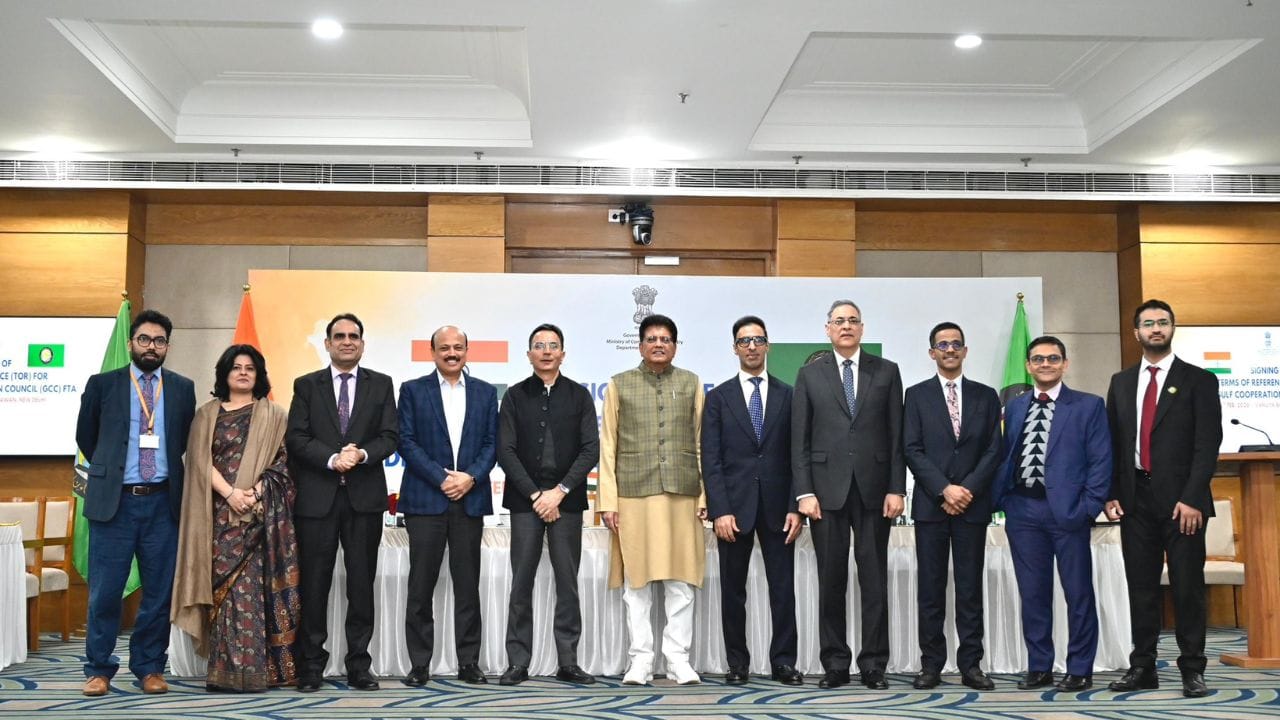
New Delhi: India will restart negotiations for a free trade agreement (FTA) with the Gulf Cooperation Council (GCC), Union commerce minister Piyush Goyal announced on Thursday, signalling a renewed push to deepen economic ties with the Gulf region.
The announcement comes close on the heels of India concluding two major trade agreementsone with the European Union and another with the United States, underscoring New Delhi’s broader trade diplomacy reset.
The GCC is a six-member bloc comprising Saudi Arabia, United Arab Emirates, Qatar, Kuwait, Oman and Bahrain. Within the bloc, the UAE and Saudi Arabia are India’s largest trading partners.
Historic trade ties and Indian workforce in focus
Explaining the rationale behind reviving the talks, Goyal said the proposed agreement would further consolidate India’s long-standing economic relationship with the Gulf.
As per the union commerce minister, the FTA will strengthen the relation between India and the GCC, which “have been trading amongst each other for over 5,000 years”.
He also highlighted the role of the Indian diaspora in the region, noting that nearly 10 million Indians live and work across GCC countries, contributing significantly to their economies.
“It is most appropriate that we now enter into a much stronger and robust trading arrangement which will enable a greater free flow of goods, services, bring predictability and stability to policy, help encourage a greater degree of investments,” Goyal added further.
Pak–Saudi defence pact adds geopolitical layer
The renewed India–GCC engagement comes months after Pakistan and Saudi Arabia signed a defence ageement, adding a geopolitical backdrop to the trade talks.
In September 2025, Riyadh and Islamabad inked a Strategic Mutual Defence Agreement (SMDA), reviving an older security framework. This followed a military stand-off between India and Pakistan under Operation Sindoor.
From May 7 to 10, India and Pakistan were locked in a cross-border confrontation after New Delhi carried out a tri-services strike in response to the Pahalgam terror attack. On April 22, 2025, 26 tourists, including 25 Indians and one Nepali national, were killed in Jammu and Kashmir’s Pahalgam. India blamed Pakistan-based LeT offshoot The Resistance Front for the attack.
UAE–Pakistan ties under strain
Questions over Pakistan’s ties with the UAE have also surfaced in recent months. Shortly after UAE President Sheikh Mohamed bin Zayed Al Nahyan visited India, Abu Dhabi reportedly shelved a key agreement with Islamabad.
According to a report by Express Tribune, the UAE put on hold a deal related to the management of Islamabad International Airport after Pakistan failed to identify a local partner for outsourcing operations.
“The Pakistani side had sought a clear response from the UAE by sending a final call letter. In response, the UAE conveyed that it was still unable to confirm any nominated entity,” sources told the Pakistani daily.
Ties reportedly cooled further after Pakistan’s strategic pact with Saudi Arabia, even as UAE–India relations continued to deepen. Following Al Nahyan’s brief but significant visit to New Delhi, India and the UAE agreed to step up cooperation and set a target of doubling bilateral trade to USD 200 billion by 2032.